| HOME | ORDER | AUTHOR | CONTACT AUTHOR | LINKS |
|
DEALING TIPS |
Stick to the Basics
By
Dale S. Yeazel
I
teach people to play craps everyday, that’s my job. I don’t mind it; I
figure I am doing my part to promote the game. But I see people make the mistake
of trying to understand the more advanced bets before they have an understanding
of the basic bets. The basic bets are the best bets anyway.
I define a good bet as one with a small house percentage. I like to think
of it as the interest you pay on a loan. The less interest you pay the better
the deal. So I teach people to make bets that have the smallest house
percentage. My philosophy on gambling is you try to do the most logical thing,
and then hope for the best. I am going to teach you the only bets on the crap
table that I endorse.
The
first thing you need to understand that there are only two main bets on the crap
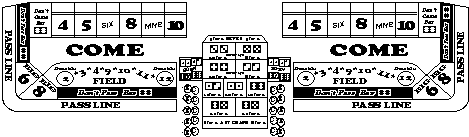
table, the “pass line” and the “don’t pass”. Every other
bet on the layout is just some kind of side bet. So your first goal should be to
have a complete understanding of these two bets and not concern yourself with
anything else at this point. To learn how to play the pass line and the don’t
pass require a small amount of memorization on your part. The sooner you
memorize what you need to know, without concerning yourself with what it means
the sooner you will be on your way to enjoying one of the classic games of
chance. Please don’t try to paraphrase the terms I use into something you
think you will understand better. The sooner you learn the language of craps the
sooner you will understand the game.
Pass
line
Those
of you that ever played craps in an alley or barracks will think of betting on
the pass line as betting “with the shooter.” Or you may think of it as
betting that the shooter is going to win.
On
the first roll of the dice (the come-out roll) the pass line wins if the
shooter throws a 7 or 11.
On
the first roll of the dice the pass line loses if the shooter throws a 2, 3
or 12 (craps). Are you confused yet? Remember what I told you about this
requiring a certain amount a memorization on your part.
You are not required to understand at this point. Your desire to
understand is what has kept you from playing craps so far. What is required is
that you memorize this simple thing: 7 or 11 wins.
2, 3 or 12 lose.
If
it’s the come-out roll (yes the first roll of the dice) and the shooter does
not throw a 7, 11, 2, 3 or 12 then he must have thrown a 4, 5, 6, 8, 9 or 10.
When the shooter throws one of these numbers on the come-out roll that number
becomes the shooter’s “point.” The dealer will then place the
“puck” on the point number box for that number so everyone will know what
the shooter’s point is. After
the shooter establishes a point the only thing that matters is that he throws
the point number again before he throws a seven. 11, 2, 3 and 12 don’t
matter. It also doesn’t matter how many other numbers he throws. The shooter
will shoot until he either wins by throwing his point number again or he will
lose by throwing a seven (called seven-out).
So
it is either the first roll of the dice and the shooter wants to throw a seven
or eleven so he wins or he has a point and he is trying to throw his point
number before he throws a seven.
When you want to know if it is the come-out roll or if the shooter has a point
then you need to look where the dealer has the puck. If it is black side up and
at the end of the layout, then it is the come-out roll. If it is white side up
and on one of the point number boxes, then that number is the shooter’s point
for the pass line.
Don’t
Pass
The
don’t pass is the OPPOSITE of the pass line. What this means is that if
the pass line loses the don’t pass wins. If the pass line wins the don’t
pass loses.
So
if the shooter throws a 7 or 11 on the come-out roll the bets on the don’t
pass lose. If the shooter throws a 2 or 3 the don’t pass wins, If the shooter
throws a 12 (boxcars) the don’t pass bets “push.” If a bet pushes it means
that it doesn’t win and it doesn’t lose. Casinos were forced to create this
exception to give the casino a percentage of don’t pass bets. If the shooters
makes his point, the don’t pass bets lose. If the shooter throws a
“seven-out” (seven before his point) the don’t pass wins.
All
bets on the pass line and don’t pass pay even money. You cannot bet the
don’t pass if the shooter has a point for the pass line.
When
you first walk up to the table you should look for the puck and determine if it
is the come-out roll or if the shooter has a point. Your next step to playing
will be to take some money out of your wallet. You then look for the dice. If
the shooter has the dice wait until after the roll before dropping the cash on
the table and saying; “Change!” Do not get your hands in the way of the
dice! Do not try to hand your money to the dealer. He will only tell you to drop
it on the table. As the dealer is picking up your money you should look for the
table minimum sign so you can tell the dealer if you want dollar checks (chips).
If
the shooter has a point for the pass line the casino allows you to bet on the
pass line. However this is one of the most disadvantageous things you can do.
Instead you should make a “come bet.”
Come
A
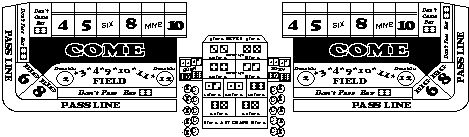
come bet can be made anytime there is a point for the pass line. Like all bets,
make your come bet in the area of the box in a position that is as close to you
as possible.
Making
a come bet is exactly like making a pass line bet on the come-out roll. 7 or
11 wins. 2, 3 or 12 lose. If the shooter throws a 4, 5, 6, 8, 9 or 10 the
dealer will pick up the come bet and put it on the point number box so that
everybody can see what the point for that come bet is.
If
the shooter throws that number again the dealer will pick up the bet and pay it
in the area of the come in front of you. While a winner seven (a seven thrown on
the come-out roll) will cause the pass line to win, it causes all come bets on a
point number box to lose. A seven-out causes the pass line and all come bets on
a point number box to lose.
Don’t
come
Just
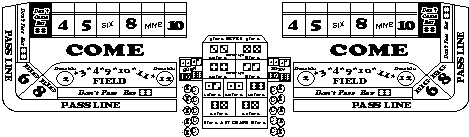
as the don’t pass is the opposite of the pass line, the don’t come is the
opposite of the come. It is also designed to be bet when the shooter has a point
for the pass line. To many players think that by betting the don’t come they
are betting against the shooter’s point for the pass line. They are betting
against the shooter on the next roll of the dice, so the rules of the come-out
roll apply. 7 or 11 lose. 2 or 3 wins, and 12 is a push. When the shooter throws
a point number the dealer puts the bet behind the point number box to indicate
the number that don’t come bet is against. A winner seven or a seven-out for
the pass line cause all don’t come bets behind the boxes to win.
Taking
and laying odds
You
often hear people say that taking (betting) odds on pass line and come bets is
the best in a casino. They sure won’t get any argument from me. Odds taken on
pass line and come bets as well laid (bet) on don’t pass and don’t come bets
give the casino no house percentage. In other words they pay true odds!
Anytime
there is a point for the pass line you take odds on your pass line bet. You can
also pick them up anytime you want to. By taking odds on a pass line bet you are
merely betting more money that the shooter will make his point. That is why you
can only take odds when the shooter has a point. If he doesn’t have a point
then there is nothing to take odds on.
When
taking odds on a pass line bet you merely put a stack of checks two inches
behind your pass line bet. When casinos use terms such as “double odds” or
“ten times odds” these are terms used to describe the most odds you are
allowed to take. Double odds meaning that whatever the amount of your pass line
bet, you can bet up to twice that amount behind. That doesn’t mean you have to
bet that much, it just gives you that option.
Make
sure you bet the correct units for the point number you are betting on!
Otherwise you are giving the casino a percentage of a bet that should not have a
house percentage. For example, if you take five-dollar odds on a point of five
or nine (pays 3 to 2) the correct payoff would be $7.50. The dealer will only
pay you $7.00 if you win. The fifty cents is referred to in the business as
“breakage” and players assume responsibility for breakage.
So
when taking odds on the five and nine make sure it is devisable by two dollars,
since every two dollars will pay you three dollars. When taking odds on the six
and eight (pays 6 to 5) make sure you bet in increments of five dollars since
every five dollars bet wins six dollars. The good news is that you can’t screw
up odds on the 4 or 10 (pays 2 to 1) since any amount you bet can be paid
double.
Since
having a bet on the don’t pass after the shooter has a point is in your favor,
you have to “lay” (bet) odds. If the shooter has a point of 4 or 10 for
every two dollars you lay, you win one dollar. If the point is five or nine, you
have two lay three dollars to win two dollars. If the point is six or eight you
have to lay six dollars to win five dollars. To lay odds on the don’t pass
heel your odds on the don’t pass next to your flat bet. If the payoff for your
lay is the same amount as your flat bet the dealer might bridge your lay on top
of your flat bet.
To
take or lay odds on a come or don’t come bet you set your odds down in the
come area and tell the dealer what you want to bet. Even is you don’t know
exactly what to say don’t try to put up the bet yourself and don’t just set
the money down without saying anything at all. Understand that craps is a very
verbal game and the dealer can’t book your bets if you don’t say anything.
Place
bets on the 6 and 8
You
can make a place on any of the point numbers (4,5,6,8,9 or 10) at any time.
However like odds taken on come bets, place bets are off on the come-out roll.
If a bet is “off” that means that it can’t win and it can’t lose. By
making a place bet you are betting on a particular number to be thrown before a
seven.
Place
bets on the four or ten pay 9 to 5. So for every 5 dollars you bet, you win 9
dollars. Since true odds would pay a five-dollar bet on the four or ten
ten-dollars the casino gets a 6.66% advantage. This doesn’t quite make it a
sucker bet, but I don’t think you should give up more than 2%.
Place
bets on the five or nine pay 7 to 5. Every five dollars bet wins seven dollars.
True odds would pay a five-dollar bet $7.50, so the house percentage is 4%.
This
is why I only recommend place bets on the six and eight. You bet in units of six
dollars, because the bet pays 7 to 6. Which means for every six dollars you bet,
you win seven dollars. It also means that the house percentage is a low 1.51%.
That is comparable to the pass line and come (1.414%) and the don’t pass and
don’t come (1.402%).
One
makes place bets much in the same manner as odds on come bets, drop the money in
the come area and tell the dealer what you want to bet. When you win a place bet
your dealer has been trained to pay your bet and leave it up the same way. In
other words, if you bet a $6 eight and it wins, the dealer will pay you $7 and
leave your six dollar bet on the eight unless you tell him to take it down.
Besides taking the bet down the other option is to press (double) your bet. In
this case the dealer will give you one-dollar change and make your six-dollar
bet on the eight look like twelve dollars.
Points to remember!
7 or 11 wins. 2,3 or 12 lose.
Remember
that it is either the come-out roll for the pass line or the shooter has a
point.
You
don’t take odds or make a come bet unless the shooter has a point for the pass
line.
When
taking or laying odds on come and don’t come bets and when making place bets:
set the money in the come area and tell the dealer what you want to bet.