| |
The Making of a Flame Job - Part 2
by Frank Colgoni |
| |
|
|
|
If day one was labor intensive because of the effort to perfect
the layout from scratch, day 2 was about transferring that layout
to the prepared body and readying it for paint.
At the end of day 1, Ron had taken the artwork with him and had
�pounced� it using a pounce wheel. Pouncing is a process of
creating a continuous series of small holes in the pattern using
the pounce wheel tool. The wheel resembles a mini pizza cutter
except instead of a blade, there are a series of points that
create perforations. When the tool is run around the perimeter of
the flames, tiny holes are created. In order to get the give in
the paper pattern to permit the perforation, a self-healing mat is
used underneath the paper when pouncing. These mats are available
in various sizes and are commonly used when cutting paper and
fabric (like quilting fabric using a rotary cutter).
Ron begins the day by placing the perforated artwork back on the
car using the registration marks as positioning guides. Once in
place, Ron uses a chalk bag and dabs the pattern over the entire
layout so that the perforations are treated to the chalk. The
flame layout is taking shape underneath the paper.
Once the original side of the car is treated, the pattern is
removed, flipped and taped to the opposite side using the centre
line as a guide. By doing this, a perfect symmetrical layout is
possible. Magic! The flip side is then chalked and the pattern is
removed. I�m going to take it with me for posterity.
|
| |
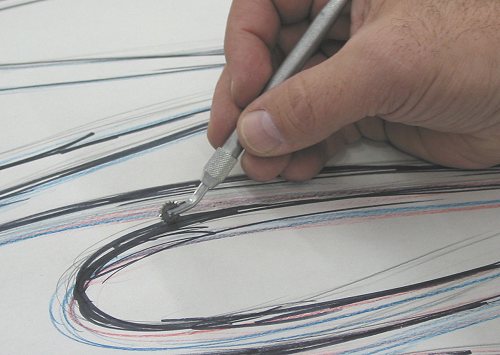
The pounce wheel |
| |
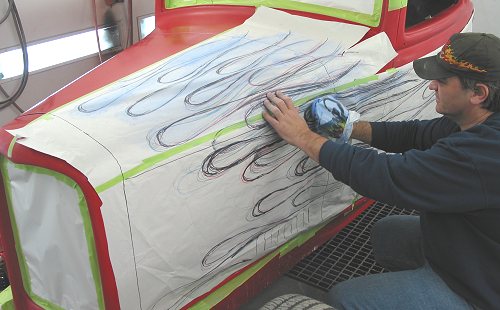 Ron chalks over the perforations in the banner paper.
 |
| |
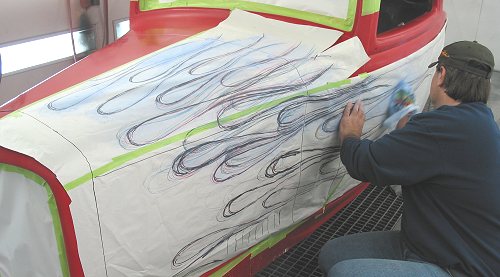 This continues until this side then the opposite are completed.
 |
| |
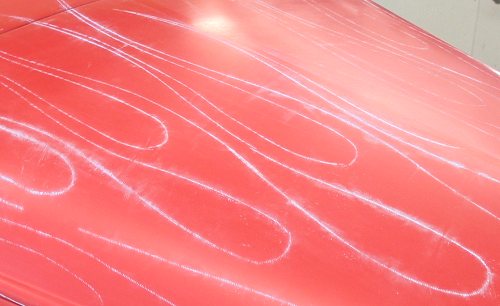 When the paper is removed, the layout is visible in chalk.
 |
| |
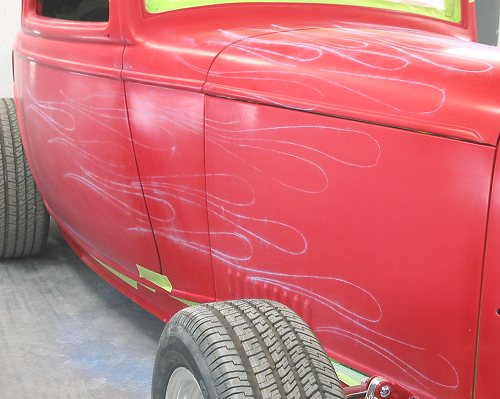 A perfect mirror image of the driver's side.
 |
| |
Before the layout is transferred to tape, back taping is completed
on any seams where paint will blow by, such as in between the hood
and sides and doorjambs. You want the paint to go into those areas
so that you don't see any cutoff points where the flames make a
transition from panel to panel. Obviously, everything under the
hood is masked off as well as paint will find it's way in there
through the tiniest of openings.
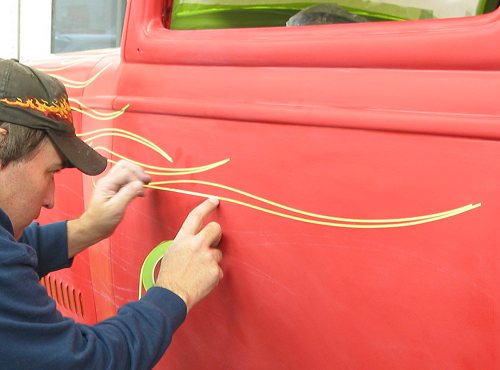
Now the taping of the layout can begin. As with the original
sketch, Ron begins on the hood at the centre line and works
across, then down and back. This is accomplished using 1/8 �
green, 3M, masking tape. Ron explains that the narrow width is
necessary to keep the tape flat and accommodate the curves.
It absolutely incredible to watch this process as Ron moves fast
and is accurate. Only a few corrections are needed over the entire
layout. Don�t get me wrong though, this is still a lot of work.
Once the entire layout is outlined using the 1/8� tape, Ron tapes
into the doorjambs around the hood and in between the rad shell
and the hood sides. After this detail the areas between the flames
(the �negative� areas that won�t receive paint) are completely
masked off using wider �� tape.
|
| |
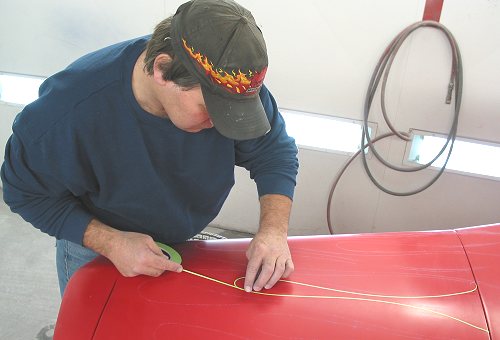
Ron begins the taping of the layout using the 1/8" tape. |
| |
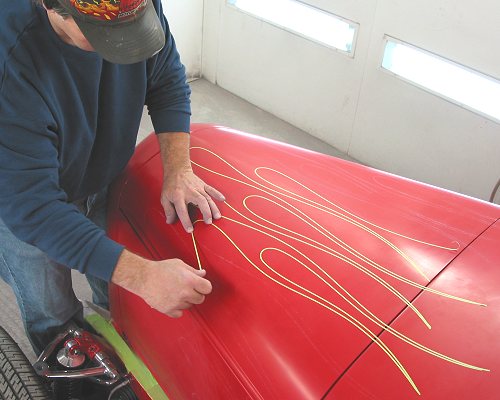 Ron is able to move quickly. You'd almost think he'd done this before..
. |
| |
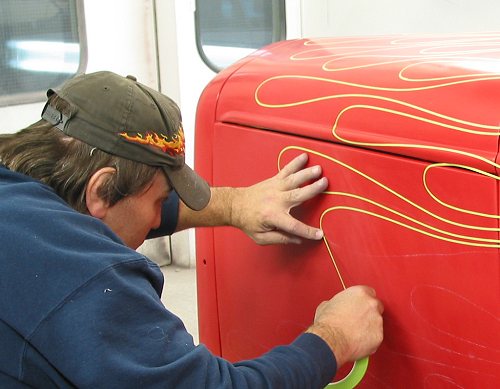 There's an art to taping a curve.
 |
| |
 And, a long flowing lick.
 |
| |
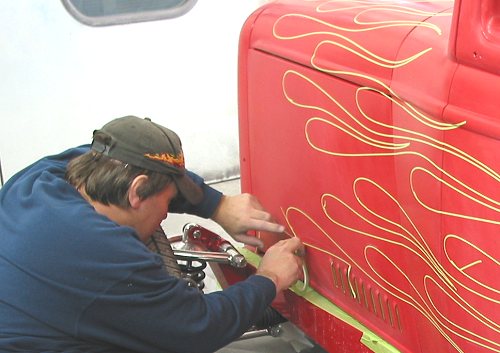 Ron had to drape himself over the tire to get at the bottom-most part of the
hood side.
Ron had to drape himself over the tire to get at the bottom-most part of the
hood side. |
| |
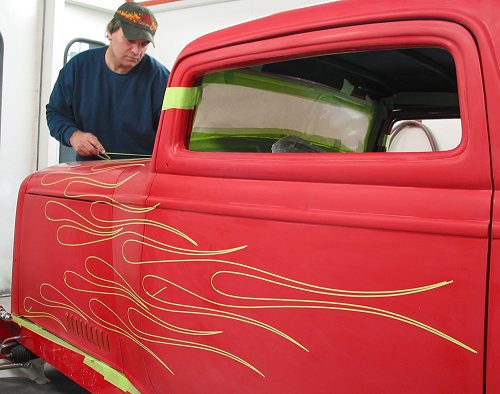 Side one is complete. Looks very good.
 |
| |
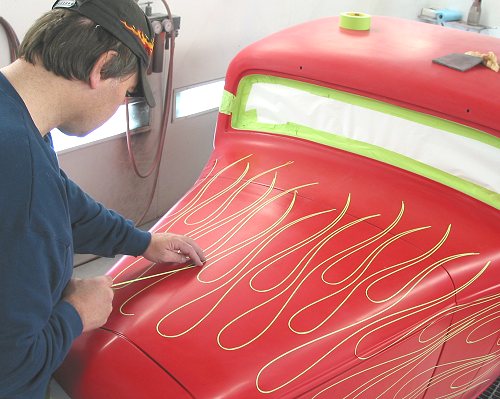 Ron completes the hood. The whole design is really coming alive.
 |
| |
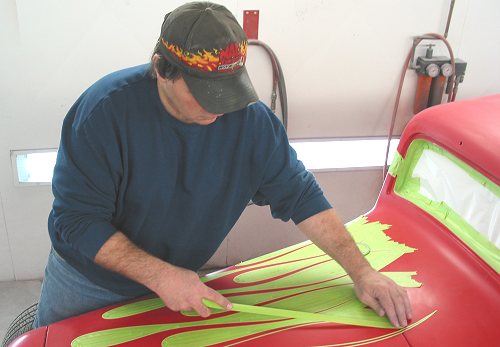 At this point the negative areas get filled in. Ron moves quickly through
this.
At this point the negative areas get filled in. Ron moves quickly through
this. |
| |
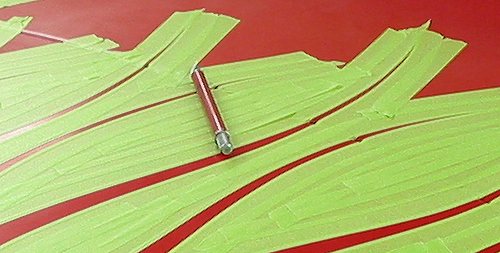 You can see in the photo that the seams are still covered over.
Ron has his knife ready to remedy this. |
| |
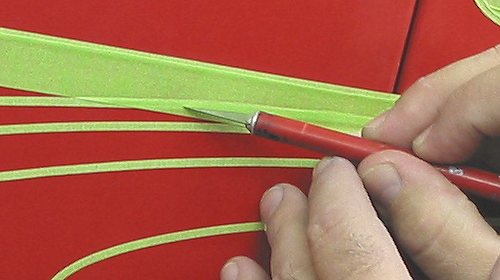 Because the 3/4" tape overlaps the smallest end of some licks,
Ron has to carefully remove the overlap. |
| |
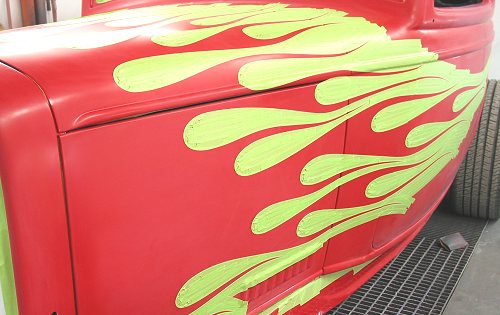 At this point, all the negative areas are covered.
 |
| |
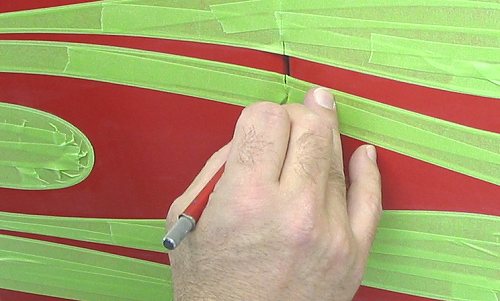
Ron now moves to all of the door and hood openings.
He slices through then pushes the cut ends into the gaps.
|
| |
Once this is complete, Ron goes over everything with a 3M plastic
Squeegee to seal the tape so that everything is well sealed. Not only
does this ensure that nothing gets through the fill areas but it also
ensures crisp edges. Final preparations before paint involved masking
off the balance of the car. |
| |
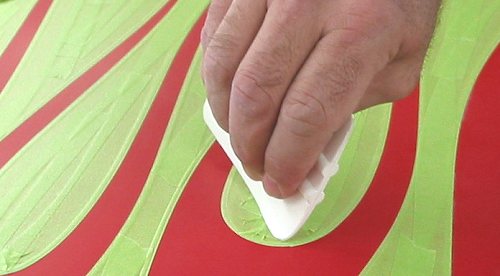 Ron advises that you have to go over everything firmly
with the Squeegee to ensure that everything is sealed. |
| |
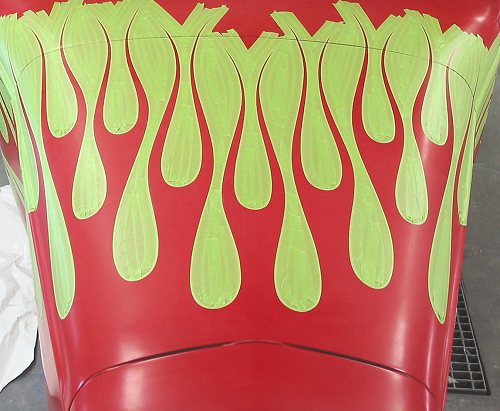 We're digging' this. Can't wait for color.
 |
| |
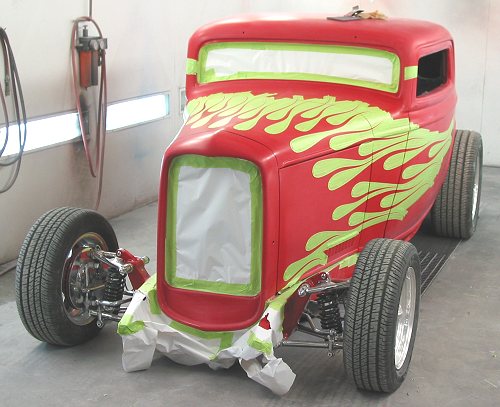 The results of another long session.
 |
| |
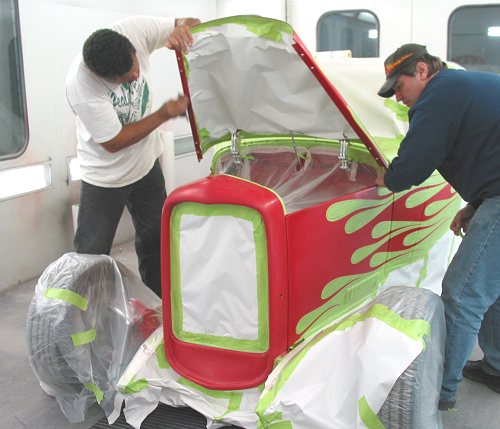 The final step before paint is to complete the cover up process.
Lots of care is required here also. |
| |
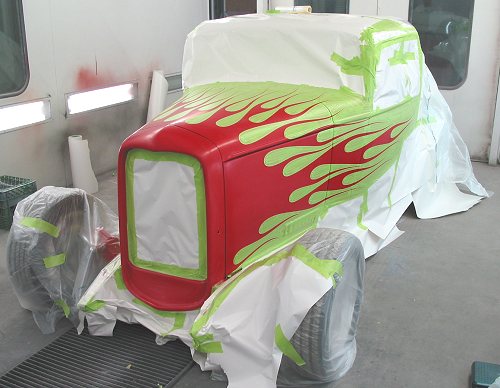 Ready to "rock and roll"
 |
| |
| |
