Hamburg Dressage Lessons
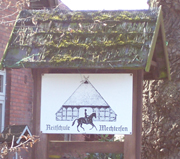
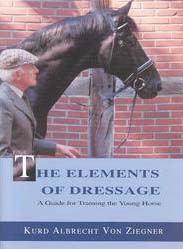
| I travelled to near Hamburg in Germany to ride at a place run by Col. Kurd Albrecht von Ziegner in March 2005.
Link to Riding School - translated to English Hobby Horse Tours ... I am going on the "Pirouette" Tour |
 |
| I've put in a short video clip of me riding, a very odd attempt at a canter pirouette then a flying change!!
Video File
|
25 March 2005 - I've completed my lessons with Col. Von Ziegner and had the most amazing time. I've learnt amazing things, and felt a horse do things I'd never thought of before!! Like .. collecting at the halt ... I didn't even really think about the concept before ... but the horse I rode was able to engage his hindquarters (if I could work it out) and put them more underneath himself, just at the halt. The horse was a lovely old sweety who put up with my total inability to get a decent 20m circle! But I had fun with pirouettes, leg yielding and piaffe - well .. odd versions that I only just managed to achieve!
Below is an account of some of my lessons/learnings/experiences. |
First Lessons
|
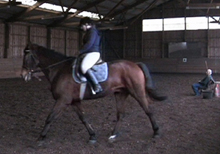
We begin in halt and I try to interpret what Col.von Ziegner means when he says the horse must give at the poll. My only understanding of this is from lessons with dubious people who pull at the reins and the horse must drop its nose purely in response to the pressure applied by the reins. I finally get a bit more understand when I am more successful in using my seat rather than my hands (even in halt). 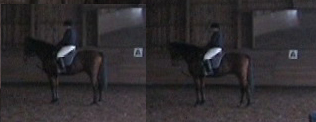 I knew my seat was ineffective (and one of the reasons I wished to travel to ride a schoolmaster) and much of this work shows how much I lift my seat believing I am letting the horse round underneath me ... but infact I am just letting them hollow. When I first try the trot work the comments I receive are "no, no, no .. very bad" ... yes ... it was horrible! My lack of ability to keep the horse's back up meant that he dropped his back which made sitting so difficult. Very occasionally I would get a stride that felt acceptable ... but these were few and far between! We work on "position right" and "position left" - the slight flexing of the horse and then how they lead into leg yielding. Col.von Ziegner was explaining to me that although the leg yield is not a classical movement, but is useful for young horses and beginner riders. The shoulder-in in his view should be introduced when the horse is ready for collection but not beforehand. During my time there we do a lot of work on the various leg-yield exercises ... until I finally get something close to acceptable and then we move onto some shoulder-in. I was asked to outline the footfalls in the paces and for once I didn't embarrass myself and was able to answer correctly!! :-) Phew! In our second lesson Col.von Ziegner attached a sort of siderein that went between the horses front legs from his bit ... as soon as this went on it was the most amazing feeling of his back coming up under the saddle! It wasn't a tight rein ... but the horse obviously knew exactly what it meant ... WORK!! I was a bit more successful in halt asking the horse to round with my seat .. but still as soon as we'd gone more than 2-3 steps in walk I lost it completely. The little achievements are so small and I feel like I am completely lost ... but when I get it right it is so obviously different! |
| The "Training Scale" | Many of our discussions range around the training scale. We discuss the current German FNs version Rhythm/Relaxation Suppleness/Looseness Contact Impulsion Straightness Collection
Colonel von Ziegner has developed an updated version which has 10 stages: We discuss the differences between the two scales and how this effects the training of the horse. The focus on straightness before impulsion, the achievement of relaxation before all the other steps ... which I feel corresponds a lot with my instructors back in Australia. |
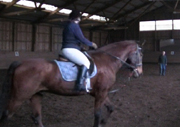
More Lessons 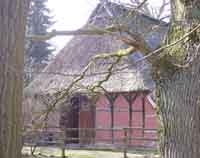  The photos below are of a piaffe attempt: 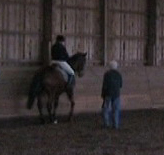 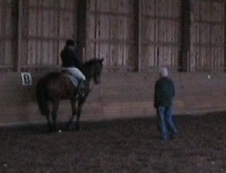 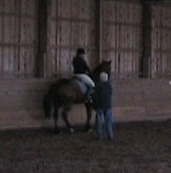
|
Whilst I stayed in Mechtersen Col.von Ziegner allowed me to watch the lesson that he taught to his students who brought their horses to his arena. There was a great variety in the horses levels (and breeding) and the riders as well. Occassionally they would very generously talk in English so that I could understand some of the lesson, but I managed to work out what was good and bad from what was said in German!! Col.vonZiegner rode the schoolmaster I was riding ... and that was a revelation for me! To seem him ride meant I could understand a lot more about what he wanted me to do. I could see how he used the reins and what that meant for me ... "the horse must give to the rein" didn't mean hold and block ... but to ask the horse to give and to encourage with the seat. I wrote in my diary after watching him ride "The horse instantly began to round and put its hindlegs underntth. I blush at the thoughts of my first attempts to pull on the horse's mouth, nothing I would do at home to my own horse ... but my interpreation of 'he must give' was so wrong!" Whilst Col.vonZiegner is riding he demonstrates the flip of the ligament in the crest changing as the bend changed. I'd read about this in books before but never seen it, nor really watched for it. The change was extremely obvious in this horse and I remind myself to see if I can try this at home! When I ride again it is very different than before, maybe not a lot more successful but a lot lighter in with the reins. I work on just trying to keep both seat bones attached to the saddle ... rather than floating above as in my normal manner! We do a lot more work on leg-yields and then graduate to shoulder-in ... keeping a watchful eye on the mirrors to ensure the horse has three tracks down the long side. Canter work is another weakness of mine! The two horses I ride in Australia are very different. One has a pony sized canter (on a 16hh+ horse!) the other has a huge unbalanced canter. With the unbalanced horse we do a lot of the transitions in a forward seat in an attempt to let him move ... I thought it was just something I did ... I now realise it has become a very bad habit and I can no longer use my seat through the canter transition. In Germany most of the transitions were from turn on the hindquarters in walk then straight into canter. Then in canter we attempt to do canter pirouettes. I'm not sure that I can really work out why some were successful and others were just odd shaped voltes! The difference in the successful ones is huge ... the hind legs are underneath my bum, that I was sitting twice as tall and the horse rotated, the contact was so light and lovely! |
Where I stayed 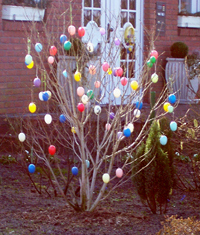
|
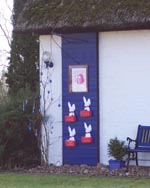
The little village I stayed in (of about 600 people) had a slight bunny obsession!! It was leading up to Easter when I stayed there and everywhere were trees hung with eggs, bunny statues and fake chickens. Being in a country where spring was about to burst made me realise the significance of Easter as the renewal of life and the starting of a new growing season. In Australia it is autumn and just doesn't have the same connotations. I have breakfast each day in the dining area of the apartment downstairs, a huge breakfast with meats and everything else. I boringly stick mostly to cereal ... I just can't quite start the day with a chunk of cheese and ham! The walk from the apartment to the stables is very short but I see flowers just beginning to burst and trees just moments off having leaves. The week before I arrived they apparently had snow ... but I had the most lovely weather whilst I was there (cold still but sun out everyday!). I walk around the village and am so surprised at how neat and clean everything is, they even rake the pavements!! I guess it is because they have such limited land and are brought up to keep it that way ... we have so much extra room in Australia we can afford to be messy ... but the house-proudness would be a good thing to rub off onto me if it could. |
| Last Lessons
Canter Pirouette:
Walk: |
Already I have learnt so much although Col.vonZiegner laments that he has such a short time to teach me! I'm not sure he realises how much I have managed to feel that has been so different to anything I've ever done in Australia. The opportunity to ride this horse and actually feel where I am going wrong is something that is not available in Australia to me. It was a long way to travel just to ride a horse ... but completely and utterly worth it! In my last lessons we work on the canter pirouettes ... occasionally I get it right and can work out where I'm going ... then as I come out of one pirouette Col.vonZiegner suddenly says to do a flying change. I know the basics of flying changes, I have experimented with them on one horse, I have read the books on what to do ... and I had no chance to think about it, just moved my aids for the next canter lead and VOILA! Amazing! So simple! Then I get stuck in a corner and realise the best way out is to ask the horse to change ... pop ... off he goes!! What a sweet heart! He tries so hard for me even though I give him the wrong signals and he guesses half the time! 
 We've also worked on piaffe throughout the lessons ... sometimes I manage a couple of steps ... othertimes I don't control the front end enough and let the horse run through. The seat is the key to everything and mine is so weak and ineffective. My final lesson ends with Col.vonZiegner saying that is all he can do for me in such a short time, I think he believes it is very little but it has been so eye opening. Each lesson has been like filling my brain to bursting point with amazing experiences and feelings. The above writings are only a small amount of the notes I took from my lessons. I have some video of me riding which I will treasure forever. And one day I hope to return ... after much work on my seat at home!! |