BCU - Water
Irrigation
Contact B.Howe
Homemade Rainbarrels
 The barrels were pickle barrels from Bick's. They are strong, plastic, 55 gallon drums with screw on lids, that can take a lot of abuse. I chose to use them, quite simply, because I had them, and I could get more for under $5 each. They can be easily worked with ordinary hand tools, and are amazingly adaptable.
To convert them into rainbarrels I merely had to add a tap near the bottom, and put some screen on the top.
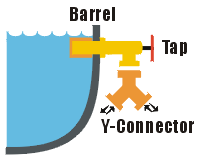 Taps: The tap is just those plastic (PVC, ABS, ??? whatever) taps that you can find around at the hardware store. Be sure to pick up a short piece of pipe to glue to inside the barrel, and use the appropriate adhesive. Drill a hole in the barrel at the height you need (allow for tap, a Y-split if being used, and room for attaching the hose). My taps are set anywhere from 4" to 8" off the ground, and I can tell you that 4" is too low unless you set the tap sideways which leads to a whole new batch of problems. You can go lower on the barrel if you set it up on concrete blocks or something strong (a full barrel weighs around 500 lbs). Insert the tap through the hole, push a short section of pipe onto the end of the tap inside the barrel and glue it in place. After the glue has had its required time to set up, silicon the heck out of it, inside and out.
 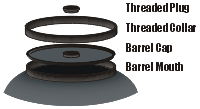 Screens: The lids pose a different problem - getting water in while leaving leaves and debris out. I'm sure people will have a million-and-one solutions for this, but here's mine. The lid assembly for the barrel is shown at the right. This makes it real easy to adapt to rainbarrels. I did two kinds of barrels - one for under the downspout, another to be connected by hose only. Each lid is a little different, but neither is difficult. Please note the barrel cap leaning against the wall behind Lucas' feet in the top photo.
Downspout Barrel: I used only the threaded collar, some wire window screen, and some silicon. I cut the screen a little larger than the collar, applied a thick bead of silicon to the top of the collar, and pressed the screen into it, making sure to get a strong grip on both screen and collar all the way around. After the silicon had set up a bit, I trimmed the screen in tight, and set the lid aside to cure for a week. When I was sure of the grip, I placed the collar back on the barrel. Using the barrel as a guide, I cut the downspout so that when I installed an elbow and another short piece of downspout, it would rest just on top of the barrel, near the back edge. When the water comes down the spout it falls through the mesh, while leaves and debris get pushed across the mesh to fall off the front edge.
Other Barrels: These barrels were being siphon-fed through hoses so it wasn't necessary to have a large area open, however, I did need a small opening to allow air to pass while the barrel filled and emptied. To achieve this I merely removed the threaded plug from the cap, and screened the hole by mounting a bit of wire mesh on the inside. Putting the mesh on the inside allows me to still use the plug if necessary.
Some Notes:
1/ Using 'wire' mesh or screen is important. The nylon window screen does not allow the water to pass as easily (higher surface tension, or some such thing). If you use the nylon screen you will probably find that the water runs straight across the top of the barrel and down the outside. This can be lessened to some extent by having the water fall straight down onto the screen, but any debris will stretch and clog the screen. I recommend using only wire screen.
2/ You want a mesh that it fine enough to keep mosquitoes and other insects out. They will lay their eggs through the screen, where they will land on the water and hatch as per their life cycle. The fun is that they won't be able to get out again, so while there may be a cloud of mosquitoes in the barrel, they are not being a pest on your deck and will probably drown the next time the barrel fills. My mother has had some success at controlling this as well, by adding a few drops of mineral oil to the top of the water in the barrel. I guess it keeps the larva from feeding or something, and because the barrel seldom completely empties, it doesn't need to be added very often.
3/ While I'm sure there is a way to keep the taps firmly in place, mine have on occassion begun to spin around, or leak a little. This was primarily on the barrels where I was frequently changing hoses. I've never worried about it much, just ignored it until the next spring when I would clean out the barrel and re-apply some silicon to the taps.
4/ I am not careful about emptying the barrels for the winter, however I try to remember to open the taps and disconnect the hoses. On a year where I did forget to open the tap, I had one full barrel freeze solid. The bottom popped out so the barrel was like a giant Weeble and tipping and wobbling all over the place. For safeties sake, I wobbled it into a sunnier spot and left it on it's side for the winter. The only damage it had sustained by springtime was a crack in one valve on the Y-connector, everything else was just fine.
5/ I keep a longer section of downspout to switch with the short section during the winter. This way I can divert the runoff over the barrel and throw it down in front a little ways away. I have a couple of fieldstones where the biggest splash hits, just to keep it from carving a hole, but for the most part it does no damage and just runs off harmlessly. The long section stays in place until I've had a chance to 'open-up' the barrels (quick spring cleaning, inspection, and maintenance).
6/ I haven't painted any of my barrels, believing that the dark barrel disappears amongst the shrubs more easily. My mother however, has hers out closer to traffic areas and has found that the melamine paints sticks and wears well with these kind of barrels.
In closing: Those are my rainbarrels, aren't you glad you met them :-) Total cost for one barrel was around $15.00(cdn), and about $10 of that was for the tap. I have to laugh when I see much smaller barrels listed in the magazines for $70-$150, that fancy downspout connector better be worth it.
Thanks for stopping by,
Brett