BCU - Water
Rainbarrels
Contact B.Howe
Irrigation System
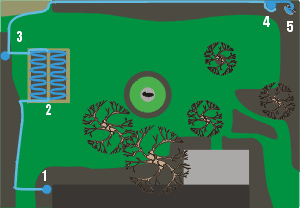
What it's designed to do: My irrigation system is designed to simply move some rainwater which landed in a useless place, to an area where it can be of some service. I am not trying to store water for the beds to drink during droughts, but rather I am trying to get as much of the water that did fall into the areas where it is needed most within a reasonable amount of time after it falls. I don't want my plants becoming accustomed to frequent waterings, but at the same time I'd like them to get a good drink when it's available. If that doesn't make any sense now, hopefully it will after you've reviewed the set-up.
Where the water goes:
1/ Rainbarrel at the downspout. This is the only point at which water enters the system. All of the water used is runoff from half of my roof. The water is delivered to the next step by an ordinary vinyl garden hose laid along the edge of the garden.
2/ Soaker Hoses for the Veggie Beds. The water it slowly leached directly into the soil reducing loss. When the soaker hoses are full the excess water will continue on through a short, plastic connecting tube to the next rainbarrel.
3/ The second rainbarrel is fed only through the hoses. It collects no water of it's own, but acts as a reservoir for the system and a connector for the vinyl hose to the next barrel.
4/ The third rainbarrel is next to the frog pond. This corner is routinely dark and dry through the summer months, and mucky the rest of the year. While we may receive rain during the summer, the storms are generally short and may not drop enough water to get through the canopy of Oak and Black Walnuts surrounding this area. To help get some water in here I installed this last barrel. In the same manner as the second barrel, it's primary function is as a reservoir for the entire system, but it's proximity to this corner allows for the next step.
5/ The Frog pond Drip-fountain. A T-connector and a short section of tubing (left over from the soaker hose installation) comprise the delivery system for the fountain. The concrete basin and stones were installed a few years ago, and now have a better chance of staying wet. I installed the T-connector on the hose before it gets to the rainbarrel so it tries to drain at the fountain first. In order to allow water to back-up into the rainbarrel I narrowed the flow at the fountain by pushing a little bundle of smaller tubes tightly into the the end of the fountain tube. The result was a slow drip, while water still pushed into the rainbarrel. I set the onto a flat, slanted rock and held it in place with a larger heavier rock so that it couldn't be seen or accidently moved. It fills the basin, and the overflow from the basin waters the surrounding plants.
My Comments: The rainbarrels have been proving themselves for a few years, however the soaker hose and drip-fountain are new this spring (2001). My intial test was to throw the hose into the first barrel and run it until that barrel fills. I noticed very quickly that the water was not being delivered to the other rainbarrels as quickly as I had become accustomed. I accredit that to the soaker hose, both because water is escaping there (lowering pressure) and because I believe the passage inside the hose is a little narrower than the garden hoses used to deliver the water elsewhere in the system. However, I was not disappointed. With that one filling, I had wet soaker hoses for 3 days.
As far as the drip-fountain goes, I cannot say how long it actually ran for. I can say that the pond filled to overflowing and stayed full for at least 2 days. The spill rock was dry when I went out the next morning (some 16 hours after filling the barrel), but that only suggests how long it didn't drip for. I'll be watching it for a while to see how it will perform. Hopefully, it will prove successful because the birds have been having a field day with it.
Thanks for stopping by,
Brett