
Gaelic Waulking Song Group
... The Old Wives' Quarrelling
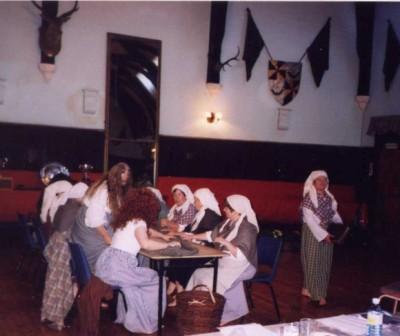
It is great fun to sing. The changing rhythms and increasing pace make it very exciting.
In our version of this seventeenth century song series, the Uist poetess, Nic a� Mhanaich, begins by praising Mac �ic Ailein, chief of Clanranald. Nic Iain Fhinn, her Barra rival, retaliates by listing some of the great MacNeill chiefs, culminating with Gilleonan, whose horses drank wine, and wore silver bridles and golden horseshoes. �But�, retorts Nic a� Mhanaich, �all you have is wee, black, withered, stony Barra � and anyway, you got your land from us when you were destitute!�
Nic Iain Fhinn is temporarily speechless, and Nic a� Mhanaich presses home her advantage, claiming that the Barraich are so poverty-stricken that they are forced to eat fish. This was a deadly insult in the old days, when fish and shellfish were despised as being only fit for the very poorest to eat.
Nic Iain Fhinn has by now recovered herself. She praises the fertility of Barra, then gets really personal! She withers her opponent with a sustained diatribe that is a masterpiece of vituperation! And it rhymes beautifully!
Nic a� Mhanaich drops down dead in sheer indignation! The Barra contingent have to make their escape in a hurry!
John Lorne Campbell, the great Gaelic scholar, suspected that not all the words were given to collectors�some bits were considered just too extreme! He also states that in Cape Breton the song was barred, as it could lead to fights between people of Uist or Barra ancestry.
He also comments that "it is a remarkable testimony to the historicity of this poem, that there actually were three daughters of John of Moydart, chief of Clanranald, in the seventeenth century, named Mor, Catriana, and Anna, and that one of them, Catriana, did marry a MacNeil of Barra."
Hebridean Folksongs II p.228
Click here for words and translation.