| The Heroic Century: Masterpieces from the Museum of Modern Art, NYC |
| General Timeline of �Modern Art�: Impressionism/Post-Impressionism: 1860 � 1900s Cubism, Symbolism, Fauvism, Dada: 1905 � 1940s Expressionism Abstract Expressionism, Color Field: 1940 � 1960s Minimalism Post-Modernism: Pop Art, Sensation: 1960s - Current Minimalism |
 |
| Abstract Expressionism: - Artist expresses himself purely through the use of form and color. It is form of non-representational, or non-objective, art, which means that there are no concrete objects represented - Now considered to be the first American artistic movement of worldwide importance - Movement can be broadly divided into two groups: Action Painting - typified by artists such as Pollock, de Kooning put the focus on the physical action involved in painting Color Field Painting - practiced by Mark Rothko and Kenneth Noland, primarily concerned with exploring the effect of pure color on a canvas. |
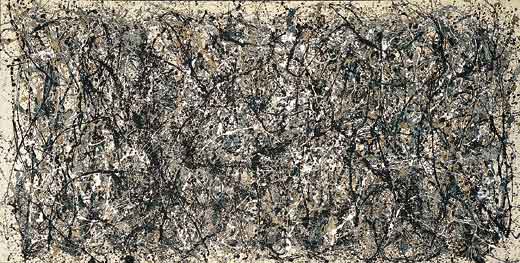 |
| Jackson Pollock. One (Number 31, 1950). 1950. Oil and enamel on unprimed canvas, 8' 10" x 17' 5 5/8" (269.5 x 530.8 cm). Sidney and Harriet Janis Collection Fund (by exchange). � 2002 Pollock-Krasner Foundation/Artists Rights Society (ARS), New York |
| - Goal: Convey set of mythical, emotional or spiritual ideas through abstract or non-representational art - Used Surrealist techniques for expressing the subconscious through art - Pollock intentionally sought to depict essential, universal truths about human nature - Pollock painted deliberately (very controlled techniques but appears to look random) - What has happened to the figure in this work and represented in other works during this period (and subsequent periods)? - What might Pollock be saying about the individual and world here? - How might Pollock techniques conflict with his message, intended meaning? - How might his worldview represented in his art reflect his behavior and lifestyle? - Side Note: Pollock said he was painting deliberately in order to say that all is chance - How did his painting technique challenge his own view? - He placed canvases horizontally on the floor and dripped paint from the swinging cans - His paintings were not a product of chance - There was an order shaping his canvases � his lines of paint followed the order of the universe itself (gravity, physical laws, etc.) - his style contradicted what he was trying to "paint" and "represent" - He is presenting a fragmented concept of reality (tied into previous �Modern� artists � starting with Cezanne) |
| My Two Cents I think Pollock and Rothko are essential two painting formats expressing the same idea. They believed that essentially there was not truly knowable, absolute truth and that the viewer had to find their own "truth" through creating the meaning themselves. Hence, there is no human form to this work. The human form is supposed to be the viewer himself. Both of these painters world views also led to hopelessness. Rothko committed suicide. (How can anyone not see the link between their style, worldview and it's effect). Pollock basically died a drunk - literally crashed his car while driving drunk and died. They were deliberately expressing their world view through their chosen form. I would frame their view of "Spirituality" as expressed in their art as self-idolatry. Which is the humanistic or modernist world view and it's now-morphed decendant - "post-moderism." |
 |
 |
| Back |
| Forward |
| Presentation |
|