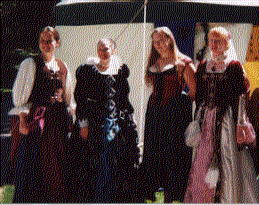
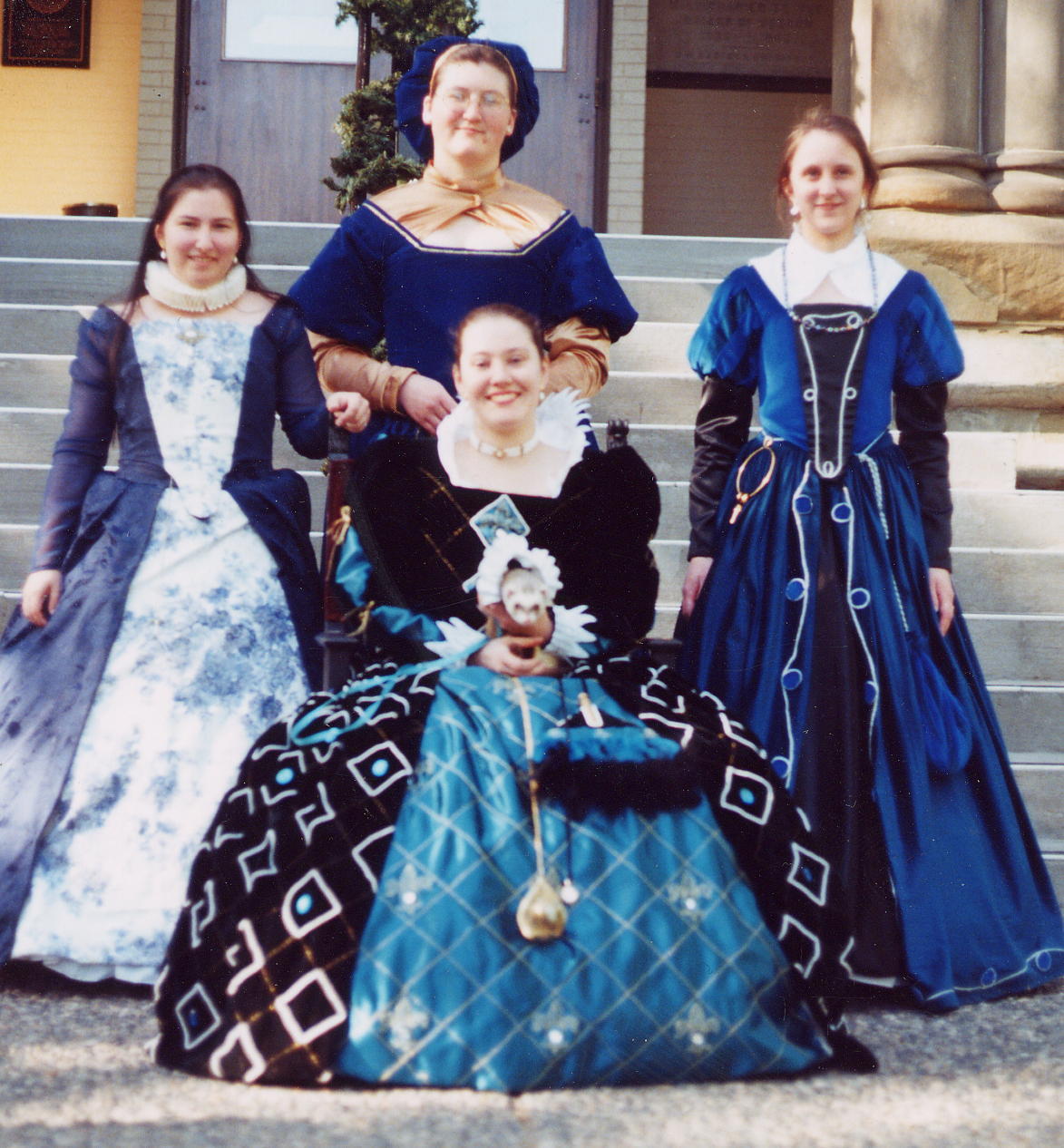
| Garb for women, part I: Wearing the fantasy! We�ve all seen the fantastic garb Hollywood dishes out every year for period flicks, but that�s not the only thing that was worn in the middle ages. Garb for women, on the whole, is easier to come by than for men. With a bit of searching, even in one�s own closet, many pieces and a little ingenuity can create much, or even all, of a good costume. For those few pieces that are still lacking, or for those who have always dreamed of that gorgeous gown (i.e. spent way too many hours watching �Shakespeare in Love�), many patterns are readily available at your local fabric store. For women the middle ages and Renaissance were effectively one of two things, at least in the world of dress: either largely practical or exaggeratedly ornate. On the former level one finds garb such as the simple but incredibly effective (both in terms of period wear and in its ability to make one look medieval quickly) T-tunic, where the latter finds its best expression in the expensively and effusively decorated bodices and skirts of the Renaissance. What you wear says who you are and what you do not only in that it demonstrates your relative wealth, but the more noble the garb the more restricted the movement. Don�t let the existence of noble garb fool you, though � some of the nicest garb either of us have ever seen has been peasant dress, and these same garbs are frequently easier (read �more comfortable�) to wear. The chief aim here is to hide your 21st-century clothing and to have fun! Easiest Wear a long (technically your ankles should not show), full skirt of a plain material and a loose shirt, ideally a �peasant� shirt. Over these either a tabard or a bodice need to be worn. If you don�t have a shirt check out the local thrift store. Again, you are searching for a �peasant�-style blouse with a laced neck and long, full sleeves. If you can�t find one of these, try searching for a high-necked, long-sleeved blouse either opening up the back or with hidden front buttons. If you don�t have a skirt, you can make yourself a basic one. 1. Measure from your waist to the floor. Add 4 inches. Write this number down (you�ll need it later), then multiply it by three. Add 5 inches to this new figure. (Bet you wish you�d paid more attention in math class now, huh?) 2. Buy an amount of material equal to the last number calculated above. (This material can be either 44 or 60 inches wide.) 3. Cut 3 pieces of cloth the width of the material by the measured length plus 4 inches from step 1 (you wrote it down, didn�t you?). 4. Cut a strip of cloth 5 inches wide by the circumference of your waist plus three inches. Cut a piece of interfacing the same size as this strip. 5. Sew the waist-to-floor-plus-4-inches edges together, forming a huge cylinder. The back seam needs a 4-inch gap (i.e. don�t sew the 2 pieces together for 4 inches) at the top. 6. Gather or pleat the cylinder to fit onto the waistband, leaving 3 inches of the waistband free at one end. 7. Sew the front of the waistband and interfacing to the skirt, fold over and sew again. 8. Put a hook-and-eye (heavy duty) on the end of the waistband to close it. You may need to put some down the gap to close it as well. 9. Hem the skirt to the desired length. Tip: for a more flattering skirt, remove a triangle of material from the top so that the waist is narrower than the hem. Make SURE to leave plenty of material to gather at the waist. Bodice Bodices are the hardest part of women�s Renaissance garb to fake. Some tank tops can do quite well though it will take a bit of searching. It must be one of the ones with wide shoulder straps (black is nearly always the best color choice, even for a peasant � in fact, for those doing this option, peasant is nearly always the best choice. The stretch velvet variety can do well for those seeking a higher class look.) If seeking to make a bodice I recommend purchasing one of the patterns readily available (YEE-ESSSSSS!) from the fabric shops at the moment. Most have curved seams over the bust or darts. These are not historically accurate but do make the creation of a fitting bodice much easier, thus are on all the patterns. Usable (but not as good) bodice patterns can also be found in the special occasion dresses section. A peasant bodice should have a round neck and lace up the front. A middle class/noble bodice usually will have a square neck though round is also possible; it could lace up the front but up the center back is more likely (you will need someone to help put this on). Tips: 1. It is more historically accurate, and nearly always looks better, to make the bodice a darker color than the skirt. 2. It is a good idea to cut a bodice out of scrap material first to make sure it fits�or at least do the lining first. 3. Do not ignore the instructions to use interfacing -- the fastest way (I�m the queen of bodice problems) to a bad looking bodice is to have it too floppy. No matter what your pattern says, it should be at least two layers of interfacing. 4. Bodices laced both front and side are easier to make fit right; this style is great for a peasant though it can work for a middle class one as well. 5. Wherever the bodice opens to allow entry (including side lacing) boning MUST be put between the edge and the closure (inside the bodice) or else it will buckle badly. 6. Use the larger size of grommets for the lacing, the small ones pull out (Yes, I do own one of these too). 7. A back laced bodice with a point in the front MUST have stiffening down the point. A piece of plastic needlework canvas works both wonderfully and easily, just make sure it is smaller than the fabric pieces so it is not in the way of the seams. The canvas should be used in addition to the interfacing (slid between it), not as a replacement! WEBPAGE CONTENTS NEXT PAGE: GARB FOR WOMEN, PART II: PIECE-BY-PIECE HOOPSKIRTS, SKIRTS, CELTIC WEAR, HATS, HAIRSTYLES, AND SHOES |
 |
 |
| (Image courtesy Schulz Family) |
| (Photo by Kristen Weaver) |