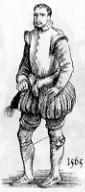
| Garb for men, part II: Grunt! Snort! Jerkins (But Nice Guys Can Wear Them Too) Jerkins were effectively the poor man�s doublet or suit coat of the late middle ages and Renaissance. They look quite dashing, as well and are the perfect thing for swashbucklers. (Use a heavy material such as denim) 1. Measure from the shoulder to mid-thigh and add 2 inches. Cut the material to this length (cutting from the top or bottom of the material). 2. Measure the largest part of the hip and add 4 inches. Cut the material to this length (cutting from the side of the material). 3. Fold the material in half, matching the sides, and cut. 4. With one (NOT both) of these pieces, repeat step 3. 5. Stack the pieces from step 4 with the outside of the cloth to the center and both tops at the same end. 6. Mark 4 inches from a top corner. Mark 12 inches down from the same top corner. Draw a line between the two (you should have a right triangle with the corner at the top of the material). Cut through both layers. This forms the front of the jerkin. 7. Sew the shoulder seams of the jerkin. This means take the other piece from step 3 and the pieces cut last in step 6 and match the tops with both V�s to the center. Sew toward the V�s (You did know to sew on the inside of the material with the outsides against each other, didn�t you?). 8. Match up the side seams. Measure down 12 inches from the top and start sewing from there to the bottom. 9. Turn the jerkin right side out and put it on. You probably will need to trim the back of the neck slightly and a bit away from the arm holes. It is much better to get someone else to help you with the trimming (and don�t have your best shirt on underneath). 10. Turn in all unsewn seams and sew them down. 11. Add a lacing (not buttons) to the front. Edward VI Jerkin These are �nicer� than the jerkin (though not necessary better) and much easier to make than the doublet pattern Worn from lower middle class to noble; depending on fabric and trim (do not trim for lower middle class) (Fabrics: corduroy, denim, canvas, duck, velvet, velour) 1) Get an old T-shirt 2 sizes larger than normally worn. 2) Cut out the sleeves of the T-shirt (do not use a tank top; the armholes are too large). 3) Put the T-shirt on the wearer over the shirt to be worn underneath. 4) Cut a round neck opening just higher than the undershirt�s collar point � if applicable (Note: the exact height of the neck opening is not very important). 5) Remove both shirts; put the T-shirt back on minus the undershirt. 6) Mark waist level all around on the T-shirt. Measure from the wearer�s waist to mid-thigh. Calculate the distance between the hem of the T-shirt and mid-thigh (this amount will be used latter). 7) Cut center front of the T-shirt (from neck to hem). 8) Cut down sides (for side seams) from the armhole to the hem of the T-shirt. 9) Cut along the shoulder seams (all the way). The wearer should now be bare chested. 10) Extend the bottom of the pattern pieces to mid-thigh length. 11) Cut out garment, adding 1 inch seam allowances on the side, shoulder and armhole seams; and add 1 � inch on the neck, center front and bottom edges (these will be hemmed latter). 12) Additionally, cut out 4 epaulet pieces and 4 pieces of interfacing to match. The epaulet is a half oval shaped piece 11 inches long on the straight edge and 3 inches high in the center of the curved edge (the curved edge will be about 18 inches long). 13) Stack interfacing, epaulet piece front side up, epaulet piece front side down, and interfacing piece. Sew along curved edge, DO NOT sew straight edge. 14) Clip curve and turn epaulet right side out; repeat for second epaulet. 15) Sew shoulder seams and side seams. 16) Pin epaulet centered over shoulder seam matching raw edges, sew down epaulet and repeat for other side. 17) Pin 2 rows of straight trim vertically on either side of center, running from front hem over the shoulder to back hem. Check on wearer for correct positioning; alter if needed then sew down trim. 18) Sew bias tape to the armholes and stitch down (as in a facing) 19) Double fold and hem all raw edges. 20) Sew hook tape to center front of jerkin from neck to waist. 21) Sew shank-style gold buttons (nonfunctional) at desired intervals from neck to 3 inches above waist � lots of buttons were common. (Thread loops can be used instead of hook tape). 22) Wear over undershirt and pants, belted at the waist. For the look of an upper class gent, button the shirt, add a ruff to the neck and ruffles to the sleeves. A short cape would have been very stylish thrown over the whole and could have had lots of fancy trimming around the edges (the more bucks you had, the more trim). The doublet described below (don�t do the jerkin) can be added to middle-class and is necessary for nobles�though you could get by in a fancy cape that you never take off so people couldn�t see you lost your doublet (did you forget to pay the tax collector again?). A tabard could also be worn over the shirt and pants but you are actually more historically accurate to leave it off. Doublets An Italian gentleman wearing a doublet (Image courtesy Gorsline) The higher-class man�s jerkin (more difficult to make but worth the extra work). These too should be made of a heavy material and probably decorated � you want to show your wealth as much as possible! Unfortunately there is no cheap, readily available pattern for a man�s doublet. 1. Measure from your shoulders to your waist and add 8 inches. Cut material to this length (cutting from the top or bottom of your material). 2. Measure the largest part of your body from your shoulders to your waist and add 8 inches. Cut the material to this length (cutting from the side of the material).. 3. Fold the material (match the sides) in half. Move one side until one piece is 6 inches larger than the other and cut. 4. Take the larger piece from step 3. (Important: I am assuming you have this piece of cloth with the inside of the material facing up and the outside flat on the work surface). Fold your right side toward the left side, almost in half, but stopping when the left side is 4 inches larger and cut. 5. Fold in the center front seams 2 inches and sew. (It is best to add interfacing). 6. Sew the shoulder seams of the doublet. This means take the other piece from step 3 and the pieces sewn in step 5 and match the tops with both sewn edges to the center. Sew toward the sewn edges but stop about 4 inches from the sewn edge (You did know to sew on the inside of the material with the outsides against each other, didn�t you?). 7. Match up the side seams. Measure down 12 inches from the top and start sewing from there to the bottom. 8. Turn the doublet right side out and put it on. You probably will need to trim the neck slightly in both the front and back (keep it as high as is reasonably comfortable) and a probably a bit away from the arm holes. You also will be trimming the waist. Trim the back to 1-2 inches below your waist and slope the sides toward a point at the front of the doublet (pin the front with the left side overlapping 2 inches before cutting). Get someone else to help you with the trimming (and don�t have your best shirt on underneath). 9. Take the doublet off and measure the neck opening. Cut a two pieces of material and a piece of interfacing this length plus 2 inches by 5 inches wide, curving the corners at the top ends. Sew around the sides and top of the collar and turn it right side out. Sew the collar onto the neck of the doublet, matching the unsewn edges. 10. Cut four pieces and (two of interfacing) 10 inches long and 5 inches wide. Stack these as though to be sew � your making two sets just like the collar � and cut one long edge into a curve (the other long edge should be straight). Sew each set around the curved edge. These are the epaulets. 11. Sew the epaulets to the arm holes, matching the unsewn edges. These should be much smaller than the arm hole, and are centered over the shoulder seam. 12. Fold in the rest of the unsewn part of the armhole and sew down. 13. (This is possibly the hardest part). Cut two pieces (and a piece of interfacing) the length of the back of the doublet plus 2 inches by 5 inches wide. Construct and sew to doublet like the collar. Cut two pieces (and a piece of interfacing) the length of a side of the doublet front - your measuring down the point, not across the waist - plus 2 inches by 5 inches wide. Construct and sew to doublet, just like the back. Repeat for the other side of the front. If the front points are less than perfect, I�m sorry. Try adding hooks to keep them in position. 14. Add buttons (use shank type) and button holes up the front of the doublet. Add any trimming desired. A fashionable man would add a ruff over the top of the neck. Hats Technically a man�s costume should include a hat but the best idea is probably to skip it. If you have long hair, pull it back into a ponytail with a piece of lacing or ribbon (tying it back with a modern tie and then running ribbon over this works fantastically better than ribbon alone). If you want a hat for sun, a straw hat is actually accurate for lower-class men. Baseball caps and cowboy hats just can�t be made to work, sorry. Shoes Most likely, dress shoes (preferably slip-on style) will be the best choice or sandals for a peasant. Boots can be perfect, but chances are you will not have the right type sitting around � you�ll want leather, low-heeled, non-"cowboy" boots. The best modern examples are actually found in motorcycle boots. Use your best option (we do!). WEBPAGE CONTENTS NEXT PAGE: GARB FOR WOMEN, PART I: WEARING THE FANTASY! QUICK-AND-EASY, BASIC SKIRTS, AND BASIC BODICES |
 |