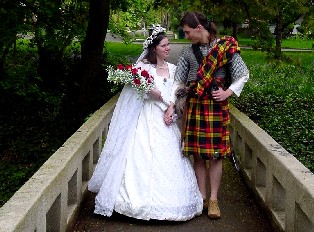
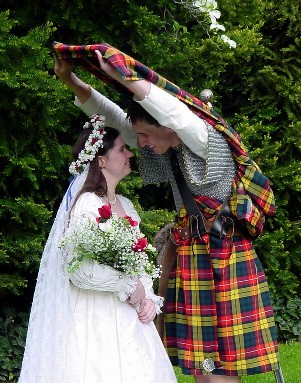
| Garb for men, part I: No tights required (we swear)! (Photo courtesy of Schulz family) Most men�s terror of middle ages attire can be summed up in one word: tights. Have no fear, though! As promised, there is a whole host of options available if you, too, fear these stringy things, and no one will call you a sissy for not wearing them (heck, a lot of these options look better than tights!). For men the middle ages and Renaissance were effectively one of two things, at least in the world of dress: either purely practical or exaggeratedly ornate. On the former level one finds garb such as the simple but incredibly effective (both in terms of period wear and in its ability to make one look medieval quickly) T-tunic, where the latter finds its best expression in the expensively and effusively decorated doublets and slops of the Renaissance. What you wear says who you are and what you do not only in that it demonstrates your relative wealth, but the more noble the garb the more restricted the movement. Don�t let the existence of noble garb fool you, though � some of the nicest garb either of us have ever seen has been peasant dress, and these same garbs are frequently easier (read �more comfortable�) to wear. The chief aim here is to hide your 21st-century clothing and to have fun! Easiest Wear a pair of sweatpants and a loose shirt (a frilly, woman�s �poet shirt� is the type being sought � these can often be found cheaply even with lacing at thrift shops). Wear long sox and dress shoes, bunching the pants up near the knee. Another option for peasants not wishing to hike up their pant legs is to criss-cross cord over the cloth from just below the knee to the ankles. With this style, called "trews", tan and brown slacks can also work well. Wear a short cape or tabard to hide imperfect shirts. Celts and Kilts A Scotsman in great kilt with his bride (Photo by Heather Brush) Great Kilt Find/purchase a long piece of material in vaguely Scottish colors (i.e. plaids, flannels, etc.), approximately 6-8 yards. Lay the fabric on the ground. Lay yourself over the fabric, wriggling until the lower edge just bisects your knees. Run your belt (you are wearing one, aren�t you?) beneath you and the fabric at the level of your waist. Wrap the fabric over your now very chilly front (�I knew I felt a draft!�), forming the �aprons� of the kilt. These should overlap, with the edge on the left side in front. Belt the aprons in place and stand up. The remaining fabric (which should be in a long train) can be wrapped around your waist, twisted and thrown over your shoulder, or pulled around you like a cloak. Wear this with a large, long-sleeved shirt or a T-tunic, which you should have put on first. Pleated Kilt Procure a pleated skirt (usually found cheaply in thrift stores in the women�s section). Technically, pleated kilts were not worn until the 18th century but they are used by many for Renaissance Faires. A pair of shorts can be hidden under the kilt for those fearful of the breeze. Wear this with a large, long-sleeved shirt or a T-tunic. Kilt/Shirt Sewing Simplicity 8913 has a pattern for a pleated kilt which includes a wonderful shirt pattern (avoid the version for the pants). The unspoken advantages of great kilts! (Photo by Heather Brush) Sewing Other garb for men Unfortunately, there are not many good options available for making men�s garb. Though most of the pattern books have patterns, they are of a style that most people would not want to wear (and I can�t blame them!). Seriously, if you are making the costume for a man, make sure he looks at these before you spend your money. On the plus side, they can be fairly historically accurate. The best idea for men is to use the T-tunic or kilt. If you must do something else, use one of the two following patterns: Simplicity 8587 is adequate for men�s peasant garb (avoid the women�s pattern -- there are so many better options) but will not work for any other class. McCalls 2258 is the best option if you need a pattern with pants, just make certain to follow the changes noted below since it is originally intended as a Revolutionary war costume. Do NOT make the vest, jacket and hat included! Make the pants as shown but do not add the decorative buttons to the sides. (You probably will want to make the pants long enough to allow a pair of long dress socks to be worn in place of tights). Do not embellish the pants further! Ignore any urges to add pockets or belt loops (they are straight from Hell, really; we have it on good authority). Make the shirt as shown but use either fancy buttons at the collar or change it to a lacing. To achieve a pleasant peasant look, lace the front of the shirt and belt it on the outside of the pants. He could also have a jerkin (see next page). WEBPAGE CONTENTS NEXT PAGE: GARB FOR MEN, PART II: GRUNT! SNORT! DOUBLETS, JERKINS, HATS, AND SHOES |
 |
 |
 |