
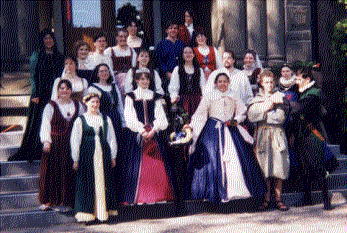
The whole point of garb is to cover up your 21st-century-ness. As long as you follow the guidelines below and a little common sense (i.e. neon green is not period, no exceptions!) you�ll not only look it, but you�ll probably even feel that you�ve stepped back a few hundred years. Pay attention to the guidelines and you�ll be more than fine � a mediocre piece of garb can go from �oh, well� to �oh, wow!� just by choosing the right types of fabrics, colors, and trims. On the other hand, do NOT freak out about accuracy! The bottom line is to make what you want, within bounds of reason -- if you want a black dress, make a black dress, and Elizabeth�s Sumptuary Laws be hanged!
Colors
Peasants
Acceptable
Rust-any shade
Red-Berry, Rose, Beet (avoid scarlet shades)
Yellow- any shade except very bright and metallic gold
Brown-any shade
Orange-any shade except very bright
Green-any shade
Grey-any shade except very dark
Off white/natural
Unacceptable
Aqua, Fuschia, Teal, Turquoise, Pink, Purple, Most Blues, Black, Pure Whites
Middle Class
Acceptable
Anything listed under peasant plus:
Black (in small amounts)
Pure Whites (in small amounts)
More Jewel toned (Ruby, Sapphire, Emerald, Garnet, Topaz, Lapis, Citron, Malachite)
Turquoise, Saffron
Unacceptable
Excess Silver and Gold, Excess Turquoise, Pink, Fuschia, Purple
Nobles
For nobles pretty much anything went except purple, which was reserved for the Queen. Avoid colors that would not have existed � this surprisingly includes most of out current pastels. Similar colors of the time would have been weak dyes or faded garments.
Fabrics
Materials play an important part in your look � fabrics will tell a lot about your class and thus lifestyle. Matching materials and colors in an outfit indicated wealth (so if you are a peasant woman your bodice and skirt will not be the same color!!!). Certain types of material will also give you a certain look. Heavier or shinier materials will be stiffer and often more noble looking, soft cottons will have less stiffness and look more peasant. For middle and upper classes, consider using upholstery fabric; it is about the right weight and stiffness. In considering the weather (sunny), keep in mind that natural fabrics such as cotton breath better than synthetics. Remember to avoid fabrics that didn�t exist: patterns (except for simple brocades), spandex, vinyl, and basically anything that screams �20th century!�
Peasants
Fabrics to use: cottons and cotton blends (light for shirts, heavier for other things), leather, wool, denim (no blue jeans), twill, duck, trigger, coarse linen
Fabrics to avoid: Velvet, silk, satin, taffeta, corduroy, fine linen, metallic
Middle Class
Fabrics to use: Silk, brocade, velvet, corduroy, satin, linen
Fabrics to avoid: Taffeta, metallics
Nobles
Fabrics to use: Anything from middle class, taffeta (including changeable taffeta) a possibility
Fabrics for everybody to avoid: blue jean denim, 100% polyester, camouflage, ripstop nylon, double-knit, sequins, neon, any floral that is not brocade, anything that is not natural. If you�re not Celtic, do not use plaids!
Trims
Fabric and color are all well and good, but remember that Elizabeth�s reign was the era of exaggeration and over-decoration. This means that everyone who could, even the wealthier peasants, would try to �dress up� their garb with fancy trims, embroidery, and gemstones, both fake and real. Peasants will mostly be confined to simple trims and embroidery, while the upper classes can go so far as to accentuate whole seams in strung pearls or similar jewels. A note of warning: remember that the wrong trim and/or lace is the fastest way to ruin an otherwise good piece of garb!
Peasants
Contrasting strips of cloth, grosgrain ribbon (not satin!), piping, rattail, plain upholstery gimp, webbing tape, simple embroidery and rope or hemp cording. Do NOT use lace.
Middle Class
Anything the peasants used only in greater quantities to show their standing. In addition they could use small amounts of copper, pewter, bronze, silver, gold trims/cord, satin ribbon, more ornate upholstery gimp, and more elaborate embroidery.
Nobles
Anything from middle class, just in greater quantities. Also consider using fake pearls and rhinestones.
Trims for everyone to avoid: rick-rack, sequins, plastics, vinyl, fringe, anything that looks manufactured or modern (if in doubt, you probably don�t want it).
Lace
Keep in mind that lace would have been very expensive and done by hand (it takes hours to make an inch of just a very basic lace pattern), so if you want to use lace look for the more expensive kind (it looks heavier and you can see the individual threads � if it costs less than $3 a yard, full price, you probably have the wrong kind). Eyelet does not seem to have been used. Be careful! Even more than other trims, the wrong type of lace is about the fastest way to ruin an otherwise great costume! Avoid all lace fabric (there are exceptions but your much better off to steer clear)!
Appropriate places to put lace are around a neckline (women), on the edge of a ruff and on sleeves. Despite what patterns are showing, even the queen probably would not have put lace down the front of her skirt or around the hem. Around the waist is mostly inaccurate as well (and really goofy looking!).
Closures
Here�s a fun question: you don�t have zippers or velcro, so how in the name of Regina do you keep that doublet shut? Period fasteners were usually buttons, lacing cords, or hooks-and-eyes and were used by all classes. Peasants would most commonly have bone, wood, or nut buttons, or hooks-and-eyes and lacing. The middle class and nobles would also have had these, though more elaborately done. Even more likely they would have had buttons of metal, cloth-covered, French knot, rope, ivory, pearl, and scrimshaw, or frogs.
WEBPAGE CONTENTS
NEXT PAGE: GARB FOR EVERYONE