|
|
|
|
|
|
|
To conclude this project, I will analyse Lowry's 1953 piece 'Going to the match'. |
|
|
|
|
|
n“It represents the heart and soul of the
game - the anticipation of the crowds going to the match.”
Gordon
Taylor, PFA Chief executive |
|
|
|
|
|
|
|
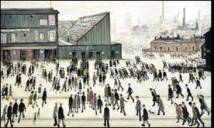
| 'Going to the match' | |
| 1953, Oil on Canvas | |
| Originally
painted for an art competition in 1953, Going to the Match (right) shows
Burnden Park, home to Bolton Wanderers Football Club, on a typical match
day. It was bought in 1999 by the Football Association for a record
£1.9million, a record for any British painting. The Chief executive of
the PFA, Gordon Taylor, said of the purchase: |
|
|
†
"I
would have liked it for a lot less than that, but it is the
football picture, it captures all the atmosphere of the game.” |
|
|
I
tend to agree with him. As a football supporter myself, I feel it
represents very well the scene that precedes a match, with hundreds of
people heading towards the local stadium to watch their team. A noticeable presence in the picture is the number of industrial chimneys in the background, which are typical of most of Lowry’s outdoor scene representations. They serve to create a link between the working class and football, a major source of entertainment in the north-west of England in the mid twentieth century. |
|
|
As
with all of his paintings, Lowry has used a limited palette of quite
dull colours, but they go well together to create an atmosphere of
poverty. The effect of a mist is created by Lowry’s technique of
letting buildings in the background ‘fade away’, and it perhaps
emphasises the plumes of smoke billowing from the industrial chimneys. In
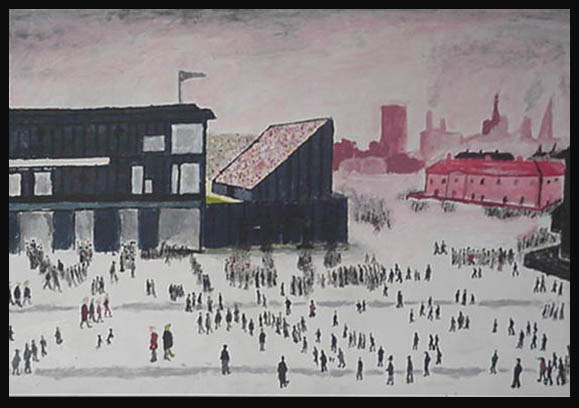
my acrylic paint representation of this piece, I have attempted to copy
the lines, marks, colours and tones which Lowry made his style. I worked
on a stretched piece of A2 paper, whereas Lowry would have worked on
canvas. I first blocked out the whole sheet with white paint, just as
Lowry would have done with his canvas to cancel out its rough texture. |
|
| Using a ruler, I then estimated where the straight lines would go before doing a rough sketch of positions of the people and buildings in relation to the piece. I proceeded to apply acrylic paint, using the rough sketch as a guideline. Admittedly, however, I did not use layers and layers of paint in the same way Lowry would have done, even though I did use a thick textured paint. The painting did take me hours to complete, though it must have taken Lowry even longer to try and paint the many people walking around individually. | |
|
Right is my version of Lowry's 'Going to the Match'. |
|