|
|
|
|
|
|
|
Lowry's background |
|
|
|
|
|
|
|
Lowry's background |
|
|
||||||||||
|
Some
might say that Laurence Stephen Lowry only gained recognition for his
works relatively late in his life. Indeed, it was in November 1938 that he
was offered a one-man exhibition at the Reid and Lefevre Gallery in
London, at the age of 51, thirty five years after he took up drawing. Having
been brought up into a typical Manchester Victorian family, with mis-matched
parents and an unremarkable education, Lowry 'drifted' into office work at
a Manchester firm of accountants. However, as with most young people
looking for employment at the time, this was merely a way for him to earn
money to survive. Lowry managed to save enough money to finance his hobby,
to purchase materials and to take a few painting lessons under the tuition
of Reginald Barber. Though Lowry sought tuition from German William Fitz,
this was all the education in painting Lowry received until he started at
art school in Manchester. l "I've
a one-track mind… I only deal with poverty…with gloom. I never do a
jolly picture."
Lowry |
||||||||||
|
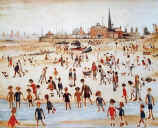
Perhaps the reason behind this stems from the fact that this was the sort of situation he grew up in - a working class, industrial background with poverty all around him. However, Lowry also concedes that he could not, no matter how much he tried, paint shadows. For this reason, all Lowry's work is false to a certain extent. This is shown in his 1943 oil on canvas piece 'July, the Seaside' (Right). A place where the sun supposedly always shines, the seaside, seems quite dull without it. In this piece, Lowry makes up for this lack of sun by purposely making the many people milling around a much darker colour than the sand that covers the ground. |
|
|||||||||
|
'July, the seaside' |
||||||||||
|
Also present in this picture are the industrial
buildings in the background, which, along with the dark colours Lowry
has used to create the piece serve to create a quite ‘boring’
atmosphere, though to the people out by the sea, this was an interesting
day out. |
||||||||||
|
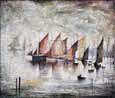
This
brings me on to the fact that Lowry loved painting the sea. In his more
Impressionist style, 'Fishing boats at Lytham' (Right, above), a pastel on paper
from 1915 depicts the sea and the sky, fractured centrally by a
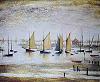
procession of boats with their sails raised high on the masts. 'Sailing
Boats' (Right, below), an oil on canvas painting is of similar composition which
uses lighter colours. However, in both pieces, there is the notable
omission of reflections in the water. This may link in with the fact
that, as I have previously mentioned, Lowry could not draw shadows.
However, his use of darker and lighter colours makes the boats stand out
from the rest of the piece. In 'Fishing boats at Lytham', the sea and
the sky are of a similar tone. Lowry distinguishes between them by using
an amalgamation of horizontal marks of similar colour to represent the
sea, and adds white swirls and flurries to represent the clouds in the
sky. |
|
|||||||||
|
'Fishing Boats at Lytham' |
||||||||||
|
|
||||||||||
|
'Sailing Boats' |
||||||||||
|
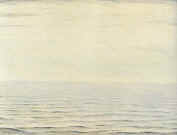
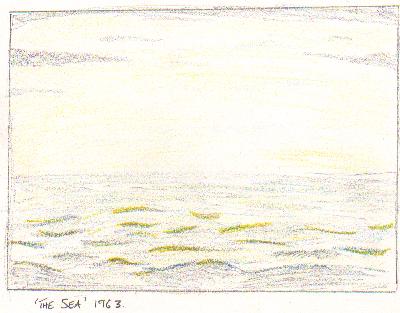
'Seascape'
(Below left) from 1960 is a simple representation of the sea as seen from
land. In it, Lowry has used the same technique as in 'Fishing Boats at
Lytham' to depict the sky, but has laid down a series of thick, dark
horizontal, wavy lines for the sea. Here, because of the difference
between the two styles and shades of light blue, there is a clear
horizon line. This is highlighted in the colour sketch I have produced
(Below centre), as is the number of wavy lines used to represent the sea. Later,
I will compare this piece to a similar painting by French Romanticist
Delacroix. |
||||||||||
|
||||||||||
| In his 1970 line drawing 'The Shark' (Above right), Lowry omits the sky, deciding instead to concentrate solely on the sea and the event, a smirking shark beginning to eat an unfortunate person who could have been out swimming, or fell overboard from his boat. Either way, although this picture is similar to 'Seascape' in that it depicts water and the sky separated by the horizon, it is not as detailed, and concentration is on the humour of the piece. | ||||||||||