|
|
|
|
|
|||||
|
Written critical studies of some of Lowry's works, with accompanying sketches and visual studies. |
|||||
|
|
|||||
|
Regent Street, Lytham | St Augustine's Church | The Fever Van | Back to Lowry's works index |
|||||
|
|
|||||
|
|
|||||
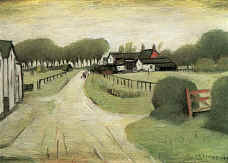
| 'Regent Street, Lytham' | |||||
| 1922, Oil on Canvas | |||||
| Lowry did not just paint town scenes with large chimneys, mills and hundreds of people walking around. Regent Street, Lytham (Right) is a good example of a Lowry rural scene. However, there are still buildings present in the distance, which form the central focal point of the piece. | |||||
|
Lowry
has tried to keep the colour scheme as true to life as possible, with
shades of green dominating the canvas, and mostly white buildings. As in
his oil on canvas piece Peel Park, Lowry has painted the
trees in the background by using a mixture of green, yellow and blue in
order to distinguish different shades according to where the light is.
The sky has been created by using mainly white, but there are highlights
of yellow and grey which help to create impressions of clouds. In
my water-soluble crayon interpretation of this piece, I have attempted
to recreate closely the colours, tones and techniques used by Lowry
using the same palette of vermilion, yellow ochre, flake white, Prussian
blue and black. |
|||||
|
|
|||||
|
|
|||||
|
|
|||||
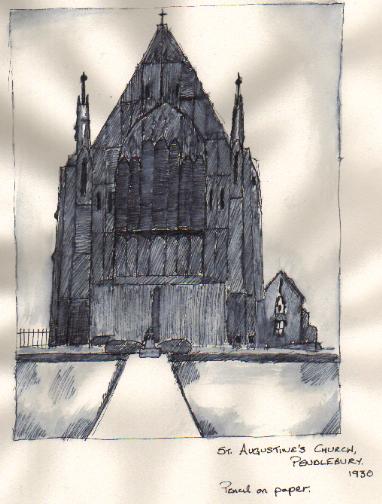
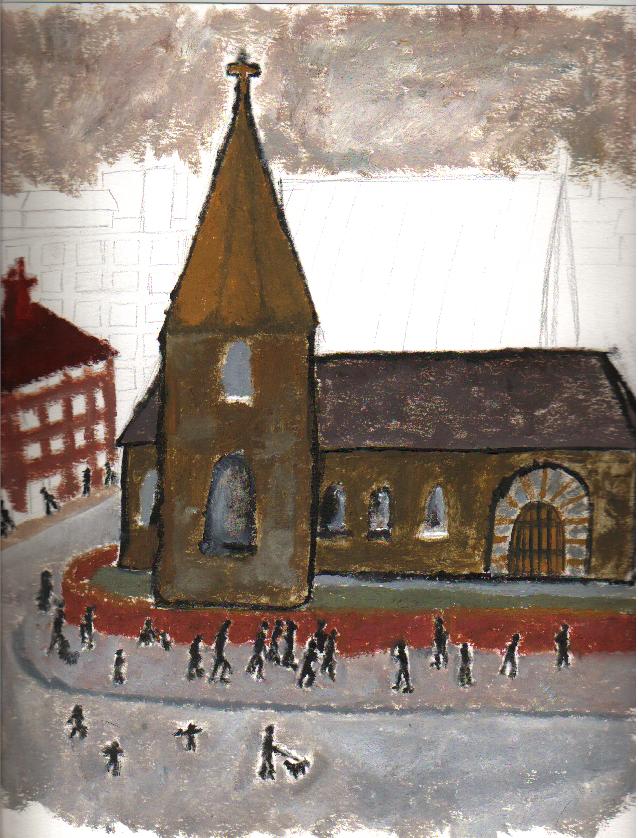
| 'St Augustine's Church' | |||||
| Pencil on Paper | |||||
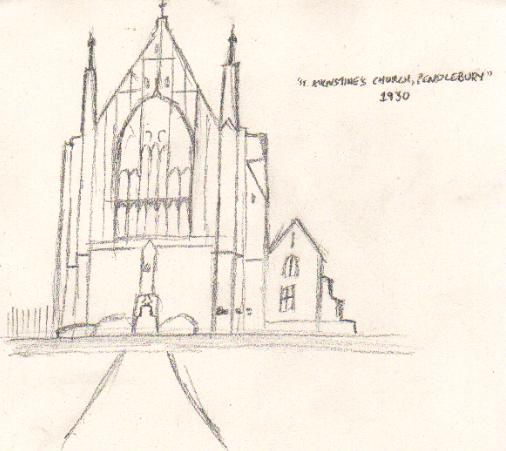
| This
pencil drawing is a good example of Lowry’s favourite medium –
graphite pencil. It also one of the many church sketches Lowry produced.
I have replicated this piece, only in fine line felt tip pen washed over
with water (right). I have aimed to recreate the different directions of
pencil marks with which Lowry has attempted to depict the various
textures of stone on the church walls, and the geometrically straight
lines which make up the outline of the building. However I could not
reproduce the grubby fingerprints with which Lowry presumably created
the sky in the same way as I could if used a pencil. |
|||||
|
This
pencil drawing is a good example of Lowry’s favourite medium –
graphite pencil. It also one of the many church sketches Lowry produced.
I have replicated this piece, only in fine line felt tip pen washed over
with water (Above right). I have aimed to recreate the different directions of
pencil marks with which Lowry has attempted to depict the various
textures of stone on the church walls, and the geometrically straight
lines which make up the outline of the building. However I could not
reproduce the grubby fingerprints with which Lowry presumably created
the sky in the same way as I could if used a pencil. ‡
“A
street without people is as dead as muck”
Lowry,
taken from the TV programme ‘Rolf on Art’, BBC programmes. |
|||||
|
|||||
|
|
|||||
|
|
|||||
|
|
|||||
| 'The Fever Van' | |||||
| Oil on Canvas, 1935 | |||||
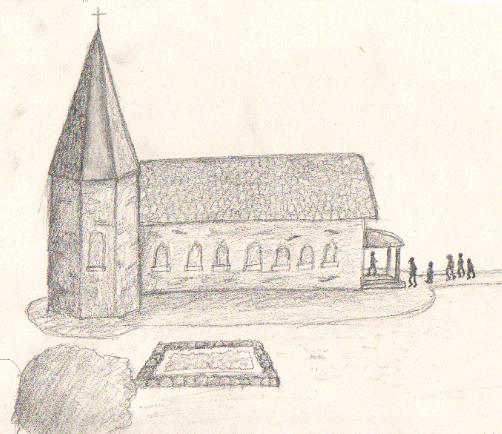
| Perhaps not one of Lowry’s most famous works, but typical of a Lowry street scene. Similarities with Street scene can be seen – the same vanishing point technique has been employed. Also, placed in the background is a church, and its faded colour ensures it is not the main focus of attention in the picture, though it is quite large. Attention is drawn to the hordes of people rushing around, and looking to see what is happening. | |||||
|
People
are coming out of their houses to catch a glimpse of this presumably
rare sight. Even today, when an ambulance appears in your street, much
attention is drawn to it, as it is not an everyday occurrence. However
in the time of Lowry when motorised transport was not as developed as it
is today, you would not expect to see an ambulance often. Present in the
picture are a number of chimney stacks filling the sky with smoke, as
you would expect from a Lowry picture. I
have viewed the original painting whilst it was on display at the Walker
Gallery in Liverpool, and have composed a brief sketch of it, showing
the positions of the buildings and people in the piece. |
|
|
|
|
|
|