|

 Home Home
Sacred
Hills
Tribal Info
Email Us

Calendar of Events
Lower Brule Counseling Services
P.O. Box 244
Lower Brule SD 57548
Office Hours
Monday - Friday
8:00am - 4:30pm
Program Director
Greg Miller
Phone
(605) 473-5584
Fax
(605) 473-9268
|
Chief Iron Nation (1815-1894)
Chief Iron
Nation led the Lower Brule Sioux Tribe through some of its most
challenging years. He worked diligently, both as a warrior and statesman,
to ensure the survival of his people. Iron Nation signed the treaty to
establish the Great Sioux Reservation in 1868. He has been described as a
just and noble leader.
The Lower
Brule Sioux descend from the Teton band of Lakota Sioux Indians. The Teton
band was the seventh nation of the original confederation of seven nations
that made up the Lakota. When the Teton band migrated west into the
Dakotas in the mid 1700s, it subdivided into seven tribes. One of these
seven tribes was the Brule.
How
the Reservation Came to Be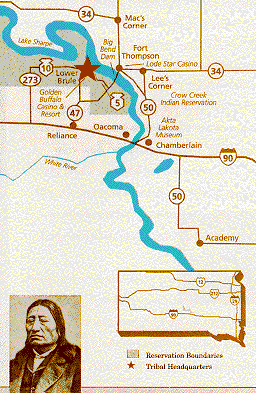
The Tetons
actively resisted the new settlers to the Dakotas only when they began
decimating the buffalo herds. The Tetons joined in what are known as the
Plains Wars.
The Fort
Laramie Treaty of 1868 ended the wars and established the
boundaries of the Great Sioux Nation Reservation. Under the treaty, the
Sioux were guaranteed that settlers would not intrude upon their land.
Eight years later the federal government confiscated most of the
reservation when gold was discovered in the sacred Black Hills.
The Brule
and other Lakota Sioux tribes were incensed, and the Plains Wars resumed.
Unlike the first Plains Wars, which ended in a military deadlock, the
tribes were soundly beaten in this second conflict. Many Sioux were pushed
into Canada. By 1890, the Lower Brule Sioux were relegated to their
greatly diminished reservation on the banks of the Missouri River.
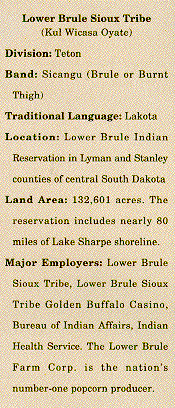 In subsequent years, the Lower
Brule Reservation was reduced to its current size of 240,000 acres by
various treaties and executive orders. Much of the remaining land was
opened up to homesteading. Many of the residents on the reservation are
white farmers and ranchers, who own 50% of the land within the boundaries
of the reservation. Though semi-arid, the land supports moderate farming
ventures, and the tribe owns several farms that produce navy beans,
potatoes, and the third-largest crop of popcorn in the nation. In subsequent years, the Lower
Brule Reservation was reduced to its current size of 240,000 acres by
various treaties and executive orders. Much of the remaining land was
opened up to homesteading. Many of the residents on the reservation are
white farmers and ranchers, who own 50% of the land within the boundaries
of the reservation. Though semi-arid, the land supports moderate farming
ventures, and the tribe owns several farms that produce navy beans,
potatoes, and the third-largest crop of popcorn in the nation.
The Missouri River establishes the eastern
boundary of the reservation. Historically, the Missouri's bottomlands
provided food, wood for shelter and fuel, forage for cattle and wildlife,
and plants utilized for medicinal purposes.
The Crow Creek Sioux Tribe lies directly across the Missouri River from
the Lower Brule Sioux Tribe. The creation of the Fort Randall Dam and the
Big Ben Dam flooded our respective reservations simultaneously, although
the Lower Brule Sioux Tribe lost more land.
The Golden Buffalo Casino, which serves as the anchor for a motel-resort
and convention-center complex, generates significant tribal revenues and
is the reservation’s largest employer. Other tribal programs employ 150
people, and the BIA employs over 90 people. Tribal members have
established a guide service that leads commercial expeditions for the
abundant hunting, fishing and water-sport activities that are available on
150-mile long Lake Sharpe. A tribally owned RV park and campground are
located on the lake.

~Golden Buffalo Casino~
The Lower Brule Sioux Tribe also
owns a retreat center in Meade County near Sturgis, South Dakota. The
property, known as Sacred Hills
Healing Center, was originally designed as a
treatment facility but is now being used for conferences, staff trainings
and retreats. Sacred Hills Healing Center can accommodate up to 26
guests. The property offers a serene setting with a fantastic view of Bear
Butte. |