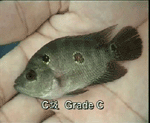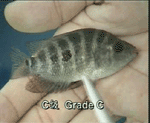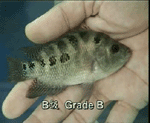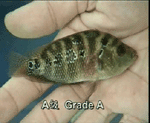



Grading
This is a simplified tips on how to grade a young Flowerhorn. Read on.

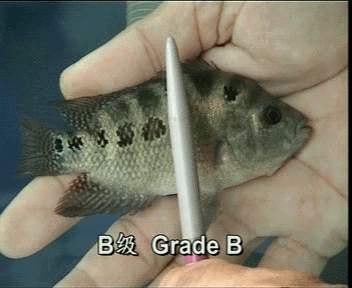
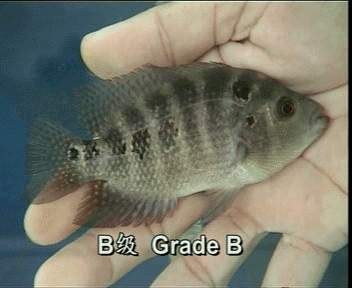
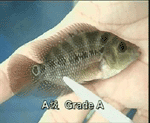
- Lateral flowers did not exceed centerr line
- Gold spots can be seen


grade a1
|
|
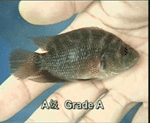
grade a2
|
|
grade a3
|
|
grade b
|
|
grade c1
|
|
grade c2
|
tank setup
A simple guidelines for first timers. In time you will develop your own preferred steps.Step 1. Choose a tank
It is solely up to you how big you want your tank to be. But make sure it's not
too small as to cramp your fish or too big if you are only housing one fish. A
simple 1.5 feet (for one occupant) or 2.5 feet with partition (for two
occupants). Suitable for Flowerhorn around 1.5" to 3".
Step 2. Cleaning your tank
Wash your new tank with clean water, then fill it up with water before adding
salt to it. This is to get rid of any left over chemical on the tank during the
building phase. Leave it overnight to check for leakage if there's any.
Step 3. Tank location
Place your tank on a strong support. Remember to place a layer of styrofoam
under the tank which will help sustain the pressure and prevent cracks. Do not
place your tank in direct contact with sunlight as it will promote rapid growth
of algae.
Step 4. Water quality
One of the most important thing in keeping your Flowerhorn healthy is the water
quality. Make sure you add anti-chlorine and salt to the water during every
water change. Afterthat, add in benificial bacteria (solution can be bought at
any local fish shop)into your tank, they will help in breaking down ammonium and
nitrate. Leave the tank for a minimum one day to let the bacteria multiple. PH
level should be maintained around 6.8 to 7.5. It would be best if you have a
water heater if the tank is in an air conditioned room. Preferred temperature
would be 28 C. A good filter system is important as well, make sure you consult
with your local fish shop owner on which filter/pump suits your tank size.
That's it! You are ready to introduce your Flowerhorn to your house!
Cleaning your tank
For many newcomers to the hobby there are many problems that arise from not cleaning your tank correctly. Read on.Cleaning an empty tank.
Luke warm water should be used. The only cleaning fluid I would recommend is
Formalin which is a disinfectant and is more commonly used for skin infections
on fish. Scrubbers such as an old pair of tights or a plastic (brillo type) pad
is also good at cleaning the glass. After the clean, rinse thoroughly.
A routine clean is normally carried out every few weeks depending on size of tank, size and type of filter and how many fish are kept. The routine clean is mainly to remove any waste products lying on the bottom of the tank, a quick filter clean and a 20% water change. Firstly remove the water from the tank. To do this it is common to use a peace of hose (Solely for your fish) and a bucket or if your tank is high enough a hose that will reach the sink to save any lifting. Syphon the water out of the tank into the bucket, remember the water may syphon out at a fast rate and you do not want to take to much out as this will cause havoc with your water chemistry. When your bucket is 2/3rds full unplug your filter and take out the media, use your old tank water to clean the media (rinse the media lightly in the bucket were not going for overkill), thus not killing any of the friendly bacteria. Place the media back into the filter and switch back on (only if the water level is not below the manufactures recommended level). If needs be, fill another bucket and empty until you are at your desired depth (I would recommend only removing 20% of the water for a routine clean). At this point it is best to clean the glass if there is any algae growth. Use tights, soft cloth etc. Remember don't use items from your household cleaning tools. At this depth there will be less chance of you spilling the water when your hand is splashing about in the tank. To fill the tank back up make sure the water has been treated with a dechlorinator and has reached the approximate temperature of your tank. To fill pour it through a colander, or onto a plate to stop the substrate getting disturbed.
A major clean involves a bit more thought. This is where you get to clean and move your décor and your plants if you want. We also clean and service our filters if needed and our gravel. We must remember one or two things before we start, we must remember that if we clean everything in the tank at the same time we will not only remove the waste products but also the helpful ones as well. By this we mean the bacteria responsible for the nitrogen cycle. We must remember that these bacteria not only live in the filter but they also live on the décor and on the gravel and if we clean everything at the same time there will not be enough bacteria to do the proper job. We then have big problems with New Tank Syndrome i.e. ammonia or nitrite poisoning.
A regular water change is advised with the extras of a major clean. We therefore have to decide is the filter really needing cleaned or is the gravel, never do them both together. If you decide the gravel needs cleaned which should not be very often especially if you have real plants then you could try a cleaner that looks like a plastic bottle on a piece of plastic pipe, this works by siphoning water through it and allowing the gravel to swirl inside the bottle and then drop down again while the mulm is removed. The filter should only be cleaned in water that has been removed before hand from the tank and never washed under a running tap or with detergent of any type. If you have a sponge filter it should look brown, you only want to unblock it not scrub it. If you have different filter media (wool, carbon, etc.) Then you should only replace the dirtiest bits never replace the whole lot. By doing these things you will preserve a lot of bacteria and stop your tank from becoming over stressed and your fish from dying. I hope these few words will help you on your way in this interesting and very rewarding hobby.
Article by TropicalAquariums.co.uk
fish diseases
All aquarium fish carry with them a variety of pathogenic bacteria, fungi, and parasites. The aquarium itself also harbours many pathogenic organisms. When fish are healthy, well fed, and have the proper water conditions, their immune system is strong and easily able to fight off these disease organisms.Many parasites cannot tolerate heat or salt, which makes these two treatments alone highly effective. Fresh water ensures contaminants in the aquarium are removed or diluted.
Isolating the fish protects it from tank mates that chase or harass it. If the fish dies, isolating it will also prevent other fish from eating the carcass, and possibly contracting the disease. Treating only the affected sick fish with medication will reduce stress levels on the healthy fish. The cost and ease of treating and maintaining a smaller tank is preferred over treating an entire large tank.
A hospital tank does not require much. A simple 5-10G tank with a heater and air stone will do fine. No plants or decorations are required. Having a cycled tank is also not required since water changes should be done on a daily basis while treating the fish.
Follow directions very carefully and observe your fish closely while treating them. Many medications themselves are toxic to fish, and can do more harm than good even when used as directed.
Removal of the activated carbon from your filter is sometimes necessary when using medications in order to prevent diminishing the effects of the chemicals. The carbon filter media can be replaced once the medication is no longer needed.
Anti-bacterial medications should not be used unless infestations are clearly visible on the fish.
Mouth Fungus/Saddle Back Disease
Cause: Flexibacter Columnaris is a common bacteria found on the
slime coating of fish.
Appearance: Although commonly called mouth fungus this infection
is really a bacterial infection. The bacterial colonies form raised greyish
patches on the fins and mouth area of fish. Live bearers such as Guppies and
Mollies develop greyish patches on their back giving rise to the name
"saddle back disease". The infected areas may develop into red ulcers
and also infect the gills causing rapid loss of fish.
Treatment: Treat with an anti-bacterial medication as directed.
Ich, Ick, White Spot Disease
Cause: Ich is caused by the external parasite Ichthyophthirius.
Appearance: This microscopic parasite has a multi-staged life
cycle and is invisible during its ineffective theront stage. Theront burrow into
gill and skin tissue causing severe electrolyte loss, gill damage, and secondary
bacterial and/or fungal infections. The theront matures forming the
characteristic cyst or white spot. This white spot or trophont will fall off the
fish, mature and release up to 2,000 free-swimming tomites which re-infect the
fish. Fish will exhibit laboured breathing and may remain at the surface of the
aquarium near filters and aeration devices. White spots may not be visible.
Early symptoms include darting in the aquarium and scratching against gravel and
ornaments.
Treatment: Raise the water temperature to 32C for 10 days. The
parasites can only be killed while they are in the free-swimming tomite stage,
before they attach to a fish. Raising the temperature speeds up the life cycle
of the parasite bringing the parasites to the treatable tomite stage. Use a
commercial ick medication containing malachite green oxalate as directed.
Hole in Head Disease
Cause: Hexamita and/or Spironucleus parasites infect the
intestinal tract of many tropical fish especially cichlids.
Appearance: The most obvious symptom is the pitting and erosion of
skin and muscle tissue around the face of the fish. The erosion of the tissue
appears to be a symptom of the parasite in the intestine - not on the surface of
the fish itself. Many fish simply show poor appetite, weight loss, nervousness,
and ultimately death.
Treatment: For mild attacks, use a general anti-parasite
medication as directed with a vitamin rich diet. For more severe attacks,
obtain gabrocol or metronidazole from a veterinarian.
Fish Lice
Cause: The Argulus parasite walks about on the outside of tropical
fish and goldfish, piercing the skin and sucking blood and tissue fluids.
Appearance: Argulus is easily identified by it's round flat shell.
The parasites often can be seen moving about on the fish. The piercing mouth
part damages the skin leading to secondary bacterial and/or fungal infections.
Treatment: Raise water temperature to 32C. This will speed up the
life cycle for the parasite thus enhancing the treatment process. Use a
general anti-parasite medication as directed.
Anchor Worms
Cause: Lernia are copepod parasites that attach to the body of
tropical fish, goldfish, and Koi. Fertilized female Lernia penetrate the skin
and embed an anchor-like attachment into the fish while developing visible egg
sacs. Gryrodactylus worms attach to the skin of tropical fish via hooks and suck
blood and body fluids.
Appearance: Lernia can easily be identified as a greyish worm
attached to the fish with two egg sacs at the opposite end. Tissue is often red
at the point of attachment. Secondary bacterial/fungal infections may occur.
Skin flukes are not visible without the aid of a microscope. Fish will scratch
against objects in the aquarium and appear listless. A greyish film may form on
the body. Secondary bacterial/fungal infections are common.
Treatment: Use a general anti-parasite medication to the aquarium
as directed.
Neo Tetra Disease
Cause: Plistophora hyphressobryconis is a microsporidian parasite
capable of infecting all tetras, angelfish, barbs, and rasboras.
Appearance: Parasites infect the muscles of the fish resulting in
loss of color and a deformed appearance of the fish. Fish loss can be high.
Treatment is not always successful.
Treatment: Use an anti-parasite medication as directed.
Fin and Tail Rot
Cause: Several bacterial infections can cause degradation of the
fins and tail of tropical fish, goldfish, and Koi. Pathogens include Flexibacter
columnaris, Nocardia, Mycobacterium, and Pseudomonas species.
Appearance: Fins appear ragged and split. Disease can progress
completely eroding fins and tail to the body of the fish. Secondary fungal
infections commonly occur.
Treatment: Treat with an anti-bacterial medication containing
furazoldone as directed.
Dropsy and Malawi Bloat
Cause: Internal Aeromonas bacterial infections are the most common
causes of this disease. Viral and internal parasitic pathogens (Mitaspora
cyprini) have also been indicated but are untreatable.
Appearance: Fish develop a bloated appearance due to build-up of
fluid in the body cavity. Scales may appear to stick out from the sides of the
fish. In advanced cases goldfish lose ability to swim and float upside down.
Treatment: Treat with a medication containing furazolidone as
directed.
Eye Cloud, Pop Eye, Body Slim
Cause: Bacterial pathogens include Pseudomonas, Mycobacteria, or
Streptococcus. Parasitic pathogens include Ichthyobodo, Trichodina, and
Chilodinella.
Appearance: Eyes develop a whitish haze and/or protrude from the
head. Fish's body develops hazy or slimy patches on the body. If parasitic, fish
may scratch on objects in the aquarium and exhibit rapid breathing.
Treatment: Treat with a anti-bacterial medication as directed.
Furunculosis
Cause: Aeromonas species are responsible for this common bacterial
infection.
Appearance: Fish exhibit open red sores on the body.
Treatment: Treat with an anti-bacterial medication as directed.
Fungus Infection
Cause: True fungal infections are caused by Saprolegnia and Achlya
species.
Appearance: True fungal infections appear as whitish cottony tufts
or patches on the mouth, skin, and fins of tropical fish, goldfish, and Koi.
Treatment: Use a general anti-fungal medication as directed.
Bacterial Gill Disease
Cause: Bacterial gill disease is caused by Pseudomonas species
bacteria.
Appearance: This disease is difficult to accurately diagnose
visually. Fish may breath heavily and show bright red gills. Fish may sit on the
bottom of the aquarium or near filter returns at the water surface.
Treatment: Treat with an anti-bacterial medication as directed.
Velvet
Cause: Velvet is caused by parasitic Oodinium species.
Appearance: Parasites on the skin cause a golden velvety
appearance on the sides of the fish. Gills are also attacked causing laboured
breathing and scratching on objects in the aquarium.
Treatment: Raise the water temperature to 32C for 24 to 36 hours. For
fish that cannot tolerate such temperatures, treat with a general anti-bacterial
medication as directed.
Bacterial Hemorrhagic Septicemia
Cause: Pseudomonas, Aeromonas, or Streptococcus species of
bacteria.
Appearance: Fish show blood streaks in the fins and body.
Treatment: Treat with an anti-bacterial medication as directed.
Subclinical Parasitic Infestation
Cause: Tricodina, Ichthyobodo, and Chilodinella, are protozoan
parasites that infect the skin and gills of the fish.
Appearance: Fish may simply scratch on objects in the aquarium or
develop sliminess of the skin or laboured breathing.
Treatment: Treat with a general anti-bacterial medication as
directed.
The above act as a simple guidelines only, always seek advice from your experienced local fish shop owner or pet veterinarian.
Article by Phil Edison.
Breeding Louhan
This is the #1 topic which a lot of Flowerhorn hobbyists are asking. Information are largely compiled based on experience gained by fellow hobbyists. Read on.1. Female is ready
Matured female Flowerhorn have a higher chance of breeding and the eggs have a
higher chance of survival. Depending on which breed, usually a female Flowerhorn
will be fully matured by 4-7 months. Immature females will usually eat the eggs
before they are hatched.
2. The sign
When a female Flowerhorn is ready for breeding you will notice the color on her
body will be very intense and normally black stripes will also appear. Their
breeding tube (U-shaped)will be more visible as they are getting ready to lay
their eggs.
3. Preparation
Remove all pebbles and stones from the tank. Put in airstone for aeration, if
you have a powerful pump try to switch it to minimal or switching it off
totally. You do not want your eggs flying all over the place! Put a clay tray
(big and flat type) in your female's tank, hopefully the female will lay her
eggs on it as it also prevents the eggs from being scattered around the tank.
4. Introducing the male
Do not introduce a male directly, place them together with a partition. Let them
see each other for a day or two. Do make sure your male Flowerhorn is slightly
bigger or 1/2 the size of the female. Smaller males will suffer violent attacks
and may result in unsuccessful breeding.
5. The moment of truth
Remove the partition and observe closely. Quite frequently both fishes will
fight and will suffer losses of scales and suffers minor body and mouth
injuries. But you have to make sure they can get along after an hour or two.
Continuous fighting and you will have to remove the male and introduce another
male. Once they seem to have settled down, use a dark cloth (preferably black)
and cover your aquarium and set the lighting to minimal (hey! they need privacy
too!)
6. Spot check
Carefully do a spot check on them, see if they have successfully breed. Breeding
usually takes a few hours, from egg laying to fertilization. After
fertilization, gently remove both male and female from the tank and put them in
separate tanks.
7. The eggs
Do not remove aeration from the egg tank. Upon successful fertilization, the
eggs will hatch within 3 days time. There's no need to feed them immediately as
they will feed on their sac which contains enough nutritions to last them 2-3
days. By then you will need to feed them.
8. Feeding time
Fries must be fed daily but do not pollute the water with too much unconsumed
food. Feed them with brine shrimps, daphnia, or even egg york (water will be
cloudy). You can also buy Liquidfry from your local fish shop and feed it to
your new born fries.
That's all! All the best!
If you think we have missed something or would like to add something into this article please do not hesitate to email us at [email protected]