Optimization Of Functions [cont.]
ROLLE'S THEOREM
The Mean Value Theorem has proven to be a tremendously important idea in mathematics. Rolle's Theorem is a modification of that theorem.
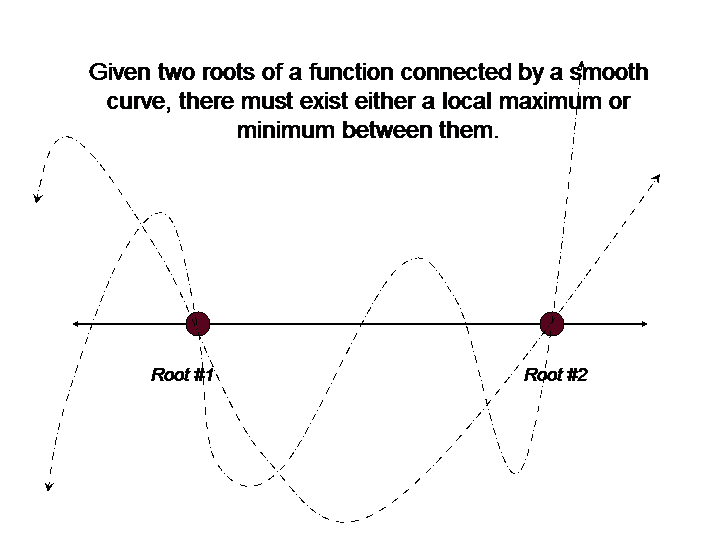
Connecting the roots with a continuous curve means that you must draw at least one max or min point between them. There certainly could be more than one such point - Rolle's Theorem states that at least one will exist.
These local extreme points occur when the slope is zero - the tangent line drawn to these points is horizontal.
QUESTIONS TO CONSIDER
- On the functions above, draw in each horizontal tangent line - indicate whether each point is a local max or min.
- If between two roots are both a local max and min, must there be another root in the interval? Why or why not?
- By translating a function up or down does it have an effect on the number of possible roots? Does it have an effect on the number of possible local extreme points? Explain.
DETERMINING POINTS OF MAXIMIZATION
One of the important uses for Calculus is to determine maximum and/or minimum points of functions. Companies that invest in the stock market employ statisticians whose job it is to "fit" a function to the short-term behavior of an investment and then determine low points [buy, buy, buy] or subsequent high points [sell, sell, sell].
Optimization means being efficient - getting the most, paying the least - which is why determining these points is so important.
Start with an 18" by 24" piece of aluminum sheet metal. From each corner, equal square pieces will be cut out and the sheet be folded into an open-topped box.
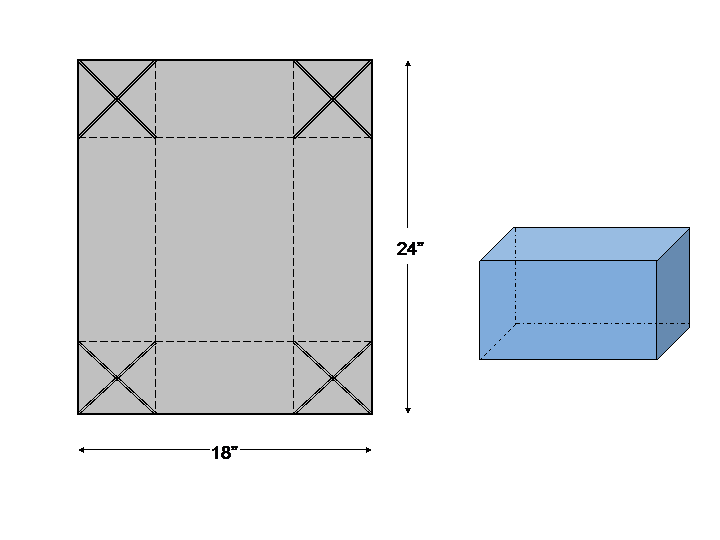
Which dimensions would maximize the volume of the box? What square, when removed from each corner, will produce a box having more volume than any other?
Once we determine the function with which we're working, what do we look for?
**A change in direction of the graph
**Finding where the slope of the function equals zero
**Fitting a horizontal tangent line to a point
**Values increasing, then decreasing in our table
All of these indicate a critical point in the function, likely to be either a local maximum or local minimum.
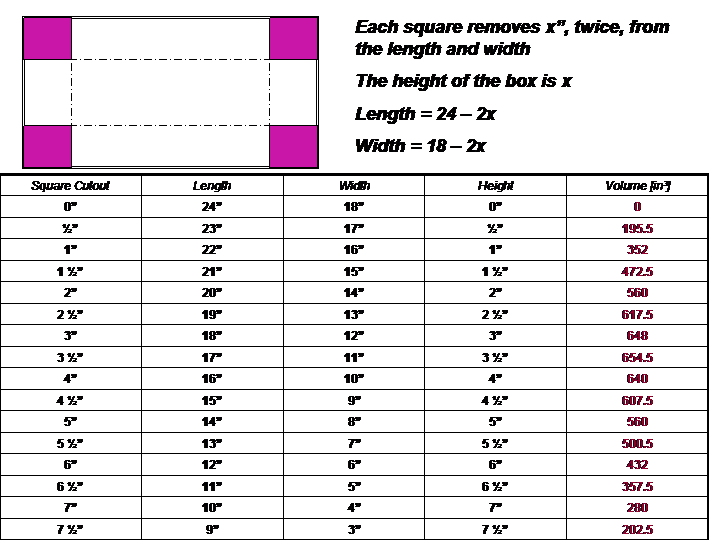
Let's determine the volume of several different boxes:
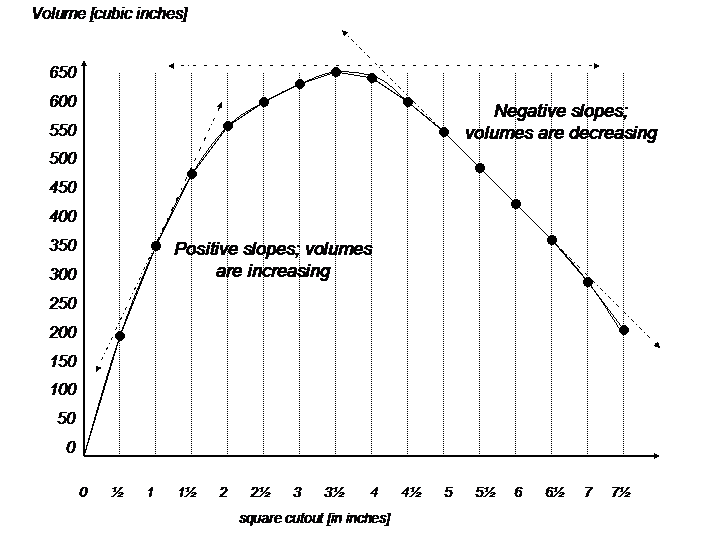
At the critical points of a function, the rates of change reach zero. In order to cross from positive to negative, a zero value must occur at some point. If the curve is that of a polynomial function, this point is called a vertex.
QUESTIONS TO CONSIDER
- According to the table, what is the maximum volume of the box?
- Which of these dimensions represents the change in x? the change in y?
- Show the maximum volume by indicating the point at which the slope changes direction.
OPTIMIZATION IN PLANE AND SPATIAL FIGURES
Important relationships amongst area, perimeter, volume and surface area are nicely explained in terms of optimization. These relationships allow companies to design products and packaging that minimize costs and maximize revenues.
Let's look at relationships among plane figures given a fixed perimeter:
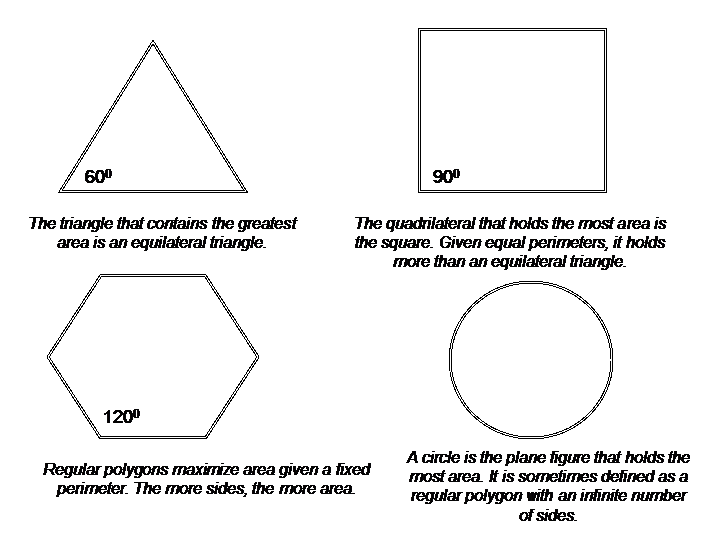
Now let's examine the relationships among space figures given a fixed surface area:
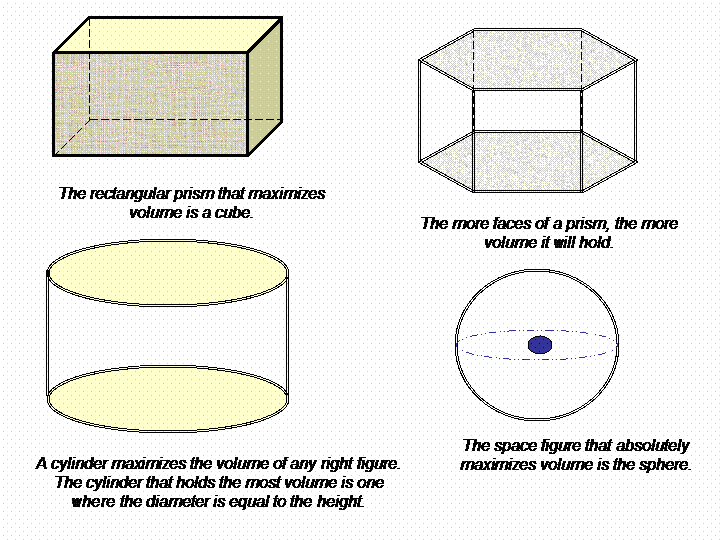
QUESTIONS TO CONSIDER
- Given 12" of perimeter, calculate the area contained by the following figures: an equilateral triangle, a square, a regular hexagon, a circle
- If the sphere is most efficient, why aren't more products packaged that way?
- Starting with a piece of sheet metal 24" by 14" and cutting squares from the corners, what's the maximum volume the box will hold?
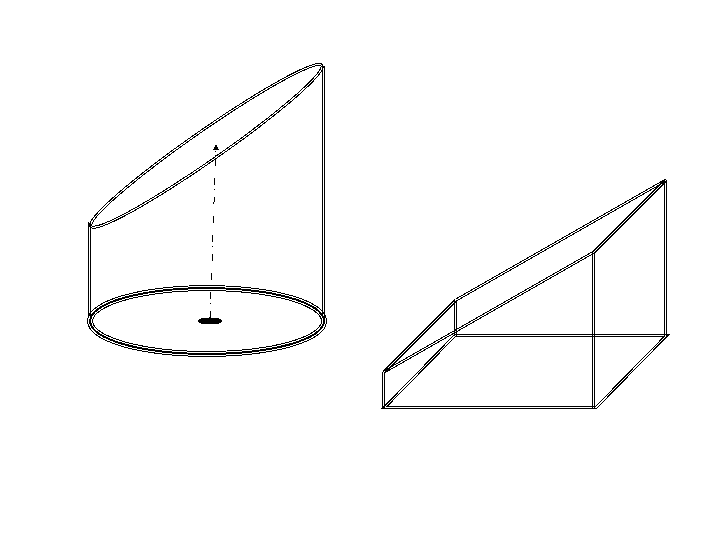
- If the figure was NOT a right figure [such as pictured below], would it hold more or less volume given a fixed surface area? Explain
click here to move on to Techniques Of Graphing
go back to the main page