OPTIMIZATION OF FUNCTIONS
click here to enjoy the Optimization Of Functions word search
We're at Fenway Park in Boston - the Red Sox are playing the Yankees. There are two outs in the bottom of the ninth - the Yankees lead 5-4 but Johnny Damon is on first and David Ortiz is at the plate. He takes a 3-2 pitch and sends it rocketing upward at 92 feet per second and outward at 76 feet per second. The bad news, however, is that the ball is heading towards the deepest part of the ballpark and Bernie Williams is playing center field for the Yankees.
So how does the game end? Or does it?? Does the ball clear the wall - a monstrous 420 feet away? Does the ball nestle into Bernie's glove giving the Yankees the victory and sole possession of first place? Or does the ball bounce off the wall, scoring Johnny and making extra innings a possibility?
Once we figure out the flight of the ball, we'll graph it - then we'll know...
Author's Note...
I realize that Johnny has departed the beloved Sox for the Evil Empire - and it's still a matter for the higher powers that guide baseball to decide the fate of that situation. However, Johnny will always be THE Red Sox centerfielder for many of us and I prefer to remember him just like that...
First, let's look at the ball's upward flight - a flight affected by gravity. Gravity's downward acceleration is 32 feet per second per second. The equation to calculate the height of a projectile at time t is
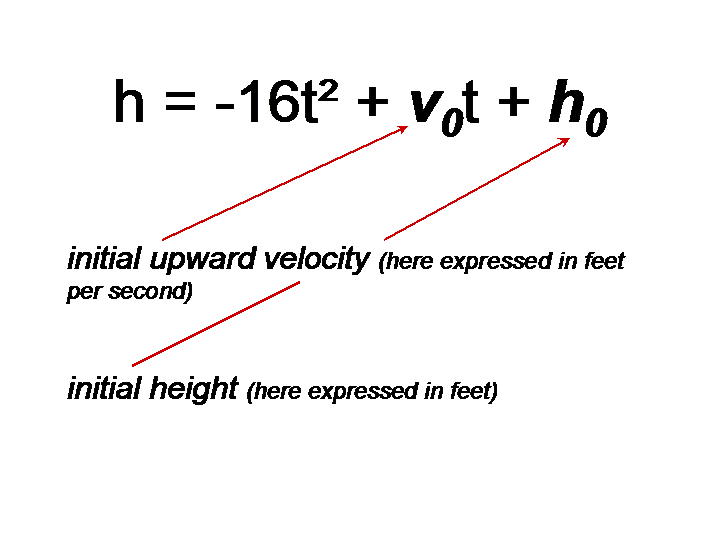
So let's see how long this ball stays in the air. Since the initial upward velocity is 92 feet per second, we substitute 92 in for V. We'll assume the initial height is zero....
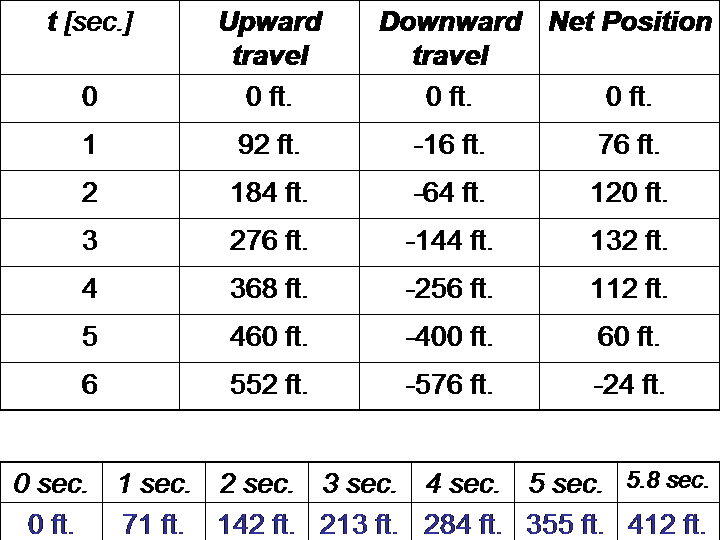
The first table tells us that the ball will hit the ground somewhere between 5 and 6 seconds. We could solve the quadratic equation to get a better answer, but it's pretty clear we're in the neighborhood of 5.8 - 5.9 seconds.
The outward velocity is 76 feet per second - however, air resistance is likely to reduce that by about 5 feet per second, so every second the ball remains airborn it will travel 71 feet further. The second table illustrates the ball's outward flight.
Plotting the flight of the ball produces the following graph:
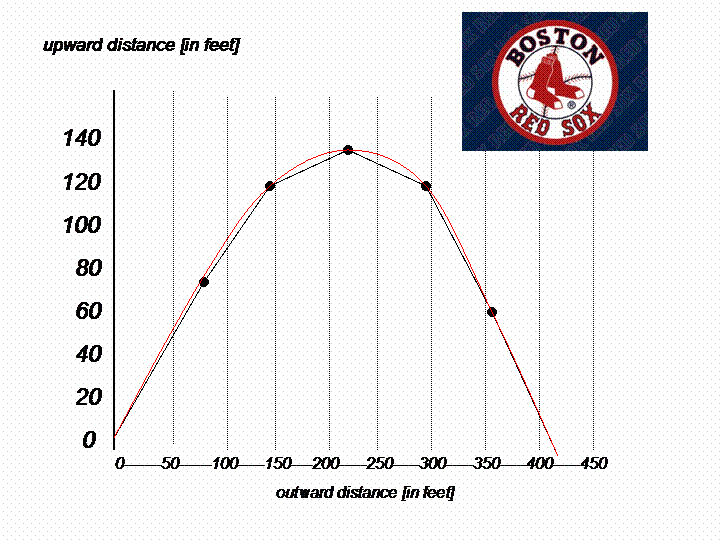
Hit to the deepest part of Fenway, it wouldn't clear the wall. Sox fans will certainly say it would be over Bernie's head for an easy double. Yankee fans will have Bernie playing deep, making an over the shoulder catch to end the game...
LOOKING FOR CHANGES IN DIRECTION
So what does a ball hit by David Ortiz have to do with Calculus? Plenty. When a function reaches a critical point, it has a slope of zero. In this case the ball stopped going up and started coming down - its upward velocity was zero.
Changes in a function's direction are shown by horizontal tangent lines.
Let's take another look at the ball's upward/downward flight, this time with more intervals in our table:
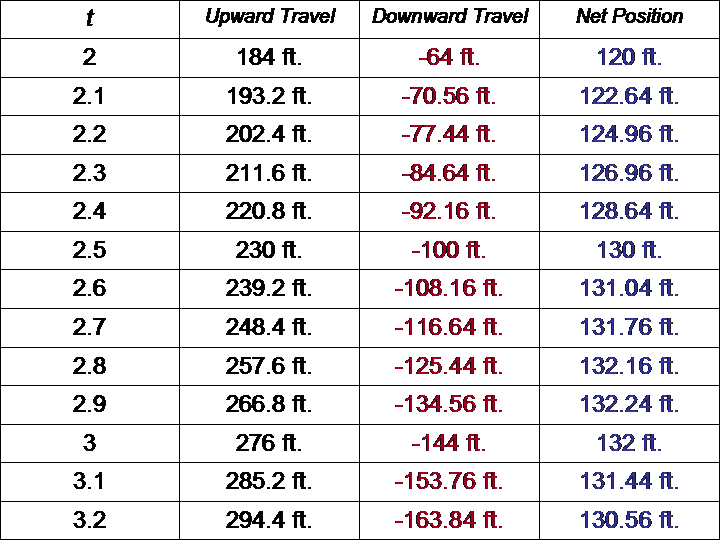
A change in direction happens around t = 2.9 to 3.0 seconds; the ball's height is less than it had previously been. This marks the first time interval where this happens. If we reconfigure our chart, we can look at this in terms of slope:
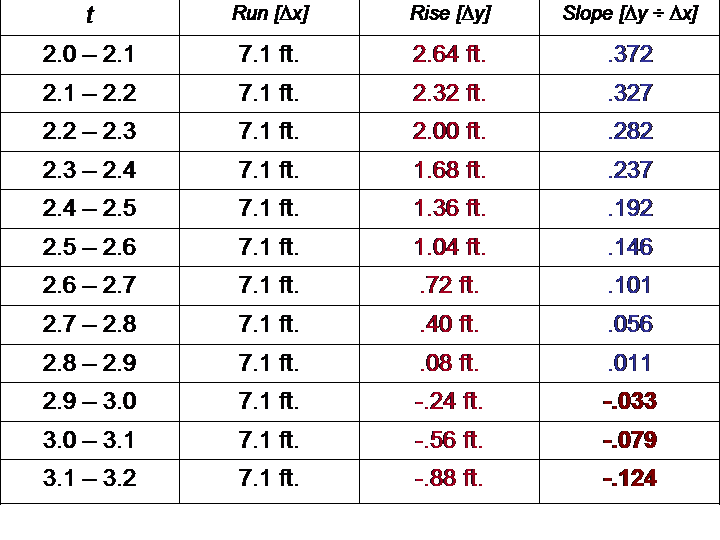
Changes in direction indicate critical points in the function. At these points, a number of things could happen:
The function could reach a high point, or local maximum
The function could reach a low point, or local minimum
The function may reach a change in concavity, or point of inflection
continue with this section
go back to the main page