 |
|
| The "Great South" The Nguyen Empire of Vietnam |
 |
 |
|
|
 |
 |
 |
|
| The Last Emperor Bao Dai The Rebel Emperor Ham Nghi Review of the film Indochine Emperor Khai Dinh The Ly Emperor Cong Uan The Catholic Empress President Ngo Dinh Diem How Vietnam Was Lost |
| The "Bao Dai Solution" Royal Vietnamese Culture Why Vietnam? The Fall of the Monarchy Emperor Dong Khanh My Website on VietMonarchy |
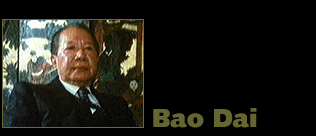
| Vietnam has a very long and fascinating history, and one which is dominated by a constant circle of being invaded, conquered and enslaved, followed by a period of rebellion, liberation and reestablishment after which comes an era of strength and prosperity only to be followed by some disaster and foreign invasion at which point the cycle begins again. For centuries this struggle almost always involved China, Vietnam's massive northern neighbor. At times Vietnam was a conquered province, at other times an independent vassal of the Chinese Emperor. Ultimately, however, the Vietnamese always managed to drive out the Chinese, and once even defeated an invasion by the seemingly unstoppable Mongols under the Yuan Emperor of China, Kublai Khan. The height of Vietnamese glory came during the long reign of the Le Dynasty. At various times Vietnam controlled all of modern day Vietnam as well as Laos, Cambodia and parts of Thailand, becoming the most powerful nation in Southeast Asia and known around the world for her wealth, learning and civilization. However, such glory always proved fleeting. The last Le Emperor, Le Chieu Tong, was overthrown by the Tay Son Rebellion and the effort by the Qing Emperor to restore him was the last invasion of Vietnam by the old Chinese Empire. A period of division ensued as Prince Nguyen Anh tried to overthrow the Tay Son who had wiped out his family. Prince Anh was first aided by the Siamese who invaded Viet-Nam on his behalf, but were defeaed. He then turned to the French Catholic Bishop Pierre de Behaine. With his help Anh succeeded in defeating the Tay Son and in 1802 founded the Nguyen Dynasty reign, proclaiming himself Emperor Gia Long. Vietnam seemed on the brink of a new era of greatness, but there were many peasant revolts and French influence continued to grow. When subsequent emperors began to harshly persecute the Christians and missionaries in Vietnam the French intervened and slowly conquered all of Indochina. Emperor Tu Duc made peace with them, but a succession crisis followed his death with three emperors coming and going in one year. The Nguyen accepted French rule rather than be overthrown and an uneasy truce followed as Indochina became a French colony. When Emperor Ham Nghi resisted, he was replaced by Emperor Dong Khanh who knew when a battle was lost. He was followed by the mysterious and possibly psychotic Emperor Thanh Thai, who was deposed in favor of his son Emperor Duy Tan. When the youth became rebellion he and his father were exiled to the Indian Ocean. After this fiasco, the next Emperor, Khai Dinh, cooperated with the French, even sending his son to be raised and educated in France. The last Emperor of Vietnam, Bao Dai, tried to turn his country into a modern constitutional monarchy but was thwarted at every turn and lacked the strength of character to lead a popular movement. Another effort was made during the Japanese occupation but proved futile. In 1945 Emperor Bao Dai abdicated to the Communist government of Ho Chi Minh, which he served for a time as "Supreme Advisor" before going into exile. In 1948 the French restored Bao Dai as "Head of State" but gave him girls and money instead of a role in policy-making. Staying in France rather than the turmoil of South Vietnam he was easily removed again in 1955 when South Vietnam became a republic under President Ngo Dinh Diem. The Communists eventually drove out the French as well as the U.S. and continue to rule Vietnam to this day. |
 |