 |
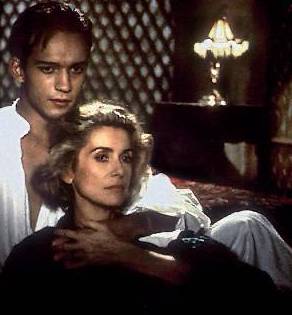 |
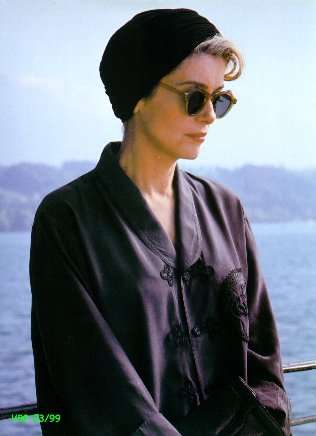
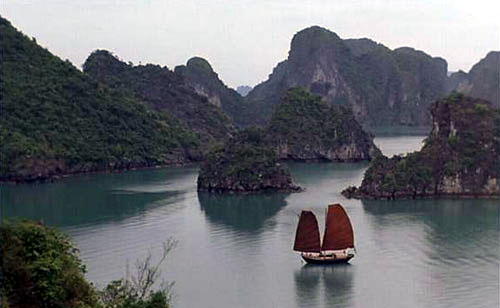
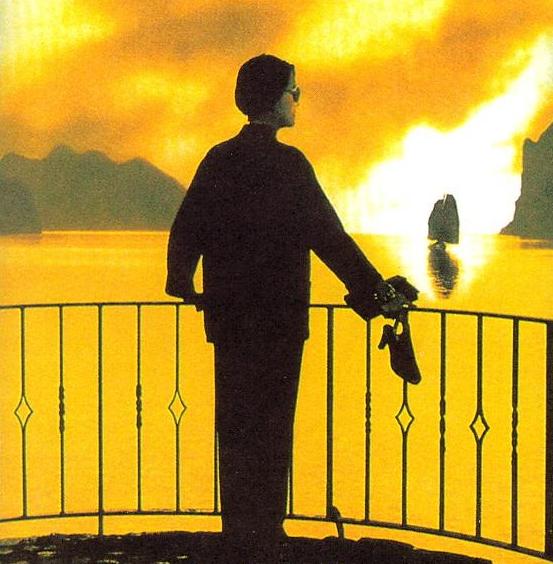
| Let me be perfectly blunt: if you don't think this is at least a visually beautiful move, there is something seriously wrong with you. The story is the sort of personal drama set against political turmoil that may not captivate everyone, but if the images on the screen of Vietnamese waterfalls, mountain pagodas and Ha-Long bay don't make you applaud then nothing will. Sadly, I know too many people in this country who would turn it off as soon as they realized everyone is speaking French. (mon dieu!) The actors all do their jobs flawlessly. Vincent Perez (the heart-throb of the film) is excellent although most Americans have probably never heard of him. Better known is the star Catherine Deneuve, who some reading this will probably remember from at least Mayerling and the White Queen, who is just as glamorous as ever. Yet, |
 |
 |
 |
| "Indochine" |
| the real 'find' in "Indochine" is Pham Dan Linh, who, to my knowledge, has only been in two major films. Even with Deneuve as the center of attention, it is Pham and Perez who come through with the most dramatic scenes. The story follows the wealthy rubber plantation owner Eliane Devries, a French woman who has never been to France but spent her entire life in Vietnam, aka French Indochina. She considers herself Indochinois rather than French. Her story is taking place at the same time that |
| colonialism is ending and the Vietnamese Communist Party is gaining ground. It is Eliane (Deneuve) who, in her own life, represents to us the French colonial system. After the death in a plane crash of two close friends, she adopts their daughter Camille, a Vietnamese princess played by Linh Dan Pham, and raises her as her own. Family life is thrown into chaos by the arrival of a French naval officer (Perez) who unwillingly makes things very complicated for the Devries house. Eliane portrays the French colonist by being able to be both a nurturing mother to an Indochinese daughter, who also has no trouble taking in hand the flogging of a worker who tries to run away. She is also totally involved in her own affairs and quite oblivious to the rising |
| tide of anti-French sentiment. Camille is very representative of the traditional Vietnamese elite. She has been raised in a mixture of French and Vietnamese cultures, and is totally unaware of the plight of many of her people until a trek across country reveals the massive exploitation of her countrymen. Jean Baptiste is introduced to us as a no-nonsense, by-the-book officer who refuses to let emotion cloud his judgment. Needless to say, through the course of the movie it gets very clouded. Through the supporting cast we also get to see a glimpse of colonial society in French Indochina, the hopeless task of security given to the colonial police force and the imperial court at Hue which is divided between fighting the French and remaining loyal to their ancient ways. |
| Camille is set to marry a royal cousin, but despite his status he was expelled from school in Paris for anti-French activities. We see how well developed the Communist network was in Vietnam, and the way they were able to manipulate the circumstances to gain power. One thing I really like about the shadow political side of "Indochine" was the fact that, despite all of the arguments made by both sides today, we see in this film that people in Vietnam became |
| Communists be default rather than ideological loyalty. As I believe to have been most often the case, the VietMinh gains strength, not through genuine popularity, but by being percieved by so many as the only game in town. |
| Ultimately, as with any realistic film dealing with Indochina, there can be no really happy ending in the traditional sense. In this case, the best you can hope for is to lose as little as possible, but you know you will lose something. For Eliane, she was faced with the curse of hindsight, looking back at all of the opportunities she missed and all of the warnings she took no notice of. Even coming from France this film naturally does not take a favorable view of the colonial system, nevertheless we can still see the tragedy of the case. Not every French colonist in Indochina was a ruthless exploiter, yet they all had to leave the only country many of them ever knew when the VietMinh took over. Likewise for the Vietnamese, even when independence came, sorrow and hardship were not to disappear for a very long time to come. |