
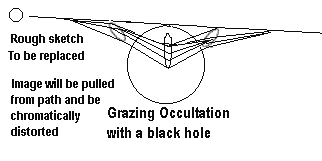
Here is a simple experiment. Step 2
Is there any resemblence?
Step 3.
Having done that, with a reasonable art program (paint Shop Pro), adjust the colour saturation
and colour density, or push the histogram to the maximum, so that the white centre becomes
a black hole.
This experiment shows that what is seen in print, may not be true in Nature. Any image can
be treated to appear as something quite different and perhaps unexplainable. The same can be achieved with any CCD or vidicon camera when incorrectly adjusted. CCDs and
other light sensitive devices are colour blind, so it is necessary to use filters and digital
means to colourise the image. There are many video primer books that discuss image retention
and other CCD effects like overdriven elements. It is always best to seek out older astronomical
works and compare the optical image with the portrayed evidence Some things done in the
photoshop/lab are untrue to Nature.
The moral of this exercise, well there are two.
Take a
round glass ball, be it a crystal ball and place a small torch or tiny pea globe light
source behind it. Use the sphere to project the image onto a wall....
Does anything
in any of the photographs of gravitational lenses appear in any way similar to the image?
Enlist the aid of a friend to hold the glass sphere, or use a stand, and place a disk
in front of the sphere, so that the circumference of the sphere is visible. Have the pea
globe situated behind the sphere, at any distance. Now, look towards the sphere so that the dark disk
shades the direct light, and only the light of the sphere's circumference observed. Stand
at various distances from the sphere and compare what you see to the images being portrayed
as gravitational lenses.
Now, a second experiment.
Download a picture from some astronomical observatory,
particularly a globular cluster. These appear like balls of stars.
1. If you believe in something so much, and you go out of your way to seek out the evidence,
you will find what you sincerely believe to be convincing evidence, even though your evidence
may be something quite innocent.
2. If you tell a lie offen enough, people will believe it as the truth..(Joseph Goebels).
The scientific method only reveals the truth when the truths that make up its foundations are true in Nature's Universe.
(the longhaired1)
A really cool site to check out the differences between optical and claimed gravitational lenses is
http://vela.astro.ulg.ac.be/themes/extragal/gravlens/bibdat/engl/gld_homepage.html
As will be seen, the mathematics and theory suggested can be related to both Optical and
gravitational lenses, however to attribute the effect to just a gravitational effects
excluding optical effects from the explanation when there are specific optical effects that
must be found, or to deem the effect as being a consequence of a gravitational effect
alone, when there is no concrete proof to explain the effect, would be apprehensible,
as it is scientifically incorrect and misleading.
Remember, when the gravitational cause for light bending around the Sun was first identified, the effect was claimed to fit perfectly into Einstein's predictions. During the 1930's-40's and 50's, the Solar Corona was not understood, or its size realised. These observations were accepted as truth because theory said it was true. Today the Solar Corona is known to be 5 solar diameters in size, so where does optical refraction fit into the original calculations?
If refraction was not included, then the mathematics do not perfectly fit, so the predicted effect, owing to the refractive component produced by the solar wind pushing outward, and the solar atmosphere's pressure meeting that outward force. Although the Solar Corona would have a refractive index, all calculations must include optical refraction as the primary cause. It does not take much to ask the question if the results fitted perfectly before the Corona was discovered, and still claimed today as fitting perfectly, when so little is really known about the Corona, who taught the physicist mathematics and optics?
Something appears to be amiss.
The big problem with accepting either description, refraction or gravitation, is one of light differentials, where the normal Moon halo is many astronomical magnitudes less than the brightness of the full moon. Even with a mock sun or mock moon, where atmospheric refraction forms an apparent second source about 21degrees from the source, where the light is more focussed, there are at least 10 to 15 magnitudes difference in brightness. These lens images, if they exist around galaxies and blackholes must be several orders of magnitude fainter than the source owing to chromatic dispersion and magnification.
To explain the Einstein Cross, please examine the radio image of the active galaxy Centaurus A, to determine how star light passing through the enormous hydrogen wings would suffer from refraction.
It is important to realise that such lenses are not going to have the refractive properties of solid or liquid surfaces, (or be it both as in a glass of wine or a bottle of water). Atmospheric and gravitational mock effects should be very diffuse and many times fainter than the source, unless one is situated directly along the caustic chromatic focal cusp. Changes of this happening are smaller than winning Lotto.
Many optical experiments designed to work in the laboratory to prove gravitational lenses, only seem to work because solid objects produce diffraction, thus, one is easily deceived. Care must be taken in calling such lenses exclusively gravitational in origin, for there is every chance the cause may be exclusively refractive. Owing to Hubble's constant being a constant, and diffraction occurring, light is a magnetic wave motion not affected by gravity. Light is affected by matter, especially transparent matter. As matter is affected by matter, the effect of the altered refractive index will mean that Snell's Law applies.
 |
|