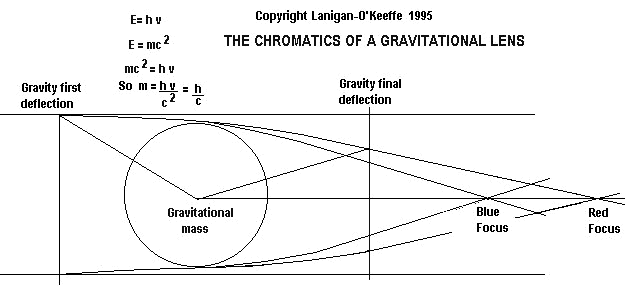
Such beliefs defy optical theory, unless the lens is non-regular and non-spheroidal. If anything, one must observe a chromatic astigmatic ring surrounding the interveining galaxy or mass. There must be characteristic optical effects observed that will identify the optical characteristics of the lens, including the radius of curvature and refractive index,
The optics of a gravitational lens must be the same as a simple single element chromatic lens, however, the images and proofs of objects claimed to be gravitational lenses, exist outside optical theory. If General Relativity is correct, then this first illustration would predict a chromatic image as the light skirts a gravitational mass.
As a distant object passes behind a massive gravitational mass, the light must be spectrally separated, appearing as a comatic astigmatic light with the blue end refracted to the greater degree. The path would also appear to be deflected, passing over the hidden object.
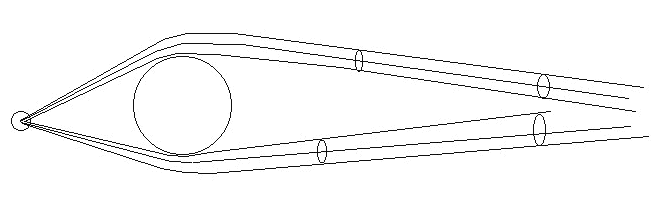
One of the proofs of General Relativity is that the solar gravitational field would be great enough to bend the light. This prediction was made in 1917. However, little was known about the Sun at that time. With the discovery of Radio Astronomy, and solar radio research, in 1980, the Solar Corona, the solar atmosphere, was measured to extend 5 solar diameters, yet little or no research has been done to determine or suggest a refractive index of that atmosphere or its effects on light passing through it. The reason is that science today blindly accepts Einstein's dubious prediction, or face a loss of face in the great theory.
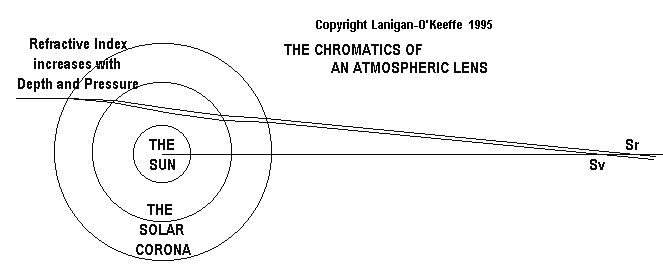
The Earth's atmosphere, as transparent as it is to light, actively distorts and shifts the positions of the stars, the planets, the Moon and The Sun. Atmospheric refraction is observed with grazing occultations where stars pass behind the great planets, Jupiter, Saturn, Neptune and Uranus. It was also identified through the Mars atmosphere, and only recently, photographed from space through the Earth's atmosphere. Atmospheric refraction does not occur with lunar grazing occultations because the Moon does not have an atmosphere. Equally, there are no gravitational dispersion or spectral effects observed.
Statistically, the observations of stellar positions made during total Solar eclipses are not exactly as predicted by general relativity, for in most cases stars and planets are seen to 'swim' about, a description that is often used to describe poor seeing conditions through the Earth's atmosphere. Gravitational lenses would not "swim" about unless the gravitational field is fluctuating. "Swimming images" are pure optical effects caused by the changing refractive index of a moving atmosphere. When a solar telescope, on Earth or in-space examines the visible solar surface at high magnification, the granulations and sunspots appear to "swim about", due to the ever-changing moving solar corona.
So why does science promote gravitational lens effects in preference to examining the remote possibility of atmospheric lens effects?
All gravitational effects, including gravitational red shift can be attributed to atmospheric lense effects.