 Return to Chapter 2 |
|  Advance to Chapter 4 |
Return to Chapter 2 |
| Advance to Chapter 4 |
Human weakness plays a key role when researchers name and give suitable definition to each newly identified event type, process, or response effect. Rather than creating a reserved word with unique and specific meaning, History identifies many instances where researchers merely bounced important sounding buzzwords across the scientific demarcation barriers. An overview reveals many shared or poly-defined terms where the faculty, branch, or department, exclusively accepts a specific and absolute definition, different and distinct from definitions granted in other faculties, branches, and departments. Confusion comes with each faculty defining the shared term, describing different response reactions, processes, and-or procedures. Novice causal research students should attempt this simple exercise researching various shared words, writing the following headings across a page and then under each heading, compiling the dictionary definition followed by its faculty and department specific meanings.
| Plasma | Displacement | Polarisation | Ionisation | Potential | Solution | Nucleus |
| example Dict: formless matter protoplasm | ||||||
| At.Phy: Active nuclear soup Biol 1: Liquid blood component Biol 2:Living cell's liquid components Biol 3: a colloidal system Elec 1: Electrical ionisation Elec 2: = ion & electron concentration in vacuo Geol: Subtranslucent cryptocrystalline silica |
Then again, depending on circumstance and faculty, within a scientific demarcation, a single process may be described through many uniquely defined words (evaporation, dissolving, sublimation, ablation, chemical reaction, et cetera), or when discussing atomic resonance producing the emission and propagation of light and heat, many distinct terms could define a common event such as, ionisation, fluorescence, phosphorescence, incandescence, iridescence, photo emissive, luminescence, sonoluminescence, steady state propagation, radiance, radiation, vibration, resonance, reverberation, transmission, shock, and even, convective emission. Equally, the atom itself may be called a nuclide, isotope, element, chemical, cation, anion, ion, or matter. Suddenly, even the most common term becomes subject to one's interpretation. See Item 2 of the Chapter Notes for an amusing example.
When faced with explaining away a scientific mystery, through procedural agreements, researchers or the scientific community adopted articles of faith as the most-likely most-convenient explanation. Generally, international scientific conventions attribute or adopt a particular measurement standard, name, procedure, or process, however, researchers may incorporate non-egotistic names (such as Calculus and Fluxions, with consensus of opinion accepting the name Calculus). Unfortunately, procedural agreements often referred to by the terms, consensus of opinion and by convention, created more problems, many ignorance-based notions entered the science as articles of faith. Although by convention standardises scientific research and explanation, in both communicating and defining experimental results, the fixed mind-set approach caused by indoctrination and blind acceptance produced more damage than good, in that the sanctified belief-set,
Because the electrical component identifies itself as a physical manifestation, as an observational illusion, considered totally irrelevant during propagation, and relevant only during artificial production and reception, these shortened terms become more meaningful describing the transmission, propagation, reception and response reactions taking place producing observational illusions. When considering mechanism and the atomic processes involved, the prefix electro complicates and confuses the issues. Any atomic charge (or change to the atom's electron carrying ability) at the atomic level must alter the atomic molecular magnetic field structure, producing magnetic molecular alignment changes in the surrounding matter. Such changes give rise to the physical illusion of a molecular field of influence, where the affects of changed conditions promotes various effects in the surrounding environment with changes to alignment, position, activity, resonance, loading, throughput and chemical bonding. With this atomic level magnetic appreciation of atomic interactions, as the explanation of catalysts becomes more evident through local atomic magnetic effects, the chemical sciences begin dumping many historically accepted errors.
Amazingly, the sciences accept and maintain many known errors, such as the three temperature scales and Franklin's electrical current theory. Unfortunately, the sciences also maintain and promote many stupid errors, some defaming brilliant research, such as Rőmer's speed of light calculation of 1675 (Chapter 16). Then again, because of sensational claims made when hijacking genuine observations, and promoted by the media as true, many in the target audience accept the promoted invalid flavour-of-the-month speculation as fact, which by way of peer pressure and indoctrination, elevates trite speculation as fact into scientific dogma. As part of the media, science fiction scriptwriters and journalists often give credence through sensationalism to strange notions and devices, (including tractor beams, impulse and warp drive engines, trackeons emissions, teleportation, parallel universes, time travel, et cetera), some of which entered cosmology and Quantum Theory as convenient explanations and analogies before contaminating mainstream Science. Some of this speculation and conjecture came from trivial mistakes.
Oppenheimer really messed-up when he developed blackhole theory by incorrectly applying orbital escape velocity as THE VELOCITY OF ESCAPE. The two effects remain totally different in Astronomy and Physics. To reach the velocity of escape, the lift force must be greater than gravitational force, hence, an elevator rises, a hot air balloon rises, a bird saws to great height, a person climbs a staircase, or conquers a mountain top, an aircraft presents a lift force. However, the escape velocity refers specifically to the orbital speed, when an object in orbit must break away and travel away from the primary gravitational body. According to some, using Newtonian Physics, they predict that an object in orbit must accelerate to break away from the primary gravitational body's field of influence, however, acceleration reduces the orbital height. Others correctly apply Newtonian Physics and verify the observed fact that a slight decrease in orbital speed actually lifts the object to a higher orbit. Breaking away from an established planetary orbit involves entering another gravitationally affected orbit around a star, another planet, or a galaxy.
Unfortunately, with Oppenheimer's confusion, basing his postulation on escape velocity and Einstein's prediction that gravity not only affects light speed, it deviates a grazing light beam and changes its frequency, when the gravitational attraction increases to a point that not even light can reach the orbital escape velocity, then as light attempts to move away from a large gravitational body, a blackhole forms. This speculation completely abandons Physics, because Oppenheimer fails to explain away light radiating vertically from the body's surface, affected by the velocity of escape, accelerating with greater height due to decreasing gravitational force. When Oppenheimer made his stupid error, he derived a mass estimate of just ten solar masses, far smaller than many known red giants, and in so doing created a vicious knowledge virus. With promotion, as science fiction scriptwriters and special effects artists began presenting this trite as fact, cosmology entered the event horizon being sucked in to the abyss of bad science. Suddenly, giant red stars that range from 12 to 80 solar masses became scientific mysteries because the objects defied this accepted but deluded theory.
In 1729, John Mitchell (an Eighteenth Century amateur scientist and Rector of Thornhill Church in England) contemplated Newton's view of gravity, along with the corpuscular theory of light, and wondered about the size of a gravitational mass capable of pulling the light back to its surface. Chapter 16 describes more fully how Mitchell correctly formulated the concept of the black star using the velocity of escape, where the gravitational acceleration towards the body equals the light speed value away from the body, deriving an estimated size around a hundred million solar masses, just a tad larger than Oppenheimer's 10 solar masses.
As a junction point on which others derived theory, to overcome the Red Giant problem, cosmologists began looking at the atom itself, and in furthering uncorrected preternatural theories, without any mechanism that explains gravity, other science fiction concepts entered the scientific belief-set. Many argued that matter must collapse into itself under the extreme pressure, forming a super dense gravitational point source that collapses through time itself, producing a hole in the space time continuum. In making the blackhole a more spectacular and beneficial object, science fiction writers envisaged the spinning blackhole forming a spiralling wormhole that negates time.
Wormhole speculation includes several science fiction stories based on unproven notions. As all time measurements depend on light speed, when an object enters the blackhole's calculated event horizon, a point where light speed and escape velocity equal, a point exists where all time must therefore cease, cosmology speculates that this solid body must collapse into itself, and as a point in space with a massive gravitational attraction and no mass, begins a spiralling vortex that links to similar spiralling wells with the mutual space-time rotation forming a super highway across the Universe. The application of the deluded mathematics of time zero, in basing the time standard on light speed, theory takes pre-instantaneous time to an unnatural limit, tracing the path taken by Oppenheimer and the cosmological fraternity, devising many invalid theories expounding parallel universes and instantaneous travel across the Universe along wormhole distortions. The credibility of such theory being granted by movie makers' special effects department and peer pressure presenting baseless rubbish as cutting edge Astronomy, along with cosmologist hijacking genuine observations, reversing a galaxy's spiral arm expansion, claiming the galaxy as the effect of a large blackhole sucking-in all neighbouring stars.
Another flavour-of-the-month wormhole theory states that when a solid blackhole develops a mass so great (about 10 solar masses), the blackhole collapses into itself, and that since time no longer exists, the wormhole forms a doorway into time. Of course, at this non-moment in time, the hypothetical blackhole links itself through the fabric of the time-continuum to other blackholes along the spiralling vortex across the Universe into parallel universes. In this theory, wrongfully linking light speed to time progression throughout the Universe, at time zero, the wormhole establishes an instant pathway across the Universe, and between other Universes. The proof of this considered using the argument that since time progresses at both ends of the wormhole at the same rate, and as both ends share the same moment, matter can instantly pass between the two. In accepting this as true, then as one enters the wormhole at one end, one immediately exits other wormholes far across the Universe, or in parallel universes, at this same instant in the now. Believe it or not, although obvious contradictions and tautologies exist, through media promotion, this invalid speculation became scientifically accepted as a penultimate truth.
In defiance of Einstein's relativity and Nature, both cosmology and quantum theory propose that, when a blackhole forms, this moment forever negates time to the zero instant, so the laws of Nature do not apply. Having abandoned Nature, with Quantum theory hijacking genuine observations and inventions, even though such objects could never exist, everything becomes plausible because everything predicted by Quantum Theory must be true.
Both Cosmology and Quantum Theory do not consider many key facts. As the opening of a wormhole must be a blackhole's event horizon, then if one enters the wormhole, one must be spaghettified (stretched apart by the enormous change in gravitational attraction over a short distance). The theory also says "nothing, not even light can escape the clutches of a blackhole's gravitational attraction," so, having entered a wormhole, how does one exit from the blackhole at the other end? The theory proves itself incorrect for when one enters the event horizon, theory predicts crashing into the solid object itself. When negating time in the empirical equation, because speed determination involves dividing distance by time, all things (including light) must travel at an infinite speed, with infinite mass, requiring infinite energy input.
Without invoking blackhole theory, but using the same deluded mathematics, one can prove that at this moment being the same moment everywhere in the Universe, one must be everywhere in the Universe at this moment without doing anything. So then, why does it take such a long time to get anywhere? Using this preternatural fixed-mind-set, because of the now being an instantaneous moment, man must exist everywhere in the Universe at this instant, and therefore should never-ever be late for an appointment, since, one already exists at that space-time location, at that moment, for all travel instantaneously occurs. If true, such a view egotistically replaces God with man, because Christian dogma states that only God exists everywhere at the same time. The Koran opposes this view by stating that God requires three days to travel across the Universe. Should not the 15 different Big Bang theories be considered as heresy, because cosmology promotes as fact that before the moment of the Big Bang, before the warp in the fabric of time formed matter, not even God existed.
Since time-zero stands as the greatest most mystical force of the Universe, cosmology becomes a religion of the faithful, towards a non-god-head where sanctimonious cosmologists preach to the converted about moving wormholes throughout the Universe to other sites, perhaps positioning them close to where it would best serve mankind. This may sound wonderful, an achievement of Science, but what revolutionary technology must be created to tow an object of just 10 solar masses about the Universe without getting sucked-in? Mankind's many atomic experiments prove the extreme difficulty of pushing the Earth from its orbit. What does one do, attach a tow rope to the old Chevy and pull the blighter down the intergalactic highway before taking the interstellar turnpike? "Arrr, not a problem, for all one needs is a few Danger-Wide-Load signs and a long tow line." One could be sophisticated, thumbing a ride on a passing blackhole. As the blackhole driver tows the wormhole to its new location, dropping it off like a consignment of fruit, it becomes problematical to stop and position the blackhole. Does one use a large net, disk brakes, or the free set of stainless steel carving knives to cut the towrope and release the blackhole?
The budding cosmologist should try this little exercise. "Suppose that the opening to a wormhole, a blackhole, existed at a fixed location between the Sun and Alpha Centauri, (just two light years from the Earth), calculate the gravitational effects on the Earth's orbit around the Sun. Please use a range of mass estimations from 10 to Mitchell's hundred million solar masses, and apply the inverse square law to predict the consequences." After examining the mathematics one will viciously discriminate and actively protest about having that kind of black neighbour in this white, yellow and red-star neighbourhood as the gravitational changes on the Sun would throw the Earth into a completely new orbit. The ocean tides would clear the land. Better still, what effect would happen locating a blackhole in close orbit around the Sun? Would the Sun be sucked into it, or has humanity been sucked-into accepting this rubbish, this load of baseless speculation and hogwash, as cutting edge Science? One can only laugh at this arena of Science, for the proof comes from the media promoting this naive follow-the-leader unscientific tautology, quoting cosmologists saying, "Since no one can prove the mathematics wrong, and as the theory says these objects do exist, these objects must exist in the Universe! The mathematics are unequivocal." Such wild and baseless speculations do not stop there, rather things become worse. According to a sanctimonious cosmologist at the Royal Observatory Greenwich,
Power transmission from a remote blackhole some 200 light years away would present losses exceeding 99.999999 999999 999999 %. Perhaps the power transmission factor could be improved by using very long extension cords running all about the Universe? As empirical Newtonian physics predicts that power generation through motion presents a resistance to that motion, the losses incurred generating any power must cause the power station to succumb to the gravity of the parent object. As the forces must be reciprocated, the power station would need to be in a perpetually powered orbit. Why go to a blackhole when the Earth's Van Allen belts could be harnessed without the need to perpetually correct an orbiting power station's orbit?
Observations of far distant galaxies skirting more massive closer galaxies fail to show any of Einstein's predicted gravitational effects. In pushing, promoting and advertising the cosmological belief-set as truth, reputable cosmologists hijacked many common astronomical objects, deeming them as gravitational lens effects. Others went to the next step, stating that these objects satisfy the predictions made in Oppenheimer's flavour-of-the-month theory. In foregoing all other explanation, in claiming proof, these reputable cosmologists validate their explanation with the argument that these predictions agree with Einstein's theory of relativity. Problem, which theory of relativity?
Under Einstein's Special theory of Relativity, not even gravity affects light, when this theory gives light mass. The Special theory denies gravitational lenses, blackholes and the predictions made by General Relativity due to light's fixed and finite speed. Built on Newton's gravitational potential energy error, Einstein's General theory of Relativity stands in direct contradiction to his Special theory, though considered by some as an extension of Special Relativity.
Rather than seeking a reason, Einstein complicates the description of independent reference frames by using poor experimental results to make matter change length and mass as a consequence of the time dilation effect. He did not realise the errors in the Michelson Morley experiment, or the dangers in accepting notions derived from thought experiments. He set-out to resolve far too many problems through the introduction of generalised approximations, the space-time continuum, time dilation effect, and his unswerving faith in Newton's belief-set. Unfortunately, he based the General theory on Newton's revised gravitational theory (1713), the Coriolis corrections made to Newton's energy theory, and on Newton's acceptance of René Descartes' corpuscular model of light, which Descartes introduced without proof in 1637 AD. Einstein's acceptance of Newton's errors as unquestionable and true, without a full appreciation of matter, of energy, of propagation, led him to several rather deluded and contradictory conclusions about energy, gravity, matter and light. Consequently, with his acceptance of notions, and indoctrinated teachings, at three major branch points, Einstein's thought experiments initiated several virulent knowledge virus infections.
In his theory, space-time links the three dimensions of position with the continuous march of time. When giving an event a universal position in 3-D along an arbitrary x-axis at (x1), along the y-axis at (y1), and along the z-axis at (z1), denoted as position (x1, y1, z1) and starting at time ( t1 ), the event takes place at space-time (x1, y1, z1, t1). Since the event's duration took several seconds, with the event concluding at a different position (x2, y2, z2) and at time (t2 ), its new space-time position becomes (x2, y2, z2, t2 ). If the event occurred but did not change its physical position, with respect to a Universal Stationary Reference frame, the object being absolutely stationary, then the only difference must be in time, so, some would-be mathematicians argue that the change occurred at
An event that occurred at this time yesterday, precisely 24 hours ago, did not occur at time minus 24 hours. The time must be taken as the "then" present time as relative datum time point as "zero plus", and the "now" expressed as relative time, as zero plus 24 hours. This simple distinction makes a great deal of sense, giving real time and rate to real positions and changed conditions. In certain applications, the approach of using absolute time as a function works only because it forces one to remember that all action-reaction cycles require time and response rates. As action occur during one period of time, reception begins and continues during an overlapping time period, giving rise to primary responses during a third overlapping time period, which initiate secondary responses throughout a fourth time period until the reaction ceases. With this reaction cycle affecting matter, each reaction transmits various signals-of-change that propagate locally and universally during subsequent time frames.
Since pre-instantaneous time negates the Laws of Nature, the time error condition facilitates the application of energy released from an event before the event, where that energy becomes freely available today. One could harness all the energy resulting from the future destruction of the Earth, before the Earth's destruction, to move the Earth into a safer orbit, averting destruction. In generating infinite free energy from nothing, from future non-events, this amusing dilemma created by this paradox shows that not even the laws of thermodynamics apply at pre-existing time zero. Although mathematicians state that dividing a number by zero or a negative number does not give a true or real answer, these same mathematicians apply exactly this condition in cosmology, where the use of such invalid mathematics proves all things at this non-moment as real objects and actual events, claiming and promoting the mathematics and deluded theory as unequivocal.
Because the deluded theory predicts the existence of objects in this non-moment of time, the object must exist somewhere in the real Universe, as a real object in real time. Such deluded theory claims the physical existence of blackholes, wormholes, neutron stars and the like, as real physical objects that exist in the now. With cosmology hijacking genuine astronomical observations as proof, and since best fit mathematics describing the observed effects predict the observed effects, written as an equation and appear in published scientific articles, such theory must be accepted above Science, above Nature and above God. The philosophy and fundamental problem with modern cosmology seems to be that "since no one can prove us wrong and as no rules apply at time zero, the gullible public will generate peer-pressure promoting greater acceptance of this hogwash." With indoctrination and special effects fanatically locking the mind-set, it becomes almost impossible to correct invalid long-held beliefs.
Because all natural reactions do not occur instantaneously and cannot occur before an event that initiates the reaction, the rule must always express time as a Positive number, always greater than zero, [ t > 0 ] , as the [ absolute time ] ,
or [ t ] = [ t2 - t1 ] = [ t1 - t2 ].
Despite a great deal of hard evidence supporting the Æther Theory, Einstein re-introduced several dangerous techniques, concepts and notions used by René Descartes in the 1600's. With Einstein abandoning the Scientific Method, accepting the accuracy of thought experiments, accepting derived notions as the cause, his subsequent speculations and mathematical approximations without mechanism, without a suitable Universal Reference Frame, without a complete and true picture of matter, he divorced himself and his theories from both Science and Nature. The Scientific Method warns against the enormously high error probability caused by such action, especially when conjecture and speculation expressed as best-fit mathematical exercises link alien response reactions.
 In giving light a fixed and finite colour dependent energy under the Special Theory, it must have mass, which under the General Theory, as a theory of gravity and energy, based on Newton's potential energy error, Einstein made some woeful assumptions about matter and Astronomy, reverting the description of light back to Descartes' corpuscular theory. Due to Einstein's acceptance of thought experiments as supplying reliable predictions, at this point of time, at the end of the Nineteenth Century, his acceptance and the predictive accuracy depended on the then current knowledge, including many flavour-of-the-month speculations, and problems that defied explanation. In this gas-lit horse and cart world, with steam power driving the Industrial Revolution, with electronics in its infancy, with so much still to be revealed about Nature's Universe, Einstein assumed far too much, and made far too many mistakes.
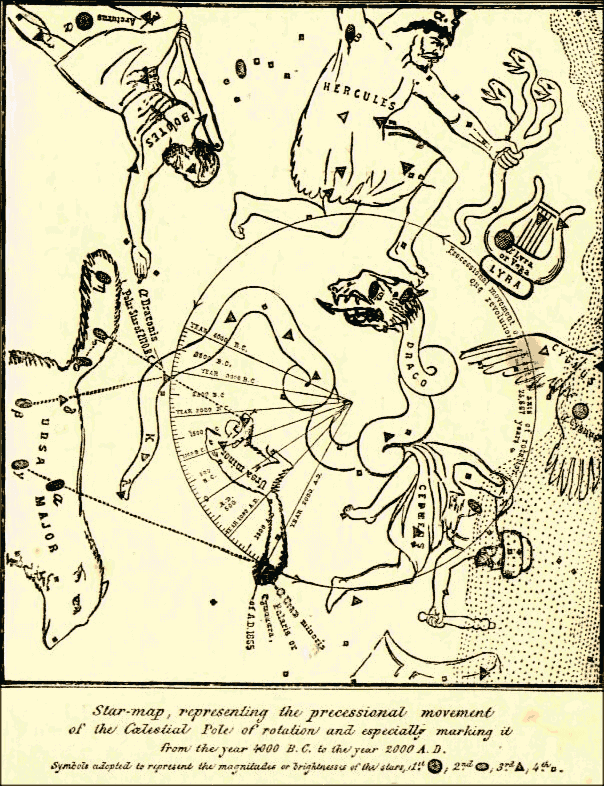
From Tycho Brache and Kepler's early planetary measurements, astronomers noted that Mercury's orbit did not follow a classical almost circular elliptical orbital path, varying by over 24,000,000 Km (15 million miles) between perihelion and aphelion, with greatest positional distortion occurring with the planet on the Sun's far side. Like the Earth and most Earth intersecting asteroids and comets, with precession occurring in the same direction as orbital motion, Mercury's extremely eccentric orbital track follows a slightly distorted rosette-shaped path. To the surprise of most astronomers, Einstein predicted that Mercury's ellipse precesses around the Sun by 43 seconds of arc per century. In comparison, the Earth's almost circular orbit exhibits a far greater precision, near 50.09 arc seconds per year, ( or 1 minute 23.79 seconds per century), requiring about 25,870 years to complete a wobble. Consequently, (as illustrated), the pole star, Polaris, should reach its closest point to true North in 2110, and then again in 27980 AD.
Einstein argued that because light has energy, invoking Newton's belief in light being corpuscular, as a photon, as light with mass and frequency, must be affected by gravity, and this must produce observable effects. Without any knowledge of radio astronomy, let alone any real knowledge about the size of the Solar Corona (the unseen enormous atmosphere around the Sun), Einstein's Nineteen Century ignorance blinded him to the Universe, for he argued that distant stars light skirting the Sun (considered as a million mile diameter finite body) must be bent by the solar gravitational field, producing a deflection tending to a maximum of 1.75 arc seconds. This level of measurement requires magnification, and pinpoint accuracy. Although the angle 1 arc second may seem a very small angle, (1°=3600"), a generalisation establishes the 4½ inch (11.43 cm) diameter telescope objective as an arbitrary resolution standard for many amateur astronomers because the resolution just separates close objects 1 arc second apart. Based on Yellow-Green light, as this optical generalisation predicts that,
| inches | 4½ | 10 | 15 | 20 | 25 | 30 | 45 | 60 | 100 | 150 | 200 | 450 |
| cm | 11.4 | 25.4 | 38.1 | 50.8 | 63.5 | 76.2 | 114.3 | 152.4 | 254 | 381 | 508 | 1143 |
| resolution | 1.0" | 0.45" | 0.3" | 0.225" | 0.18" | 0.15" | 0.1" | 0.075" | 0.045" | 0.03" | 0.0225" | 0.01" |
| relative arc second | 1 | 2.2 | 3.3 | 4.4 | 5.5 | 6.6 | 10 | 13.3 | 22.2 | 33.3 | 44.4 | 100 |
| relative light gathering power | 1 | 4.94 | 11.1 | 19.76 | 30.87 | 44.5 | 100 | 177.8 | 494 | 1111 | 1976 | 10000 |
This claimed gravitational bending being an optical refraction event that occurs in all atmospheres. Despite claimed proofs, Einstein's predictions fail to describe or predict the true observations, across the entire magnetic spectrum. The only genuine test for Einstein's gravitational bending model requires using a relatively large gravitational body devoid of all atmosphere. Such objects do not exist. Some astronomers consider the Moon as a possible contender, however, with the solar wind giving the Moon a shock front (a bow wave), and tail (a wake), even during a lunar eclipse, that fine solar wind atmosphere must be evident. Equally, for distant starlight skirting the lunar edges, Einstein's mathematics predicts that at the Earth's surface, a two metre gravitational bending effect between the Red and Blue event components. Regularly, astronomers accurately estimate the heights of lunar mountains and crater walls during grazing occultation events, where a mountain on the Moon's edge eclipses the star for a certain period of time. Data from numerous sites across the eclipse path builds up a very accurate silhouette of the lunar surface. However, the predicted 2 metre spectral distortion that must gradually vary the starlight's intensity before and after each occultation event fails to eventuate. Rather than showing Einstein's predicted gravitational bending effects, high speed sensitive photomultipliers and photodiodes often identify extremely close binary and trinary star systems, as each component suddenly turns off then flashes back on, without any spectral change.
Before publishing the General theory, around 1911, Einstein suggested that light coming from a large gravitational body, much larger than the Sun, should reveal the star's mass through red-shift observations; the gravitational field slowing the time cycle pushing the spectral lines towards the spectrum's red end. Astrophysicists grew very sceptical of this claim, because the evidence did not exist. However, in 1960, researchers supporting Einstein's theories devised a way of proving this effect under free fall conditions in the laboratory using the Mössbauer effect, where the precisely defined frequency and energy of gamma rays produces a red shift, within ± 10% of Einstein's predictions. This scientifically unacceptable 10% error being too large suggests that other factors must be involved.
Einstein made several other flavour-of-the-month plagiarised predictions about matter and the Universe. Since 1840, following the development of photography and photochemical reactions, many scientists muted the idea of a photoelectric effect, since light produces electrochemical reactions, then light striking a metal must liberate electrons. Soon after the semiconductor Selenium showed its photoelectric properties in 1873, being a photo-resistor and the first working photodiode, the German scientist Paul Nipkow invented and obtained a patent for a workable but slow closed circuit television system in 1884. Within a few years, the photo-diode led to the invention of the first transistor, but without suitable speed and application, the television system and transistor remained as laboratory toys for many years. With the invention of wireless communications, Selenium diodes and other semiconductor crystals (Iron pyrites and Galena) came to the fore, with magnetic amplifiers and semiconductor crystals rectifying the faint radio signals, predating all thermionic valve radio receivers. In 1913, although not a semiconductor, Potassium hydride coatings showed improved semiconductor properties, making better photocells. During World War II, the semiconductor diode became the mainstay of portable radar receivers. Despite the transistor's re-invention in 1948, Quantum theorists give Quantum Theory credit for all solid-state semiconductor technology, because only Quantum Theory explains how semiconductors work, and no other explanation need be considered.
Although Einstein's best-fit mathematical approximations give parallel explanation, not a prediction, he proposed that, the energy released by the impact of a photon of light liberates an electron from the atomic structure. Again, because Einstein aborted the Scientific Method, in giving credence to best-fit mathematical solutions as the means to develop theory, in creating false theory generated more observational illusions (as discussed later), where the effect of applying additional circuitry also hides matter's working mechanism. Due to Einstein's involvement in the development of the photomultiplier, his photo-optical theory won respectability.
In common use today, many other photosensitive devices exist that defy Einstein's predictions, such as CCD television systems (using a technology first described by A.A. Campbell Swinton in 1908). As the photon theory fails to explain diffraction, then it must be considered invalid. Perhaps the greatest observational illusion comes from the resolution of electrical measurement, where at low illumination levels, the electron's electrical potential quantises all measurement. Extremely long exposures (by photographic or CCD) reveals faint objects not detected in real-time by photomultiplier systems. Typically, all discussions concerning the photomultiplier exclusively refer to the stepladder amplification circuit, rather than the optical surface semiconductor interface or the atomic mechanism's response reactions taking place on that interface.
Although many academics state that Einstein discredited the Æther Theory, they give Einstein's theories credibility based on the fourth prediction which calls on the Æther recoiling with the Big Bang's shock front travelling away from the centre of the Universe, as a sound. In seeking proof, using creative astronomy, cosmologists found the proof, dubbed, the microwave background radiation. The indoctrinated accept the discovery of this steady state background radiation as proof, and denying all other explanations for this effect. Whether a petty confidence trick to sell relativity to a gullible and incredulous public, or a bizarre series of observations that deny the truth, with respect to the astronomer's star charts and radio-maps of the sky, any examination of the mottled Universal background radiation map reveals something far more interesting. In claiming proof of contradictory relativity theories far too early, breaching the scientific method by denying the Æther Theory, it becomes necessary to challenge the scientific credibility of those making such claims.
Confused by colourless fuzzy blobs of light in the night sky that look like comets, the comet hunter Charles Messier identified and published a list of 100 nebulous objects. With this list virtually stating "Don't waste your time looking here", the objects include both illuminated and luminous gas clouds, as well as close star clusters, distant galaxies and Quasars, which astronomers until 1818, believed existed inside The Milky Way, inside the Universe. The Nineteenth Century astronomer, Amédée Guillemin, described The Milky Way in the work, "The Heavens" (1872) as The Universe, and from Herschel's description in 1818, other far distant galaxies as other Universes. The ORIGINAL concept of parallel universes being a concept of unique and far removed galaxies.
The parallel universe theory suffered badly when the 100" Mt Wilson and 200" Mt Palomar telescopes, as brand new instruments, gave Hubble the opportunity to resolve, examine and explain the Messier list and several thousand previously unidentified nebulosities. Using the then scientific knowledge, and as the first in the field, Hubble did some amazing work, disproving the parallel universe theories, defining these far distant objects as other galaxies. However, without a full appreciation of the Universe or Nature, in attempting to comprehend and explain far too much far too early, he fell into some amazing traps, accepting simple observational illusions that directly led him to formulate several invalid conclusions. Although Hubble discredited the concept of parallel universes, scientific inertia maintained and mutated this knowledge virus, through Quantum theory giving the concept mystical connotations based on Einstein's space-time continuum.
Hubble's biggest failing being the acceptance of Nineteen Century Science, for he did not appreciate, nor did he recognise the true nature of light. As described more fully in Chapter 12, his spectral research revealed a geocentric effect that directly opposed all existing light theories, which defined light as something special, a unique natural effect. Hubble identified the fact that with greater distance from the Earth, as wavelength increases, a galaxy's spectra shifts further to the spectrum's red-end. With this observation implying that as light refracts across the Universe with reducing amplitude, energy conservation and refraction, the wavelength increases as the propagation speed increases, with red light travelling slightly faster than blue light.
Rather than advancing such a radical change, Hubble attributed the increasing red-shift to the Doppler effect, adding an additional clause to the conclusion, the greater the acceleration away, giving these distant galaxies progressively faster motion away from the Earth, with increasing distance from the Earth. This concept geometrically positions the Earth at the very centre of expansion, in accordance with Church teachings. Despite geologists giving the Earth an age around 3 or 4 thousand million years, when Hubble back calculated this expansion to an origin, his estimate placed the concentration of matter in a single ball 1.8 thousand million years ago.
This fitted nicely with the Judeo-Christian belief that God created the World first, and then God made the Universe. To Hubble's surprise, as more distant objects appeared, it became necessary to revise the expansion constant. With new discoveries, with larger telescopes, astronomers revised Hubble's constant eight times during the Twentieth Century! Present day astronomers from two different faculties use two unique and different values for this constant, when mathematics defines a constant as being a unique and fixed single value. Unfortunately, for the concept of an expanding Universe, the simple geometry of an expansion defined by the observations conclusively proves that Hubble's expansion theory centres the Big Bang at this very location in space 12 to 15 thousand million years ago, at the ego-centric, observer-centric, egotistical universal centre, the Earth.
Since Einstein needed to overcome Newton's Potential Energy problem, with infinite height giving an object infinite potential energy, limiting the size of the Universe, he incorporated a gravitational constant to prevent the Universe collapsing in on itself. When pointed out that the Relativity theory, as a theory of gravitation allowed expansion, Einstein changed the gravitational constant to agree with Hubble's expanding observations.
Michelson & Morley's involvement:
Around 1800, when Thomas Young challenged 150 years of blind acceptance, with the scientific community maintaining Newton's corpuscular light theory for its failure to explain colour, howls of derision came from the arrogant and indoctrinated scientific community mocking the proposed Æther theory as a suitable replacement. Modelled on sound propagation and rippling water waves over a pond's surface, based on observation and speculation, the infant theory struck great resistance until 1817, when Young successfully demonstrated optical polarisation, an effect that conclusively proved light as a transverse (side to side) wave motion. Following this revolutionary change, with wave motion explaining colour, diffraction and optical polarisation, Nineteenth Century physicists considered the Æther as a hypothetical sub-atomic fluid that fills all matter and space, and as a medium permits the propagation and distribution of energy throughout the Universe.
Since Chemistry's knowledge virus incorporated notions, assumptions, speculation and conjecture in defining matter, critical mistakes entered this Æther theory, with similar notions and speculations describing the Æther as sub-atomic matter exhibiting most unusual properties. Educational indoctrination mutated and spread this false belief-set, promoting as true, erroneous elements of the theory, such as, the Æther medium passes through all matter and is unaffected by matter." Many scientists argued that, if true, then as the Earth moves around the Sun, the Æther wind passing through the Earth must be detectable. This theory failed to consider the Earth's environmental relativity, where, like moving in an enclosed capsule (vehicle, train, aircraft, tram, or bus) very few inertial effects provide a hint of actual motion, be that motion across the Earth's surface, around the Earth's axis and orbit, and with the moving Solar System travelling in The Galaxy through the Universe.
Unfortunately, without any appreciation of Environmental Relativity, the closed mind-set of arrogant Nineteenth Century Science doomed all attempts to detect this motion. The prevailing scientific appreciation led to poor assumptions, inferior experimental designs and inadequate mathematical arguments. Rather than explaining the mathematics relative to the apparatus moving through the Æther, two critical mistakes entered the experimental design stage making the Æther's movement relative to the apparatus and to the Æther as external to the apparatus. As a consequence, Michelson & Morley incorrectly applied the Pythagoras Theorem to the apparatus, generating a mathematical dilemma proving the apparatus as viable, when the design itself hides the effect of relative motion. Rather than measuring the hypothetical Æther wind, as explained more fully in Chapter 16, in the famous experiment claimed as a proof of Einstein's relativity, the poorly designed apparatus measures the temperature effects and distortions in the beam-splitter, and-or the thickness and transmission qualities of other transparent objects placed across the optical path. Due to Michelson & Morley accepting an incorrect reference frame, irrespective of environmental conditions, by design the device gives negative results.
Needless to say, the observations failed to detect any movement of the Æther wind through the Earth. Assumptions and indoctrinated assertions, not proof discredited the belief that the Æther passed through all matter unaffected. Despite the fact that the Æther theory remains as a viable theory in need of major correction, popular scientific propaganda (in promoting Einstein's relativity) preaches that not even Einstein accepted the Æther theory. Einstein's Postulate or Principle of Relativity includes a statement affirming reference frames as interchangeable between "space" and the Æther. Equally, the indoctrinated and the misguided use Maxwell's Æther equations as a means to disprove the Æther, in support of the photon theory, when the mathematical parameters and constants needed in these equations define the Æther's transmission properties through and between matter.
Accepting contradictory Nineteenth Century electrical theory and much irrelevant knowledge describing matter and conductivity in rarefied conditions, Lorentz assumed too much. Throughout his high voltage discharge tube experiments, he noted that as increased electrical potentials forced electrons to travel faster in a terrestrially produced vacuum, electrical resistance increased. Because this strange effect demanded explanation, Lorentz applied approved trial-and-error mathematical juggling procedures to find a best-fit empirical mathematical description, which, if it seems to fit and provides accurate predictions, then the equation must identify the cause, and therefore must be a suitable explanation. Although the scientific community promotes this method as a clever backdoor procedure forcing Nature to identify the natural processes, the Scientific Method warns against it, owing to problems caused by parallel mathematical solutions working without mechanism. Lorentz and other scientists of the time could not readily explain the observations in terms of the accepted electrical or molecular theory.
Because he attempted to rationalise his observation with a mathematically invalid hypothesis, the problem of insufficient data force Lorentz completely off-the-track, to accept an observational illusion as proof. Well before Lee De Forrest and Edison began experimenting with thermionic electron valves, well before the evolution of these radio valves showed molecular activity, when Lorentz determined a limiting effect that becomes more evident as higher voltages pushed electrons towards light speed, rather than disputing and correcting accepted electrical theory, he modified it with observational illusions, proposing empirically derived parallel mathematical extensions. Rather than applying mechanism that would discredit and disenfranchise accepted electrical theory, at this branch point, without any real proof, when Lorentz introduced the notion that time itself distorted as electrons neared light speed, he initiated a knowledge virus to explain-away the effect.
Unfortunately, his observational results and best-fit empirical solutions became the basis for the time dilation effect in Einstein's Special Theory of Relativity. As researchers evolved and improved thermionic radio valve design, they failed to challenge electrical theory with actual observations. Through trial-and-error exploration, seeking better signal to noise ratios, they made enormous modifications to the thermionic valve, with corrections increasing molecular circulation effects through anode ventilation and increased volume as a means to establish a more efficient molecular return path from the anode to the heated cathode, where the molecules accumulate picking-up electrons before being dragged in spiralling molecular vortexes through the Grid to the Anode. The correct application of mechanism identifies electrical conductivity and the effects of supersonic molecular drag in radio valve design.
Since the empirical parallel equations of Lorentz, Maxwell and Einstein, all work without mechanism, researchers should try replacing light speed's value, denoted as c, with the atmospheric speed of sound, to verify the fact, that as an object's speed v' approaches the medium's relative sound barrier in a medium moving with velocity u, the objects effective velocity v reduces because the object's mass increases as time changes. This being confirmed by the mathematics accurately predicting that a linear increase in velocity requires an exponential application of power to overcome the progressively increasing atmospheric resistance.
The involvement of Rutherford:
Around 1911, Rutherford carried out an experiment where he assumed far too much about matter without the necessary tools or equipment to substantiate his notions and beliefs. His research based on observational illusions and the chemical model introduced by Davy around 1810. At the time, Rutherford knew very little about the nature of metals, or the properties of atoms, so he drew his conclusions based on the accepted electro-chemical theory, observations, and here again, observational illusions distracted Rutherford from making the correct conclusions. As the next several Chapters explain, in the explorative research stage, with a high probability of error, Rutherford drew three conclusions far too early, which he promoted as true. Owing to his flawed experimental design, his analysis and research conclusions produced an atomic model that failed to explain Nature's Chemistry. With scientific acceptance coming through the backdoor, "Since Rutherford shattered the atom which Chemistry states as indivisible, then his atomic model must be true." As a junction point, the acceptance and promotion of Bohr's atomic model by Rutherford, introduced many scientific mysteries. So poor the Rutherford concept in explanation, Chemistry maintained the 1806 atomic model introduced by Dalton, because many crystal and molecular structures defined chemical precision, described and explained by chemical alignment, bond position, bond-length, bond strength and structure, all of which instantly became scientific mysteries.
The involvement of Quantum theory:
Since Rutherford's atomic model kept falling-over with trivial problems that should present Natural answers, Quantum mechanics began from many ignorant and arrogant Nineteen Century notions, speculations and assertions, bridging and maintaining Davy's electrochemistry, Rutherford's analysis, and the status quo. Without a workable atomic model generating a suitable gravitational theory describing exactly how gravity affects matter, without a mechanism allowing chemical bonding, with the sciences placing light on an enormous pedestal as something so unique, quantum theorists began relating sophisticated chemical beliefs to Nature's precision, order, and harmony, through chaos, uncertainty, faith, hypotheticals, analogies and by whatever means possible, including blatant deception. Few checks and rules governed this infant non-science, and as self-important academics tailored the Emperor's new clothes with complex and convoluted scenarios forcing the acceptance of make believe, Quantum Theory became fashionable through indoctrination and peer pressure.
To alleviate the disastrous situation produced by accepting an unnatural atomic model, claiming proof of the quantum atom as true, by hijacking genuine observations, quantum theorists defined the photon as a massless-dimensionless particle with both wave and particle properties, that exists in several parallel universes at the same time. With Quantum theory presenting contradictions as proofs, one can argue that because this belief-set plays with people's minds, it should be outlawed. Still, in this body of work, important serendipitous breakthroughs appear, which although attributed to invalid processes, demand complete explanations. Consequently, great care must be taken when examining this belief-set, extracting fact from fiction.
As mentioned in Chapter 1, Faraday's simplistic terrestrial response to Davy's question concerning electrons coming from a chemical bath, as perhaps electro-chemical in nature, made explanation of the observed effects relatively simple. However, with Davy's absolute acceptance of this observational illusion as proof, giving credence to the observational effects as the responsible mechanism, casting aside the actual mechanism of chemical bonding, his use of indoctrination techniques and public awareness to make the laboratory safe, released and spread this virulent knowledge virus, that, as the foundation belief, confused, convoluted, and corrupted the sciences.
For explanation purposes, in his attempt to simplify, popularise, and make scientific knowledge interesting, Faraday used many analogies, simplifications, approximations, speculations and notions. Faraday's 16,041 documented experiments explored numerous aspects of Chemistry, Physics, and Mathematics. As a polymath, he paved the way for many new technologies, considered commonplace during the late Twentieth Century, but in accepting terrestrial observations and the work of others as true, his human approach created, and-or branched several viral infections. Faraday accepted and based his electro-magnetic theory and explanation on Franklin's incorrect electrical theory.
To simplify magnetic theory, Faraday made several intrinsic but invalid assumptions about magnetism and matter. He took this action establishing the necessary conventions needed to standardise magnetic explanation, observations and results. Rather than describing the magnetic line-of-force as a two-dimensional cross-sectional geometric-construct of a three-dimensional field-flow structure, (much like an isobar joining points of equal atmospheric pressure on a weather map), Faraday explained the path of equal magnetic strength as a real line with real properties, when the line-of-force, as an observational illusion, does not physically exist. The same applies to a molecular alignment field where the lines-of-force illusion appears. When sprinkling Iron filings on a sheet of paper covering a magnet, or with seeds floating on an oil surface exposed to a molecular alignment field, this display method fails description for it does not display physical lines-of-force. When fragments align in a molecular alignment field, gap fields jumping between each fragment create repulsive conditions between parallel fragments and therefore the illusion of lines appears as parallel circuits separate. Consequently, the line-of-force illusion, as indicative of field strength and alignment, as an effect, predicts other related effects without invoking mechanism.
Faraday's magnetic experiments classified matter into three categories, depending on the chemical's response to an applied magnetic field. In the strongest classification, he identified Iron, Nickel and Cobalt, calling these Ferromagnetic (or Iron-like). The second classification showed much weaker magnetic properties, which he called Paramagnetic. In these situations, Faraday noted that paramagnetic substances stretched themselves as they aligned between a magnet's pole pieces. By far the strangest classification, the diamagnetic materials defied logic and all scientific explanation, for these materials compressed when placed between the poles of a strong magnet. Unfortunately, Faraday applied a poor experimental method that failed to consider the Earth's more paramagnetic atmosphere. Almost a century later, as the atmosphere's secrets became understood, many of the chemicals that he listed as diamagnetic, became paramagnetic in a vacuum, simply because the more magnetic atmosphere affected the measurement. The key fact to explaining matter's magnetic properties appeared with the identification of the strongly diamagnetic Inert gasses, with their almost total failure in forming molecules, and their atomic masses revealling atomic singularities, as individual atoms that exist in the atmosphere.
For reasons of the atmosphere exhibiting strong paramagnetic properties, aligning to the prevailing magnetic environment, Faraday and other researchers identified air core magnets, where an electrical current carrying simple coil aligns the atmosphere. Faraday defined magnetic induction using this observational illusion because it seemed to work. He believed that the principle force came from the physical line-of-force cutting through the conductor. Despite Faraday defining magnetic induction and field strength through magnetic-lines-of-force, that appear with directed magnetic fields, the endless directed toroidal (ring) magnetic field fails all line-of-force descriptions. With a coil or magnet looping on itself around an endless ring, a true toroidal magnet produces no apparent external magnetic field, however, another coil wound over the first responds to any toroidal field strength change, inductively producing an electrical current.
Although most I-E lamination transformers dynamically respond the prevailing external magnetic conditions, the non-laminated solid core toroidal transformer responds in a different way. This scientific mystery resulting directly from Faraday's invalid magnetic explanation. Although Faraday's mathematics and line-of-force descriptions seem to make sense, the equations derived from this starting point, those of Gauss and Maxwell maintain this observational illusion and invalid analogy, as the basis for all research, prediction, and explanation, so, the actual processes and responsible mechanism remained mysterious. From Faraday's magnetic work, blind acceptance on magnetic-lines-of-force being real physical lines led to many strange but invalid theories, including the Babcock Dynamo as an explanation for sunspot activity.
Lack of knowledge and technology at the time prevented Isaac Newton explaining the working mechanisms of Nature, especially gravity, light, motion, and resonance. Because Newton used intuitive and convenient terrestrial assumptions to explain his alchemistic view of Nature's Universe, Nature deceived him and his followers. Even though his empirical concepts work, the acceptance of Newtonian Physics introduced many problems, for without suitable technology, knowledge, and resolution, expediently the sciences placed seeking the responsible mechanisms in the too-hard-box. His naive empirical concepts of motion about the centres of both mass and gravity led to gross scientific confusion because he did not consider the subtleties of Nature's Universe at the atomic level.
For instance, in describing terrestrial effects, Newton explained motion as linear, as if motion works in straight lines. The application of various forces involved representing those forces by vectors relative to the direction of travel. Living in plague infested primitive conditions of England around 1666, Newton began making some startling presumptions about the Universe and "free space" that during the Twentieth Century, an infant rocket science verified. The severely limited concept of two-dimensional vector solutions become indicative when the resultant vector must explain real world conditions within a three-dimensional rotating moving Universe. Since motion, rotation, matter and gravity remained without mechanism, and not understood, many academics assume that the gravitational vector points towards an apparent centre-of-gravity, as distinct from the parent body's actual centre-of-mass, or the true centre-of-gravity!
Owing to the fact that Science fails to give a full and complete description of rotating matter at the atomic level, empirical equations describing without mechanism spinning objects and gravity must be carefully considered, due to a deceptive knowledge virus that this forced marriage produced. Through a signal-feedback effect (described in Chapter 7), gravity presents an apparent collective force between the apparent gravitational centres, irrespective of motion. During free-fall, as matter's potential energy increases with decreasing separation, all objects within the accelerating reference frame experience an apparent weightless condition, at loggerheads with Einstein's preternatural illusion of gravity. In this illusion, as Einstein considered gravity as an increasing rate of change in position, as an acceleration, he argued about the similarity of gravity and the inertial forces experienced within a progressively increasing moving reference frame. Due to relative positional change this motion generates a similar force-form directed in the opposite direction to the direction of travel, an effect that does not apply to any object outside that moving reference frame, unless attached to, or forced by the reference frame's leading surface, a force quite unlike the gravitational free-fall effect.
As the apparent force experienced in a field of influence seems to affect matter (giving mass an acceleration, in the same way as would an impact, an explosion, in pushing, pulling or carrying a secondary object internally,) it does not mean or imply that force arises from a common mechanism, or common ancestor. Throughout other sections of this work, describing Einstein's gravity illusion more fully, only the observed effects of directed forces appear similar due to the nature of a force-form's.
Around 1850, Coriolis introduced some terrible over-view concepts of energy, correcting some of Newton's errors, defining more specifically the Potential and Kinetic Energy concepts used today. Potential energy describing an object's stored energy, while Kinetic Energy being that released through a motion or an action. This most myopic view of energy, although indicative, actually fails the Sciences, because they describe relative energy conditions, not true energy. From these tragic errors came many deluded beliefs including the following illogical argument used by many to prove a sorry and invalid case, "Since Science cannot define the dimensions and as energy cannot be defined, then energy must be a dimension unto itself." This flawed tautology draws a conclusion from an invalid assertion presented as fact. Acceptance of this deluded argument into scientific dogma created a knowledge virus that through a deceptive mathematical distraction effectively stopped people seeking Nature's fundamental answers. Such a tautology fails the simplest test, for in every situation, energy remains energy, because matter stores, liberates, applies, and uses this energy in propagating, absorbing, or rejecting different energy-forms.
Unfortunately, in blindly accepting this tautology, many of today's scientists and visionaries stroll down the wrong path, along a tangent away from Nature. Any predictive theory based on poor assumptions, incorrect processes, false-beliefs, and observational results, when treated as an event's cause, or mechanism, establishes a self-proving illusion. With the scientific community establishing the basic fundamental belief prerequisite, "this is how it is, because it works, so accept it", blind acceptance without mechanism introduced faith, mysticism and hocus-pocus into the scientific belief-set. Unlike the works of Wells and Verne, the fanciful stories created by today's science fiction writers suffer from deluded dreamings resulting directly from an error trail begun by Newton, through Faraday, Maxwell and Rutherford, to Einstein and Oppenheimer. Perhaps described as an error chain reinforced by expedience, poor explorative analysis, interpretation, to notions treated as fact, faith and uncertainty (as the basis of a preternatural belief-set) became the accepted proof.
Branded as scientific mysteries, without proof Nineteenth Century Science attributed energy propagation to the unknown sub-atomic mechanism of a hypothetical Æther, that conveniently explained-away the magnetic, electric and gravitational fields. Simply because the same empirical mathematics seems to apply when examining all fields of influence, many reputable scientists since that time sought a unified field theory that if applied treats all fields as one and the same. Based on the work of Maxwell, giving a detailed mathematical description of the Æther, and Einstein's work also detailing the Æther, the claimed solution of the unified field theory, a solution that abandons using the Æther, while accepting 15 hitherto unknown dimensions, seems wrong. Since Maxwell's equations perfectly describe all fluid conditions, including hydrostatic fields, and many other fields of influence, the unified field theory becomes a mathematical aberration, as an exercise in mathematical manipulation.
As the researcher presupposes reasons for a physical effect based on learning and experience, events in the apparently stationary terrestrial world often serve to confuse the picture of things. From his experiences, Einstein implied that as gravity causes an apparent acceleration, without suitable understanding or mechanism, he presumed that gravity must be an acceleration. Although empirical mathematics agrees with this notion, as physical manifestations of directed energy-forms create relative forces, the resultant affect often produces many different response reaction effects in matter affecting and manifesting themselves as common effects in the terrestrial environment. At the atomic level, from simple response reactions, numerous force-forms and energy-forms control Nature's Universe.
Only when a compatible energy-form, as a compatible force-form, affects matter, depending on the magnitude of the primary force-form and release of signals-of-change affecting neighbouring matter, the resultant response reaction could initiate changes in state, position, composition, and structure affecting matter's properties, through resonance, throughput, activity, and/or matter's shape. Inappropriate or incompatible energy-forms may be absorbed, re-distributed, converted, or rejected by matter. Conversion and absorption of energy-forms or applied force-forms develop when matter's response initiates a completely different series of energy-forms and force-forms within matter producing effects that influence matter establishing completely different processes affecting matter. Signal rejection effects occur with matter's response failure, where an incompatible directed energy-form does not produce or pass on a specific force-form.
Owing to the numerous sources of energy and energy-forms liberated or applied, all discussions concerning energy aroused great controversy. As faculties introduced faculty specific unique models describing and defining energy, energy conservation and application through force and work, a demarcation situation developed fragmenting the branches of research and science, where faculty specific laws, theories, and terms, that apparently describe the same natural mechanism and its effect actually describe different processes and the mechanism's response reaction effects produced by different influences. To name but a few, energy exists in many forms from chemical to biological, from magnetic and electrical to nuclear, radiant, and magnetic, from physical and mechanical to gravitational, rotational, stress, strain and tectonic energies.
Faculty indoctrination blinded many from the realisation that although each faculty describes different conditions giving rise to specific energy-forms, in many cases the same natural rules, laws and processes apply producing a common response reaction, be that a force, acceleration or rotation. Even though empirical mathematics seems to cross the demarcation barriers, giving predictive answers that seem true, the terrestrially derived mathematics describing effects typically work without mechanism, due to the use of indicative observational effects being used to make observational effect predictions. With such a confused terrestrial view of energy, the scientific community placed Nature's single energy definition in the too-hard-basket. Few asked, "Could there be but one definition of energy?" Although similar energy-forms cross scientific demarcation boundaries, and defined by different terms, indoctrinated human thought processes did not.
In 1677, Edmund Halley, while on board a ship travelling from England to St. Helena (16°S) to map Southern Hemisphere Stars, busied himself with scientific observations that verified the fact that a pendulum swings more slowly at the Equator. This strange effect being a consequence of the increased distance to the centre of the Earth reducing the force of gravity, the Earth's rotational speed being greatest producing a centrifugal force opposing the gravitational force, and increasing temperature increasing the pendulum's length, slowing the pendulum. During the mid-Nineteenth Century, both Coriolis and Foucault began to explain things differently using rotation, making necessary corrections to Newton's work. Irrespective of where an observer stands on the Earth's surface to measure motion, due to the Earth's rotation, and orbital motion, all motion or the apparent lack of motion, must be described as rotation.
As most academics found rotational effects too difficult to comprehend or explain, the term by convention hides many rotational effects. Unfortunately, with the truth considered irrelevant, academics opted for the simple approach, explaining and calculating an object's relative terrestrial motion as linear motion, because the Newtonian influence gave a close enough approximation. 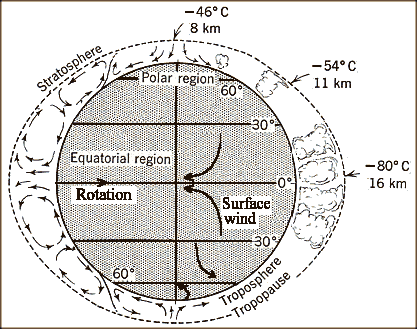 Most science courses avoid discussing rotation due to its apparent complexity. Although Coriolis first explained the world's weather systems, dividing the atmosphere into six circulation belts, three in each hemisphere, as the Polar, Temperate and Tropical zones, the simplistic description of hot air rising from the Equator and cold air falling at the poles creates a single cell per hemisphere, similar to that found on the almost non-rotating planet Venus. However, due to the Earth's rotation, air's viscosity and relative speed sweeps the tropical updraft so far behind the planet's rotation, and as it heads towards the poles, so far ahead of the planet's rotation, it reaches a point where the winds travel parallel to the equator, creating a powerful downdraft, that as it sweeps ahead of the planet, stimulates an opposed cell in the temperate regions, pulling air from high altitudes towards the Equator. As this cold air falls, it warms and in travelling from low latitudes towards the pole, it again sweeps ahead of the planet's rotation producing an updraft, that stimulates yet another updraft completing the Polar circulation cell. Amazingly, Coriolis devised this theory without present day satellite technology that verifies the many effects that this model accurately predicts.
Although Foucault's research gave rise to several rotational devices, leading to the development of the autopilot and a cruise liner's stabilisers, the limited linear mind-set demands that these devices be scientifically explained using the expressions by convention. Foucault's pendulum and his gyroscope remained scientific mysteries because of inappropriate theory, invalid assumptions, blind acceptance and academic pressure. In abandoning a Universal Reference Frame, Einstein, (in his contradictory theories of relativity), discounted motion as relative to any universal reference frame. However, as other sections of this work explore rotation at the atomic level, the Coriolis effect and these signals-of-change averaging devices verify a Universal Stationary Reference Frame. Despite the scientific community's use of abstract and unrelated concepts to explain rotation as angular motion, exploration at the atomic level reveals that only rotation and rotational momentum need consideration when describing the properties and behaviour of rotating bodies.
Towards a better Æther Theory.
Present-day measurement standards intimately link light speed, by way of atomic resonance clocking, to the definitions of time, length, motion and energy, despite the fact that light remains an magnetic resonance effect produced and propagated by atomic events in matter. Despite accepting invalid Nineteenth Century notions about time, clocks do not rule Nature, nor does light, nor does humanity's pet scientific theories. When applied to an object, the important factors defining an apparent force involve time, reaction rate, from reception to propagation, through matter's response changing position, alignment, activity, structure, and magnetic field strength. The applied force only becomes effective when compatible and exerted through the correct time frame as an energy-form with an appropriate energy level needed to affect or produce an effect in matter. Compatibility means that the matter must be in a state of activity that accepts and responds to that energy-form. Consequently, energy-forms may be absorbed, converted, stored, released, propagated, or rejected.
As a prime example of this, when a towrope responds to an applied force at one end in pulling a heavy object, certain conditions must be met in order to tow that object. When correctly mounted, a massive stationary winch easily tows ships weighing perhaps over 100,000 tons. Since the towrope must be capable of withstanding the enormous strain needed to tow such a mass, rope manufacturers use many thousands of parallel flax and fine cotton threads, some having breaking strains between 2.2 and 11 pounds (1-5 Kg) wrapped with the same initial stress into twines that form a rope. For the rope to maintain its molecular integrity, the applied strain must not exceed the molecular bond strength of the individual fibres and must be equally distributed along each fibre. If the take-up rate exceeds this value, the applied force breaks the rope. Overcoming the ship's apparent inertia and hydrodynamic drag factor, with sudden changed conditions, the stress forces may be extraordinary, exceeding this critical limit. The resistance increase being a combination of the boat's inertia, and the rate at which the ship moves water out of the way. Because the rope absorbs the application of small forces continually over a substantial period of time, until the applied force reaches a critical threshold point, where upon the boat begins to move as the stress energy releases.
Almost the same mathematics applies in descriptions of continental plate motion and all photoelectric effects. Over a substantial time period, just as rocks store tiny moment by moment increases in tectonic pressure at the plate collision boundaries, this excess in potential energy suddenly reaches a threshold point releasing the excess energy by way of an Earthquake series, through many energy and force-forms. The same applies to the entire range of photo-electric, photo-chemical and photo-reciprocity effects, where at extremely faint illumination levels, the influence of focussing a constant star field onto a photo-activated surface produces differential energy levels across the surface, which over time at the atomic level, accumulates by progressively increasing matter's activity in the illuminated areas, until the threshold energy point triggers temporary and-or permanent electrical, and-or atomic changes, giving rise to apparently quantised yes-no events and effects. The illumination may be so great that the concentrated illumination creates a progressive avalanche effect with signals-of-change migrating across and through a much larger surface area than the illuminated positions (an effect called photo-blooming).
When the atom's internal energy distribution systems fail, before considering atomic fission events, each atom releases excess energy to its neighbouring atoms through numerous energy and force-forms that propagate as changed conditions into the immediate local atomic environment, which may, or may not affect other matter. These natural events release and propagate energy and apparent force-forms through reception and re-transmission until a compatible magnitude dependent energy or force-form stimulates matter's response, where upon natural response processes liberate and transfer the energy throughout matter during a period of time. An available energy, whether liberated, absorbed or rejected by matter being dependent on the compatibility of the relationship of the energy-form and matter's ability to transfer or absorb the available energy. The Science of Nature links the mechanisms and processes, the very being of Nature, at the atomic level to all of matter's energy transfer systems.
To promote the break with conventional thinking, energy cannot be considered as a special entity, nor a dimension, rather energy must be described and defined as a property, as an effect of matter. Irrespective of a system's apparent complexity, any series of events concerning energy and matter, can be broken down into specific fundamental processes at the atomic frame of reference, where events in matter stimulate the atomic mechanism's response reactions. Each process involves simple and logical explanations. The apparent complexity and diversity of Nature being a consequence of the enormity of the number of reactions occurring in a single moment. In a candle flame, a rolling wheel, or pouring water from a jug, billions (1012 ) on billions of individual, continuous and terminal atomic events occur, replicated in various processes during the event.
A description of an oil refinery as a complex city of pipes, valves, storage containers and reaction chambers, from the reception point through various chemical processing plants, connected through various systems to the storage facility and despatch point from the operations control centre, may appear utterly complex, when the most difficult operation in the refinery focuses on the complex paper-work and accounting system documenting daily operations. The simple chemical reactions and processes taking place introduce complexity as the demands for specific products grow, with the refinery operators increasing the number of systems and processes taking place at the same instant, thereby increasing the complexity of the overall operation.
Just as in the refinery, each simple atomic event occurs in real time, within an enormous three-dimensional rotating, moving Universe, other chapters describe that from the initial event that occurred throughout a certain time frame, the released energy-forms distribute themselves throughout the Universe in subsequent time frames depending on the nature and magnitude of the cumulative energy-forms released. During a chemical explosion, the numerous energy-forms released maintain the reaction affecting matter, while producing effects as signals-of-change that distribute various energy-forms at different rates into the environment until the reactant exhaustion point occurs, but then for the environment to reach a point of energy-equilibrium, the duration could take millenniums as the signals-of-change propagate through matter's responses across the Universe.
Re-introducing Nature into the scheme of things:
In the time described by Dickens, around 1850 - 1880 AD, the old-school-tie mentality and nationalism produced so much scientific arrogance and in fighting within the scientific community, with scientific demarcation barriers preventing cross-faculty knowledge exchange, peer-pressure began stalling scientific advancement. Moulded and reinforced by inflexible European education systems, dogmatic academics defended many deluded beliefs, perhaps best illustrated by the class-conscious attitude of gentlemen comet hunters being superior to shooting star observers, and that episode where respected chemists rubbished grouping the chemical elements in periods of 8-elements under the Theory of Octaves. So dogmatic the belief-set that an academic risked reputation, status and career, suggesting, supporting, or promoting anything different. The greatest inventions coming from the private and commercial sectors, with serendipitous observations creating new disciplines while disproving scientific community beliefs. Owing to the fact that commercial enterprises sponsored much university research, academics protected their position, security and funding, often negating progress, promoting the belief, "Science has discovered everything. Nothing more can be discovered." To protect their sponsor's profits, disreputable scientists attacked inventions and theory that could upset funding and the status quo.
Such negative pecuniary scientific attitudes forced Science to take the back seat, leaving discoveries and note-worthy inventions to private individuals and rogue scientists, to change the world through patents and Science Fiction. Many defied the steadfast scientific beliefs, suggesting alternative concepts, mechanisms and philosophies, that made more sense than the confused and already convoluted scientific belief-set. Instigated by inventors (such as, Edison, Bell, Marconni, the Wright brothers) and visionaries (like Jules Verne and H.G.Wells) immense change beset the scientific community. Eminent highly respected scientists publicly rebuked such work as foolhardy nonsense. Within just 90 years, many of these great ideas became Science fact.
To the scientific community, finding fairies at the bottom of the garden had greater probability than Mr. Wells' suggestion of a manned space flight to the Moon ever becoming a reality. When Jules Verne suggested a submarine powered by atomic energy, the scientific community decried the idea because, "energy only comes from Chemical reactions." Within a century, many wondrous inventions (including nuclear power, the telephone, radio, the electric light, thermionic radio valves, the internal combustion engine, phonograph, television, AC power transmission, AC electric motors and the aircraft, rocket travel, computers, and lunar landers), all labelled as trivial and useless novelties, revolutionised industry creating worldwide communications and transport systems.
The, "We will never know" attitude in putting a damper on scientific advancement must be replaced with a more positive approach, one that says, "We will soon know." To be truly scientific, the scientific truths and scientific belief-set must have solid foundations based on mechanism, not ignorance, not conjecture and speculation, not faith, and not uncertainty. As pointed out in Chapter 1, an invalid belief-set appears with the acceptance of contradiction, exceptions to accepted beliefs, convoluted theory, mysticism, and faith. As people make mistakes in life, even long held-accepted beliefs passed down for generations, and flavour-of-the-month notions could be false. Faith and uncertainty do not grant scientific proof.
In recognising and accepting the fact that errors exist in the scientific belief-set, the causal researcher must challenge even the best thought-out most respected theory, especially those based on empirical mathematics, due to the high probability of error produced by the principle of error. A scientifically dangerous situation exists when accepting any work considered as fact, as a great insight, as unquestionable, without adequate proof. Such actions could spread a vicious knowledge virus, infecting and corrupting all future knowledge. Equally, a knowledge virus may begin with accepting a recommended change that the author promotes. Consequently, in reading the rest of this work, the reader takes on the causal researcher's role and responsibilities, protecting and advancing the sciences, selectively seeking out the correct explanation of matter, questioning, testing, and researching, the claims made by both the scientific community and the author. Of greater concern being the possibility that scientific fundamentalism may flourish, splitting the scientific community, extending, or creating more invalid fundamental beliefs.
Word count.
Revision 7 version 3 size 7,130
Revision 8 Version 1 size 14,030 - October 18th, 2005
-----------
------------------------------
Teacher: Johnny, what is the chemical formula of water?
An equation given in this chapter as v = ( v' + u ) / 1 + v'.u / c2 presents an interesting variety of answers, depending on the mathematical translation. Please allocate v' a value of 4, u the value of 2 and let c=6. What answers do the following interpretations give?
------------------------------ .
Although the misguided and arrogant must refute Chapter Three's title "Where did Science go wrong?" opting to defend absolutely scientific infallibility, these deluded unfortunates fail the sciences, presenting an indoctrinated unscientific approach to problem solving. In not researching the reasons for personal acceptance, or in examining scientific history which causal research demands, determining the how, and the why, through expedience they abandon the Scientific Method and the scientific community. For whatever reason, perhaps over a single point on page 1 chapter 1, or some grammah and mistaikes spealling, some choose to attack the author. Unfortunately, because fear and status protection prevents the indoctrinated mind asking relevant scientific questions, or making the necessary corrections, these individuals should review and reinforce their personal scientific beliefs by applying causal research, as a means to deny the author's accusation that indoctrination forced the blind acceptance of an invalid scientific belief-set.
At an Australia Day dinner party in 1995, a long discussion began concerning a televised series of educational programmes, broadcast on the ABC network for Australian postgraduate students, called, "The Infinite Universe". Academics, and would be academics voiced great pleasure and excitement, describing the series as presenting the most up to date theories, best special effects, images, interviews, and content. When the academics discovered that an astronomer in their midst had no knowledge of this series, they began deliberately targeting their remarks towards him, describing various theories, images and events. Because the astronomer considered much of the theory presented as conjecture, supposition, speculation, and abhorrent nonsense, as the Sun rose, then set, then rose again, one by one each academic entered the grieving process, having pet theories and new found beliefs, crushed, crucified, invalidated and corrected. When suggested that this discussion be written as a scientific paper, fear gripped the astronomer, because such a paper must involve changing the Universe by changing people's perception.
For the next few months, through resipiscence, these academics harassed the astronomer, demanding this work be written. To voice his objections, the author began writing this work on May 1, 1995, (AKA Mayday, - the international code for life threatening distress, for imminent disaster). With the author's first steps into causal research, realisation invoked the grieving process, with an enormous emotional outpouring of loss, anguish, apprehension, remorse, frustration, resentment and anger. These temporary emotive feelings gave way to intrigue, satisfaction, and acceptance, well before considering any attempt to detect, explain or correct the errors, tracing numerous errors through many junction points to their sources. This work examines that path. The original 17 page paper greeted by "And? And? And? There was a lot more to it than that!"
---------
Return to
Chapter 2
© Copyright 1995 AD, Robert Lanigan-O'Keeffe, Sydney, Australia.
Not for copying, publication or distribution without permission.
Changing the Universe, Introducing The AD 2000 Æther Theory.
Advance to
Chapter 4Chapter Notes
Item 1. Fusion:
In 1860, popular opinion amongst academics described solar reactions as chemical in origin because chemical energy powered the Universe, radiating life supporting light and heat. Astronomers considered two further speculations about the solar interior, describing a layered stellar body using either the Wilson model with a massive dark nucleus, or the Kirchoff model with an equally massive incandescent nucleus. When Atomic Physicists talk about the nucleus, referring to Rutherford's atomic core, one must be amused with the following description, for it correctly uses a common term of the day related to chemical bonding, but actually describes part of the reaction cycle taking place using the present day meaning.
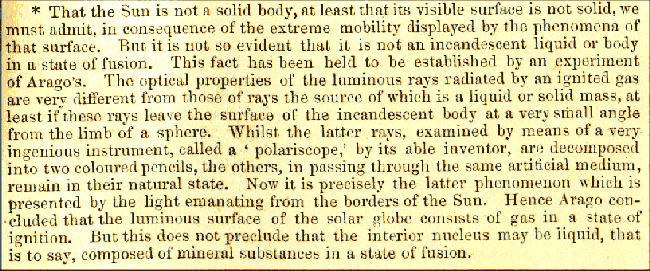
For source reference, hold the mouse over the image.
Return to text.
Item 2. Meaning being subject to one's interpretation.
A class of year 7 Chemistry students
Johnny: That's easy sir, H I J K L M N O, sir.
Aggressively the teacher responds, "What do you mean Johnny, H I J K L M N O ?"
In shock Johnny recoils...
"But Sir, yesterday sir, you described water's chemical formula as H to O, didn't you?"
A Question of Interpretation
v = (( v' + u ) / 1 ) + (v'.u ) / c2
v = ( v' + u ) / (( 1 + v').u / c2 ))
v = ( v' + u ) / (( 1 + v'.u )/ c2 )
Obviously, because other translations also exist, which answer gives the correct answer?
Return to
Chapter 2
© Copyright 1995 AD, Robert Lanigan-O'Keeffe, Sydney, Australia.
Not for copying, publication or distribution without permission.
Changing the Universe, Introducing The AD 2000 Æther Theory.
Advance to
Chapter 4