 Return to Chapter 1 | © Copyright 1995 AD, Robert Lanigan-O'Keeffe, Sydney, Australia. |  Advance to Chapter 3 |
CHAPTER TWO
EXTRATERRESTRIAL
INTERLOPERS.
Return to Chapter 1 | © Copyright 1995 AD, Robert Lanigan-O'Keeffe, Sydney, Australia. | Advance to Chapter 3 |
EXTRATERRESTRIAL
INTERLOPERS.
Unfortunately, due to the nature of litigation, when adverse research findings identify a fraud or a hoax, the media and publishing houses (responsible for releasing a knowledge virus guiding public opinion) maintain the virus by their refusal to retract the relevant stories and commentaries, describing unseen conclusions as non-news-worthy or yesterday's news. In the case of a deliberate fraud or hoax, the perpetrator may even threaten the researcher's life, security, and credibility, as a means to nullify, discredit, or prevent adverse research findings becoming public. Researchers must find other ways of stating the obvious. The work, "Let's Hope They're Friendly!" 1 , shows such treatment of research that challenges the claimed sighting, while mocking scientific community opinions made to early. The work details the story of a reporter's movie footage, and the attempt to claim $10 million from "The National Enquirer" for a genuine film of a UFO. By definition, an Unidentified Flying Object remains unidentified until identified as being something, which from that moment, the object no longer falls into the unidentified classification. Please consider as a public relations exercise, as a gimmick and as an advertising tool to tease the gullible, arousing public interest promoting sales, irrespective of what value cash and prizes an organization offers for a genuine film or genuine proof of a UFO, identification of the object negates the payment of any prize, for although the footage and proof may be considered genuine, no longer can anyone consider the object unidentified.
In support of proving a UFO as extraterrestrial in origin, in convincing others, the compromised leading question technique invokes the tautology logic style, that asks many questions containing the desired answer, illustrated with pertinent evidence (whether fact or fiction) that encourages just one specific answer, in agreement with the programmed answer. The logic style turns many normal activities and limitations into deliberate barriers that intrigue the reader, making the published article more saleable. Researchers should be aware of the following;
Unlike the journalist meeting the publisher's deadline in writing an "it will do" emotive story, scientific researchers and the scientific community must tread carefully, analysing and exhausting all the facts. Unfortunately, all costly research exercises introduce an inertia resisting the exchange of information, preventing the pre-release of findings. Before initiating any new research project requiring capital expenditure and-or resource allocation, funding must be sought for employment, facilities, transport, records, labour, security, equipment and time frame, as distinct from those resources already contracted for specific tasks, and then all expenditure must be approved. Before government agencies, military authorities, and scientific institutions, contemplate any lengthy investigation, project managers must be appointed. The project manager's job description involves seeking answers to basic questions concerning research funding, budgets, costs, administration, staffing, agenda, needs, terms-of-reference, security, loss prevention, positive benefits, time allocation, reporting, et cetera.
Made from an orbiting spacecraft, although placing the astronauts lives in danger, the NASA footage of a meteor shower from above shows some very interesting events, such as high angle bouncing meteors, to asteroids making sudden course changes when striking the atmosphere. It should be pointed out that Ufologists claim this footage as supporting their cause. Promoted as truth in the TV program SIGHTINGS, the scriptwriters presented arguments giving the UFO amazing abilities. In presenting proof for false claims, speculation replaces truth with, "Since an advanced civilization designed and constructed the extraterrestrial spacecraft, it can change direction in an instant. Such footage, Ufologists claim, proves beyond all shadow of doubt that the peculiar objects directing the meteor showers, must be genuine UFOs. The programme raised the question, "What are UFOs doing in the middle of a meteor shower?" Immediately the scriptwriters gave a catechism answer inferring that advanced aliens from distant worlds deliberately guided the asteroids, smashing them into the Earth. Without any evidence, they inferred proof with more blatant speculation, "The aliens use advanced tractor beams to direct and crash the meteors ... "
Many questions stir the imagination, about the purpose of the intelligent beings' adventure, where after journeying so far to visit this little insignificant planet, risk self-destruction through cheap entertainment throwing small rocks into a hostile atmosphere. As any aviator would testify, one could only interpret being in a meteor shower as bloody madness and sheer stupidity. No matter how good the defence mechanisms may be, what can go wrong, generally does, and craft get damaged. In removing all natural mechanisms and processes, the highly advanced aliens seem pretty stupid and rather backward in throwing small rocks into the atmosphere. Surely, to drop a rock on someone's head from that height, the aliens would think to use something a great deal bigger. During the Earth's 4.2 thousand million year history, of rocks falling from the sky, would not the aliens responsible for these annual games seek a better way, have better weapons and defence systems? It must be recognised that the astronauts who filmed this predicted annual event risked their lives to capture the graphic images, in showing humanity something never seen before.
One must question the hidden agenda of such television programmes and fictional works, in attempting to twist the subject's mind, to control knowledge, to keep people ignorant, to twist science and the truth in creating falsehoods, to destroy the great achievements in modern science by misrepresentation, using salesmanship to sell a product that does not exist. In this region of The Galaxy, with such vast distances between neighbouring planetary systems, apart from the just passing, saw your lights on serendipitous encounter, far to many claimed encounters seem unreasonable egocentric excursions, which although describing so-called advanced technologies merely regurgitate accepted flavour-of-the-month theories, fundamentalist beliefs, and terrestrial technology gleaned from stories detailing existing and science fiction, invalid theories, weapons, motive power, life-support, and instrumentation. Fanciful explanation for extraterrestrials travelling across the Galaxy with warp drive engines, to this isolated lonely planet, incorporate many valid reasons along with the trite; (just dropped in for a quick cup of tea; on holidays; some rest and recreation perhaps involving a bit of interspecies procreation; to necessary mechanical repairs; exploring as tourists, recording the moment; collecting mementoes and samples for scientific analysis; perhaps satisfying some predatory need, or in a demoniacal plan to serve man as food.)
The more immediate concern involves human apathy, general ill-preparedness, produced from ignorance and egotism, accepting false beliefs, bad scientific theory, and religious dogma, which in presenting much misinformation obscures the dangers from genuine cosmic interlopers, uncaring, unthinking mindless masses. In presenting an enormous threat from above, these bodies appear each day as meteors. Any asteroid, comet or spacecraft that impacts with a planetary atmosphere becomes a meteor (AKA, a shooting star). Astronomy defines the surviving fragments that reach and litter a planet's surface, as meteorites. Even though large atmospheric meteor events may not strike the surface, their arrival may greatly affect the planet's fragile environment. The concern being that unless prepared and action taken, approving suitable long term budgets and strategies, developing and implementing suitable technology to defend and protect the Earth, then all clocks count down to that moment when a large object destroys all life on this planet. The potential meteor threat requires examination. Numerous evolutionary forces hide the true origins of some boulders and planetary sized bodies drifting throughout the Galaxy.
For the first 180 years of telescopic astronomy, The Church and scientific community moulded and manipulated scientific attitudes, charging witnesses with heresy and fraud for describing burning stones falling from the heavens, because such events simply did not occur. Although history recounts many instances of fish, seed and frogs falling from the sky (after being swept up in water spouts), stories of burning rocks crashing to the ground required human intervention, a hoax, much like the story of Chicken Little. Under the immovable belief-set of 1790 AD, no sane person could accept stories describing lumps of burning rocks crashing down from the heavens. The Church and scientific community considered reports of such rock falls since 1600, as fraudulent and scientifically unacceptable, discounting the event by destroying a witness's credibility, as emotional and unreliable, confusing fact and fiction. The Church suppressed and actively disputed hard physical evidence including genuine meteorites. In giving humanity a false sense of security keeping people ignorant, Church and scientific authorities argued, "Anyone can find a stone once used in a fireplace or burn a rock and say it came from above. Man must use a cannon to give rocks impetus. As burning gunpowder makes a cannon ball extremely hot, then gunpowder causes the burning rock's fiery trail! Man must be responsible for such fraud! Find the cannon and the guilty party."
In Chlandni's report of 1794, he told of a dilemma concerning a remarkable mass of Iron found in Siberia. A mass that could only be of celestial origin, totally unlike any other rock within a thousand miles, and far too large to be made there, or put there by man. A year later, in 1795, a fifty-six pound (25.5 Kg) burning rock fell from the heavens, landing near Wold Cottage in Yorkshire. Several witnesses, including a clergyman, witnessed the event. Retrieved from a tiny crater and displayed at the British Natural History Museum, the meteorite, sketches, and impact reports turned the tables on the fixed belief-set. Almost overnight, with the well documented impact event considered scientific with unquestionable proof, bestowing credibility on the witnesses, a great deal of evidence concerning other falls began appearing from all over the globe. Many of these oddities seemed celestial in origin, but no common thread linked the many different materials found. Like Chlandni's report, the new reports describe alien minerals composed of metals, to various igneous and sedimentary rocks, inferring the destruction of a planet much like the Earth. During this fossicking activity, a strange glass-like meteorite appeared, the mineral, Obsidian. Occurring as tiny black disks and disk fragments, it took many years before the sciences realised that many Obsidian meteorites originated from the Earth, as spinning liquefied molten drops (of soil and rock) solidified in a cold atmosphere, forming glass.
Although the final approach trajectory produced numerous impact events, meteorites appeared to fall into several classifications depending on composition. Fossickers quickly identified and classified the five commonly found meteorites as Nickel-Iron, pure Carbon, stony (as conglomerate and igneous rocks), to various ices and Obsidian tektites.
When an object comes to grief, exploding in the atmosphere creating a debris field, or impacting with the planet's surface (land or water), then each landed fragment becomes a meteorite, from dust and grain-sized particles to progressively more massive objects. Although collectors consider finding a meteorite as rare, they fail to recognise or value the enormous number of small objects described under the meteorite classification, many of which softly land on rooves, streets, playing fields, parks and in rivers, without forming craters. Irrespective of size or origin, astronomers deem all found single-entry and re-entry fragments as meteorites, including many terrestrial rock fragments, blown from the planet's surface (as described) because such fragments show every indication of supersonic burning, radiation, and chemical change, some impacting the surface forming deep craters.
With the advent of flight, early aviators and geographers began identifying many previously unseen craters on the Earth. With space flight, even more craters appeared, some of which measured thousands of miles across, far larger than anything noticed on any aerial survey map. As space craft journeyed to the planets, pushing observational boundaries to new levels, pictures sent back told stories of other horrendous impacts, on the Moon's other side, on Mercury, the tiny moons of Mars, across the Red planet itself, and on Jupiter's moons. Holographic radar mapping of Venus revealed fresh craters under the obscuring cloud layer. The East coast of the South American Continent records half of the largest known Earth impact, an event leaving a scar of fractured rock and fault pattens along 2,500 Km of coast. Erosion virtually cleared all evidence of this event. In 1994, a worldwide audience watched and cheered as a series of cometary fragments crashed violently into the giant planet Jupiter, illustrating the devastating final effects of such encounters. Several months before, the giant planet captured a comet, which, with the decaying orbit broke up, into a string of several comets. Over several days, these tiny comets entered the Jovian atmosphere with the rotation of the planet, each striking near the leading edge sunrise terminator, punching holes into the planet's surface, bruising the giant planet, as impact plumes rose above the limb of the planet. The possibility exists that solid debris blown into space from Jupiter's surface may on day reach the Earth.
Sedimentary meteorites identify other formation processes. As sedimentary meteorites primarily consist of solidified river, delta and desert deposited materials, the largest particle size generally indicates water's speed during deposition, active streams and rivers must flow on the original planet's crust. Conglomerates made of abraded rounded semi-polished smooth pebbles, sand, and muds cemented together generally identify the faster flowing rivers, while shales identify fine mud precipitating in a lake, bog, or river delta. Such sedimentary rocks generally contain part of the Earth's fossil record (including pollen, seeds, plant, shell fish, insect, and animal remnants).
Terrestrial meteorites may not appear related to any geological region in the Universe owing to the supersonic ejection, radiation and out-gassing in a deep vacuum (perhaps for several million years), followed by re-entry heating chemically changing the mineral composition. Over this period, although the rock's physical composition changes markedly, the physical structure may appear to remain the same. Oxygen and other atmospheric gasses trapped in the rock during formation undergo radiation therapy in space, giving rise to an apparent alien atmosphere. Amazing evidence obtained from orbiting spacecraft showing the chemical change effects in the composition, in the deterioration of paints, surface coatings and metals, caused by both solar radiation, out-gassing and micro-meteor bombardment in space, states that the detected atmospheric composition contained in a meteorite cannot be trusted after just 10 years.
Some sedimentary objects may be short-term one-hop projectiles, explosively travelling from the event through the atmosphere to a far distant impact site while others become long-term satellites or asteroids in a solar orbit. Following such a cataclysm, it may take several million years for terrestrial chemically changed rocks to return and fall back to the Earth. Despite the Earth being the highest probability for fossil laden meteorites, some academics who seek pecuniary gain distort the truth claiming that these sedimentary meteorites provide the penultimate proof that life on Earth originated on Mars, "for this explanation alone", they state, "explains why these rocks differ so greatly from any rocks found on the Earth, including the composition and primitive gases contained in the specimen." Such claimed proof and explanation must be considered unscientific, as a deliberate and premeditated scientific deception.
From granites to basalts containing other silicates, as igneous meteorites vary in composition and grain size identifying the formation process from slow to rapid cooling, they narrow the original source to a planet's silica rich crust. This identifies not just the terrestrial planets (Mercury, Venus, Earth and Mars), but also the moons of Jupiter, Saturn, Uranus, Neptune and the Earth. Because solar radiation plays havoc with the material's composition, even though crystallographers attempt to carefully piece the meteorite puzzle together, without knowing the exact and entire geomorphology of each planet and moon, without knowing the period of time that solar radiation irradiated and out-gassed the object in space, without considering the metamorphic effects of ejection and re-entry, their futile attempts cannot prove that a certain igneous material came from planet X or Mars.
Since early geologists attributed mineral Obsidian veins (found between rock strata) to high altitude volcanic activity, and that some veins coincidentally defined barriers between geological periods, speculation presented the view that intense volcanic activity marked major geological changes altering the environment, evolution, and life, as precise worldwide geological boundaries mark the sudden extinction of animals and plants, followed by the survivors establishing a new world. Although absolutely different rock formations, landscape changes, erosion pattens, and fossil records mark each geological period, some continents show no evidence of change. Early geologists failed to realise the metre thick Obsidian deposits of Mexico indicated a massive worldwide environmental disaster. Such observational evidence suggests that the geological periods must have been each finished by a worldwide event, that cannot be explained through sheer coincidence, or by the sudden pressure cooker effect with a superheated Earth blowing its safety valve.
At first, the fact that very few rivers flow in Yucatān and that these rivers could not support a large population, the concentric locations of large ancient Mayan cities with massive populations around a central point somewhere in the Gulf of Mexico mystified archaeologists. The mystery resolved itself when a mining geologist searching for mineral wealth with a gravitometer serendipitously identified an almost circular ancient major meteor impact crater at that point. Geologists believe that this event, around 65 million years ago, coincides with the demise of dinosaurs in the Northern hemisphere. When the impact cratered the ocean floor blasting molten rock and superheated steam into the sky, major environmental changes took place, dumping Obsidian on Mexico and the rest of the planet. The enormous crater, in distorting the coralline limestone coastal region, formed concentric underground rivers above which the Mayans built their cities.
Because sites in the Southern hemisphere indicate that Southern dinosaurs survived a great deal longer, coming to a sticky-end at the conclusion of another geological period, without sufficient evidence, geologist suggest a similar catastrophe. A small object, perhaps between 10 to 50 kilometres across could easily destroy most life on this planet, disrupting the weather system, food chain, solar radiation, terrestrial magnetic field, coating trees, plants and seeds with unfertile glass and ash, effectively causing an apparent nuclear winter lasting about a year, in either the Northern or the Southern hemisphere due to the world's Coriolis weather system circulating the dust from the Pole to the Equator. The loss of sunlight producing a spontaneous ice age in that hemisphere. Throughout geological history, Obsidian deposits identify similar events to the Yucatān incident, resulting from either meteor impact or volcanic activity. Due to the sharp edges obtained by chipping the edge, stone-age peoples used obsidian glass to make knives, arrowheads, spears and tools.
 |
For even the most advanced radar system, most asteroids remain invisible until they become a meteor on final approach. With a scan perhaps once every two seconds, radar systems typically quantise the view of an approaching disaster. For a fast asteroid travelling 1,500 Km between successive scans, with equipment limited to a 200 Km range, with the object's rapid approach speed producing a Doppler shift beyond the detectable frequency range, normal radar equipment hides the object's approach. Because these objects do not carry transponders, and since even the most experienced radar operators and airport controllers ignore spurious bogus non-apparently related radar returns, an observed in-bound object remains undetected. Due to atmospheric refraction effects and radar detection of wind blown litter, radar operators often ignore spurious radar blips.
Occasionally, weather satellites pick up some dramatic near miss events, mainly in the Infrared spectrum showing high altitude continental length tracks (some well over 2,000 Km long), with just a tiny optical component (less than 400 Km) near the track's end point. These tracks rarely appear because most weather satellites typically image the Earth at half-hourly intervals. To confirm this for themselves, on a regular basis researchers should examine the archives of various weather satellites, especially around the Summer and Winter solstices, such as the Australian Bureau of Meteorology (Latest Colour IR Images); for the USA and most other links, NOAA Satellite and Information service (National Oceanic and Atmospheric Administration), and for Japan, the Japan Meteorological Agency. When such a track appears, examination of the visual, shortwave IR, water vapour and Longwave IR confirms the observation, revealing a range of interesting effects.
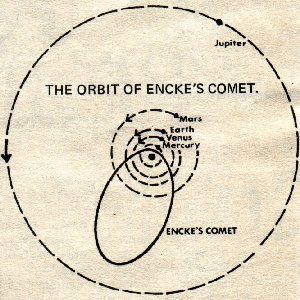
Throughout British history, due to untimely battle losses, misfortune, and the deaths of various kings, superstition branded the comet an evil omen of potential doom, gloom and disaster, while shooting stars became a sign of improving luck, on which to make a wish. Although Newton gave Haley the mathematics predicting The Great Comet's return every 75-76 years, he too considered comets as mystical bodies. However, with the predicted return of Haley's Comet in 1910, with the Earth passing through the comet's solid tail, the popular press contemplated the worst-case scenario, preaching ignorance, fear, gloom, disaster and destruction. As most observed comets rarely intersect planetary orbits and just a handful of comets intersect the Earth's orbit, this close encounter gave astronomers an extremely rare research opportunity, and a means to dispel popular misconceptions.
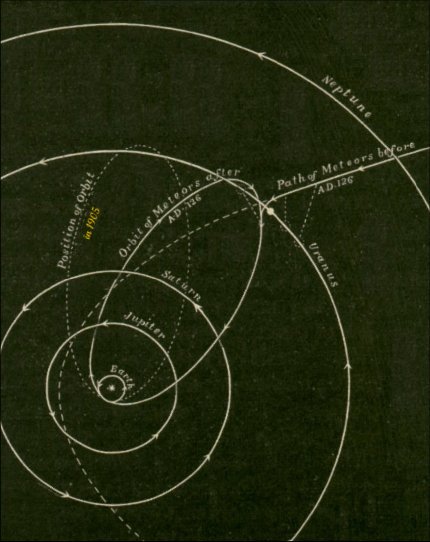 |
As researchers traced the historical records through annual shooting star observations, the startling link to the comet hunter's records generated only one possible conclusion, an invalid conclusion that from 1872 to 1886, orbital precession of Comet Biela, spawned two completely different showers. Every seven years with the comet's return, researchers identified more showers directly related to the comet's trajectory. Orbital geometry paints a more serious and valid conclusion, where Earth intersecting cometary orbital cross the orbit twice, producing a pair of meteor events. Nighttime shooting star events occur as the swarm approaches from the cosmos, however, the illustration below identifies a second meteor shower that may occur when the Earth intercepts the swarm's return, with the asteroids moving away from the Sun, producing many unseen daytime shower events. Because daytime sky glow hides these showers, apathy and indifference removes all daytime meteor prediction and mention from the astronomical ephemeris. Even though the corrected analysis should obviously read, "from 1872 to 1886, Comet Biela spawned four showers...", other errors crept into human interpretation.
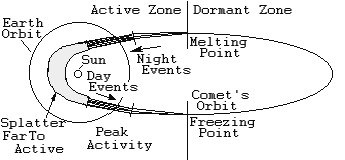 |
As the comet approaches the Sun, progressively increasing explosive melting forms a debris trail with a progressive rate of dispersion. Equally, with the comet moving away from the Sun and cooling with decreasing potential energy and incident radiation, the decreasing rate of explosive melting reduces the dispersion rate, leading to regular dumbbell swarms along the precessing orbital path. Each dumbbell representing a period when the comet approached a large gravitational body (star or planet). As the dumbbell swarms continue to orbit following the comet, the dormant regions lack of debris turns a predicted annual shower into a non-event. In the case of the October Sporadic meteor shower, the trail's active zone produces a daytime meteor shower every three years.
Serendipity plays a major role in noticing daytime events. Sometimes daytime meteor events appear during a total solar eclipse, but then they may appear just before Sunrise or just after Sunset, with the meteor display apparently coming from the direction of the Sun. However, stronger daytime showers also appear near midnight, with the meteor trails climbing vertically from the horizon. During the day, the iridescent vapour trails appear quite different to those produced by highflying aircraft or rockets. At very high altitudes observers note that fine meteor vapour trails exhibit a strange blue fluorescence which at lower altitudes blends into the sky glow. Things change when larger meteors reach the atmosphere's saturated water vapour layer at 10,000 metres altitude, appearing much like a classic vapour trail, sometimes with the burning meteor discolouring the cloud, taking on the appearance of fast moving comet-like objects, with a head and tail, separated and followed by an extensive vapour trail. Rather than radiating from an apparent sky location, radar observations show these daytime meteor clouds crossing the entire sky in bands.
Typically reported as a daytime UFO sighting, when larger objects skim the upper atmosphere, depending on relative speed, size, trajectory, and proximity, the meteor's rapid air displacement may pass un-noticed or produce unusual winds, a sonic boom, to a thermonuclear event. As the audible effects of many upper atmospheric events must travel a considerable distance to the ground based observer, the event's local effects may not be experienced, or noticed for several minutes, and then they may not be associated with the apparently silent event. Due to the altitude and necessary observing angle from the observer's location, distant horizon scanning aircraft and weather radar systems generally do not detect meteor events until the meteor enters the radar beam's observing lobe. Due to the object's speed, most Doppler radar systems cannot resolve an approaching meteor, with the technology negating the frequency shift as too great. Owing to the radar's scanning rate quantising observations, a fast meteor could enter the atmosphere and strike the ground before detection.
When the Earth's orbit crosses or comes near an expanding debris trail, then as the Earth returns to that intersection point, over a range of dates, the debris cloud impinges into the Earth's atmosphere. The above illustration shows that one cometary orbit produces two meteor showers, one at night and a generally equally brilliant unobserved daytime shower. These annual events differ from year to year owing to the broken ring's cloud density and the cloud's orbital position. For the duration of the encounter, shooting stars fleetingly appear at the same approximate angular position and time. The solar wind, gravitational effects and the cloud's diffusion rate disperse and dissipate the cloud over time, giving rise to irregular annual strength showers that seemingly age badly. Although considered fresh and concentrated in 1866, the massive Leonids shower that lasted just three-days, at its best today appears as a non-event lasting several weeks.
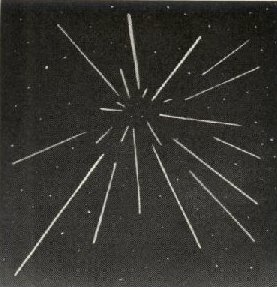
Meteor displays vary greatly from each comet's different composition, to the asteroid's trajectory and entry speed, meteors appear from exploding fireballs and rapidly moving colourful shooting star streaks to the rare overhead sightings where the meteor trails corkscrew and flash. As applies to a fireworks display, really beautiful meteor showers appear only when good seeing conditions give enormous contrast to the night sky. Due to the low brightness of most brilliant meteor shower displays, with the rising Moon increasing the sky's brightness, the meteor display seems to fade away. Equally, this low brightness creates massive observational differences between the clear country night sky and sky glow affected polluted city locations. By comparing nearby city and country meteor shower observations, the meteor shower's general brightness (or magnitude) becomes evident. In measuring a star's apparent brightness, astronomers use the magnitude scale, where higher numbers translate to fainter stars, and the lowest number to the brightest star. In the high country, as naked-eye observations reach magnitude 7.5 people see the Milky Way in its magnificence, while in the polluted city environment where the sky glow hides all but the brighter stars, reducing the seeing conditions to well below third magnitude. Unfortunately, with the intensity of some bright meteor shower events being 4th magnitude, city dwellers often miss experiencing some on Nature's most spectacular displays. Only occasionally do city folk see the really bright meteor events.
 |
Before delving deeper into meteor observations, it becomes necessary to describe in part, the working Solar System. Rather than presenting a full and complete explanation of gravity and matter at this moment, as an introduction, please consider treating the gravitational force as a differential feedback response reaction between two of more bodies. This provides an inkling into matter's mechanism and its behaviour when responding to changing conditions. Under this concept, as all matter transmits and receives signals-of-change, in passively storing and liberating energy, a feedback situation internally and externally creates the physical illusion of relative gravitational forces existing between all masses across the Universe. As a mechanism for energy propagation, in agreement with the proposed correction of Newton's error, that being, (with increasing height the potential energy decreases,) then as the separation decreases the increasing signal feedback increases a body's potential energy, until the energies at the atomic level equalise and remain constant when the bodies coalesce.
A body's potential energy (synonymous with activity) being the total energy stored and operating energy within the body, (including environmental throughput, pressure, chemical bonding, stress, compression and motion). With respect to the Stationary Universal Reference Frame, for a body at rest, or travelling with uniform linear motion in free space, its potential energy remains constant until acted upon by external signals-of-change (as force-forms or energy-forms) differentially affecting matter's activity. Other sections of this work discuss and describe more fully matter's standing state activity as dependent on environmental signal throughput. Although discounted by Einstein (due to his blind acceptance of unproven speculation and error), proof for the Stationary Universal Reference Frame comes from simple experiments and simple observations dealing with rotational effects. In other chapters describing The Solar System, in reconciling Solar rotation and the production of the star's Coriolis circulation cells, with rotating bodies differentially distributing the average throughput throughout the rotating structure, creating several important observational illusions, the proofs for the Stationary Universal Reference Frame appear.
A continuous gravity-feedback condition applies throughout the Universe attracting masses, as galaxies, stars, clouds, planets, moons, asteroids and comets orbit a local parent gravitational body. Illustrated within the Solar System, planets generally follow almost circular orbits, travelling around the Sun in the same direction, virtually on the solar equatorial plane; however, irrespective of the planet's axial inclination to the solar equatorial plane, the major planetary moon systems mimic this design, with a planet's moons extending their orbits on the planet's equatorial plane, travelling in the same direction as the planet. The Solar System's asteroid belts and planetary rings follow suit, orbiting the principle gravitational body on the common plane, in the same direction as the planet and moons, (the rings of Saturn, Jupiter, Uranus and Neptune), with common rotational attributes. In describing this common Coriolis structure, Chapters 11 and 23 discount and replace the deceptive and false flavour-of-the-month knowledge virus, served up by the media's script writers and journalists sensationalising ignorance and stupidity, wrongfully validating the Solar System's origin from a hypothetical supernova event, as fact.
Irrespective of a comet's origin, gravitational feedback between the comet and the Solar System begins well before the comet enters the Solar System, warming the comet. The rate of uniform warming being dependent on its approach speed and the gravitational signal's strength, not on radiant energy striking only one side. Friction and incident solar radiation at the extremities of the Solar System play minor roles in the development of the comet's tail. With the comet's matter receiving more throughput on the approaching side, and lesser throughput on the trailing side, energy distribution within the irregularly shaped and packed object produces gyroscopic effects changing trajectory and rotating the comet around an apparent centre of mass. As the object aligns for greatest signal reception, it begins the process of entering the Solar System, where gravitational feedback effects increase the comet's potential energy. In preheating the comet's internal components at different rates depending on the type of matter, the comet begins melting from within, where the frozen gases boil and pressurise the surface from below, explosively fragmenting and shedding the frozen atmosphere along with other collected debris.
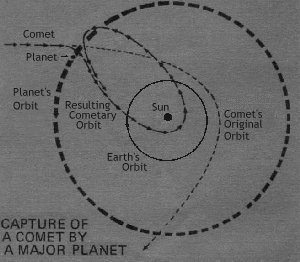
It became very apparent that the accepted cometary tail explanation only partially explained meteor events. Some asteroids become rogue objects when the orbit changes, perhaps deflected by planetary gravity, by an atmospheric bounce, or refraction passing through a planetary atmosphere. As telescopic astronomer searched for other more distant planets, they identified a series of large bodies existing between Mars and Jupiter, minor planets that fitted into the missing planetary zone, predicted by the strange Titus Bodes orbital relationship equation. Attempts to explain the spacing between the planet's almost circular orbits, theorists determined the following mathematical description. Start with this doubling sequence of numbers,
| position number | constant + | orbital variant | prediction au | Mean Radius au | Name or objects |
| 1 | 0.4 + | 0.3 x 2-1 | 0.4 | 0.4 | Mercury |
| 2 | 0.4 + | 0.3 x 20 | 0.7 | 0.7 | Venus |
| 3 | 0.4 + | 0.3 x 21 | 1.0 | 1.0 | Earth |
| 4 | 0.4 + | 0.3 x 22 | 1.6 | 1.6 | Mars |
| 5 | 0.4 + | 0.3 x 23 | 2.8 | 2.76 | Gap...asteroid belts including Ceres, Pallas, Juno, Vesta |
| 6 | 0.4 + | 0.3 x 24 | 5.2 | 5.2 | Jupiter |
| 7 | 0.4 + | 0.3 x 25 | 10.0 | 9.5 | Saturn |
| 8 | 0.4 + | 0.3 x 26 | 19.6 | 19.2 | Uranus |
| 9 | 0.4 + | 0.3 x 27 | 38.8 | 30.1 | Neptune |
| 10 | 0.4 + | 0.3 x 28 | 77.2 | 39.4 | Pluto... Non-circular orbit! |
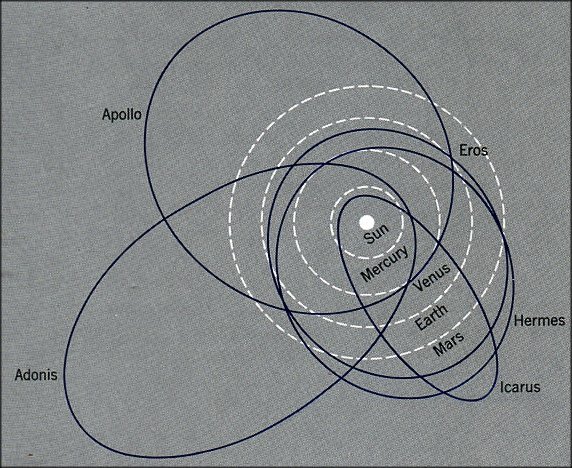
As these asteroids started to give up their secrets, much closer objects appeared, with scientific papers describing near Earth and Earth intersecting orbits. This fact worried astronomers, and more so when the diameters became apparent; some measuring hundreds of kilometres across, existing in the gaps between the Earth and Mars, and between the Earth and Venus. Suddenly the meteor picture became clearer explaining some weird December-January and July-August observations, with the Earth's orbit at perihelion (nearest to Sun) and aphelion (furthest from Sun) impinging on the closest asteroid belts.
 |
Based on the molecular movements and oxidation that began on the impact date, the only real date derived with reliability being that date when the asteroid arrived on the Earth as a meteorite. To predate the asteroid's birth before this involves making some dreadful unscientific and unfounded assumptions, about the origin of the Solar System, and the particular Solar System Origin Theory one chooses on which to base important assumptions. Due to radiation and heat treatment, atomic dating methods prove themselves unsatisfactory, as many more recently formed terrestrial meteorites appear to exhibit the same extremely distant age. Molecular migration analysis on such materials provides a more recent Earth relative impact date. Equally, lunar rock samples give a similar age for the Moon, based on these same suspect assumptions describing someone's speculation as to how it all began. When it comes to accurately ageing The Earth, tracing strata, magnetic reversals and fossil tree growth rings, progressively back in time, a technological barrier occurs at a point around 4.2 to 5 thousand million years ago, when The Earth's crust formed above the molten magma, under a superheated water saturated atmosphere.
In the stratosphere, visible and seemingly invisible meteor trails involve chemical and nuclear activity, where atmospheric and shredded materials align in the Earth's magnetic field, which for a short period of time, in a specific activity zone, act as a resonant mirror reflecting radio signals. Responsible for short-term AM radio interference, invisible meteor trails often appear in the infrared region. Radio engineers often incorrectly blame solar activity for blocking local radio signals when an intense meteor shower passes overhead.
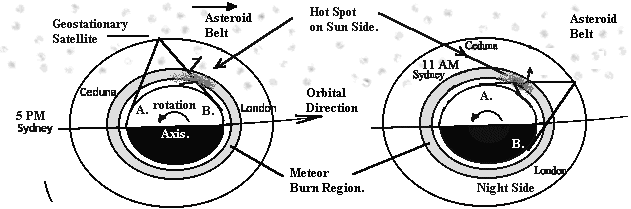
Meteor showers produce some interesting long distance radio anomalies that tell the truth. As an arc or the band of maximum intensity burn, the hot spot appears where dust and debris enter the upper atmosphere in such concentration that a strong radio-reflective barrier develops. Since all geostationary communication satellites remain virtually fixed in position above a particular region on the rotating Earth, the communication-links to and from the satellite serve to identify the location of the Earth's hot spot, severing communications between ground based stations. Equally, due to the overhead curved activity layer acting as a radio-reflective concave mirror, radio and television signals from distant countries and cities appear through meteor scatter as local strength radio stations and television channels (explaining New Zealand's TV1 being detected in Sydney Australia at 5PM AEST, then about two hours later, Townsville television appears in Bombala, Brisbane television in Melbourne. A few hours later as the hot spot passes midway between cities 1,500 to 2,500 Kilometres apart, the whispering wall effect allows local low power CB communications between Perth and Sydney.)
A rather interesting satellite communication link from Ceduna in South Australia to London, told an amazing story, a day to day story of day and night meteor shower activity. Satellite communication links involve a double-two-way data transmission transfer protocol, allowing simultaneous two-way data transmissions. From each ground station to the satellite and from the satellite to each ground station, half a world apart, the satellite uses four links per channel, as up and down links. Because both ground stations transmit a signal along a path that travels at a relatively low angle to the horizon, the links pass through a great deal of stratosphere, where the most intense meteor activity occurs. The ferocity of the hot spot burn so great that it cuts the link between the satellite and one station, producing a signal dropout. The ground-station's signals being reflected by the meteor trails to some far-off non-relevant location.
Simply by noting recurring daily dropout points, these satellite links identify the meteor storm's origin and angle of incidence, as being from a cometary cloud or from the Earth impinging an asteroid belt. As a simple geometric construct, an isosceles triangle represents the Australia-Satellite link climbing from Ceduna above Kalgoolie (WA) to the Satellite over the Indian Ocean-Africa, and then the Satellite-England component travels above Africa, over France to London. Each day at the same sidereal time, as the hot spot from a particular meteor storm crosses the line-of-sight to the satellite, each link breaking at geographically related times, the Australia-Satellite link dropping first, followed by the Satellite-London link dropping several hours later. Although this dual effect removes the Sun's position with respect to the link direction as a primary cause, solar activity should produce some disturbance. Timings of dropout events identify both the intensity (from the duration) and direction of the meteor storm. With low angle transmissions, meteor dropouts may last from several minutes to several hours. In a worst-case situation, the com-link may only remain open for about eight hours.
Fortunately, for the Australian business community placing their orders and communicating with various corporate data-bases in Europe, and the UK, British Telecom and OTC may re-route communications signals via the USA through several satellites with much steeper up-down links that do not suffer massive dropouts. The Sydney-USA-London link consists of a double hop, over the Pacific and again over the Atlantic. The Eastern route, via the USA proves itself far more dependable, maintaining better signal integrity, due to the much steeper transmission angles, and the rapid duration of hot spot cutting the links, which because the links pass through much less stratosphere, the events do not seriously interfere with business transactions.
Progressively, by a factor of just 4 minutes per day, beginning in June, the Ceduna link revealed an amazing series of dropouts that started soon after work began at 9:30 AM and then around 2:30 PM. Each day, that 4 minute sidereal difference grew towards that most critical time nearing the end of the business day, and as the dropout duration lengthened, customers scrambled to process their orders and database queries before communications failed. With the Earth's orbit reaching aphelion, this sidereal dropout effect removed the Sun from the equation and pointed researchers directly to an undetected close asteroid belt that the Earth's orbit impinges. With solar time, the daytime hot spot progressively became later and later but always the dropout effects started at around the same sidereal times. At the start of July the dropouts more serious began near 4:00 PM AEST. In late July, 6 PM and in mid-August the first event at 11:00 AM and the second around 7:30 PM. Although giving Sydney local time, the illustration below positions the regions over Kalgoolie, and over France, at two regular dropout times. It became a relatively simple task to relate the Earth's rotation to the position and size of the hot zone. In this zone, the majority of meteors and dust particles, moving almost at the same rate as the Earth in orbiting the Sun, burn up and effectively stop the coms-links reaching the satellite or the ground station.
 |
| A Australia, B Britain July Asteroid belt observations First event 9:30AM-11:00AM Second event 4:30PM->6PM |
Since the above illustration only examines the effect of an asteroid belt travelling with the Earth's direction, as an exercise, budding meteor shower researchers should predict the effects of cometary debris trails catching up to the Earth, or confronting the Earth with head-on impacts, as night and day meteor showers, approaching the Earth from the cosmos, or from skirting the Sun, as each nighttime cometary shower generally produces a corresponding day-time return-leg component. Six distinct sets of conditions apply that separate comet-debris and asteroid belt events, that anyone with a satellite television system can detect, determine and use to perform genuine and much needed scientific research. As short duration rogue meteor trails produce random minor dropout effects and as television signal loss compensation circuits activate, the interrupted television signals usually appear as a picture freeze, pixalation, sync distortion, or black image.
On October 23, 1976, at 10 AM, some hours prior to the Total Solar eclipse, amateur astronomers from the Illawarra Astronomical Society having positioned their observing site at Bombala in Southern New South Wales, watched a television test pattern in awe. The site fell unusually quiet as Channel 3 Townsville, a Far North Queensland television station, well over 2,000 miles away, came in clearer than any local television station. For line-of-site television communications, it would be foolish to suggest that ABC Townsville television installed a 300 Km high transmission tower. A daytime meteor shower most probably would account for this strange morning tea television event, perhaps causing a radio reflective barrier at an altitude of around 80 to 150 Km, however, the ionospheric predictions for that day gave no indication of any meteor activity.
 |
With the correct entry conditions, a minor planet, perhaps a hundred-kilometres in diameter could act like a skip bomb, bouncing across the surface of the ocean, destroying coastal communities, and far inland, perhaps rolling and fragmenting before coming to a stop several hundred kilometres away. Fortunately, the Earth's atmosphere makes the probability of such an event highly unlikely. Just as meteors explosively come to rest forming deep craters, they can land softly after falling through a great deal of atmosphere.
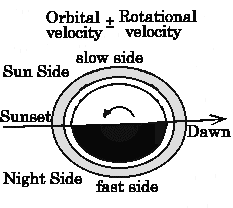 |
Please consider the Earth travelling on its near circular orbit around the Sun, with an orbital radius of 149,600 x 106m. In taking 365.25 days to complete its orbital path length of roughly 939,964 x 106m, means that each day the Earth travels 2,573.553*106m at a speed of 107,231 Km/h. Since the Earth's maximum rotational speed of 1,669.8 Km/h occurs around the equator, then with respect to the stationary reference frame, the equator varies in speed within the range (107,231 ± 1,670) Km/h and to a lesser extent so do all other locations on the Earth. This leads to an interesting observational illusion where a person standing anywhere along the Equator or on the planet's surface experiences an apparently unchanging diurnal constant speed. Despite humanity's ignorance based egocentric view centring the Universe around the self, around the local environment, described as "The World", only recently attributing this effect to rotational inertia, Chapter 14 describes more fully the Universal Stationary Reference Frame and the detectable 3,340 Km per day speed variation. As the Earth travels around the Sun, proof appears with observing the effects of Coriolis forces influencing vibrating springs, swinging pendulums, moving fluids, and projectile motion associated with rotating gravitational bodies, including Jupiter, the Sun, Saturn, Uranus, Earth, distant galaxies, and even Venus.
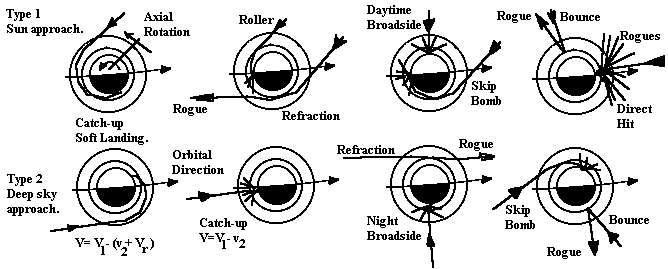
Obviously, the midnight position marks the point of highest velocity where the Earth's orbital speed and daily rotation add together, while the Noon position marks the slowest velocity. Due to the Earth's axial inclination, only on the equinox dates do all terminator locations (marking day and night) travel at the Earth's orbital speed. With the sunrise terminator being the leading edge, the new day's dawn becomes the most dangerous time of all for encountering objects head-on. Equally, this zone becomes the ideal soft landing site for catch-up meteors that skimmed through the atmosphere from the midnight position.
When asteroids venture into a planetary atmosphere, from above the poles to above the Equator, on a trajectory relative to the Earth's orbital motion and rotational direction, the eventual results of each encounter depends on the atmospheric response to the object's physical size and shape, relative speed and angle of incidence, before considering mass and composition. A relatively fast moving object travelling at 10Km per second, and just 20Km across entering the tenuous stratosphere on an almost vertical angle must begin displacing at least 320 square kilometres of air, which as the object half immerses (to a depth of 10 Km) could easily amount to moving over 2,000 cubic Km of air. Relative velocity, displacement and atmospheric viscosity creates major problems at this moment with both air resistance and viscosity increasing with depth, although the shock front's enormous compression rate establishes supersonic winds, the air in the shock front could compact to such a degree that it solidifies, reaches critical mass and initiates a catastrophic atmospheric thermonuclear event repelling or destroying the meteor and much terrain.
 |
| Different trajectories produce different impacts. |
The more dynamic meteor events occur with other trajectories, such as travelling in the same direction but entering the atmosphere travelling in the opposite direction to the Earth's rotation. A worst-case scenario being a direct hit when the Earth's orbital motion absolutely opposes the object's orbit, intersecting head-on at the sunrise terminator. With the Earth's orbital velocity about 100,000 Km per hour added to the interloper's potential orbital speed of 300,000 Km per hour in the opposite direction, gives a relative impact speed of 400,000 Km per hour. Without considering the Earth's rotation, the object passes through the Earth's atmosphere at around 110 Km per second. The absolute worst-case scenario being be a head-on direct-hit on the shoreline, along the border of a stressed continental plate, activating worldwide seismic and geological activity. If the impact interrupts the Earth's magnetic field generator collapsing the field, engulfing the planet with Van Allen belt radiation, the nuclear winter's devastation could radically change the Earth's environment, which as the impact wound opens, the affected tectonic plates crack, shatter, or cleave. Whether a direct-hit hundred-kilometre diameter meteor would rebound, could be a gamble that some may reckon a good bet.
Some object falling from the outskirts of the Solar System towards the Sun, or on the return leg coming from the Sun-side, could easily broadside the Earth. If large enough and reflective enough, a nighttime object may be seen coming, however, when asteroids approach the Earth from the Sun-side, they remain invisible until entering the lower regions of the atmosphere, but then many conditions apply before asteroids become meteors or meteorites. Unless one knows exactly where to look, or serendipity guides the observation, a nighttime approaching asteroid measuring 5 kilometres across may not be obvious until it reached a point about 200,000 Km away. Before recognised as a threat, this object as a small meteor could pass through the 100 Km of atmosphere in a few seconds, perhaps, with no warning at all. To defend the Earth against this type of impact requires a costly but necessary early warning proposal involving both robotic satellites positioned along the Earth's orbital path, and radar transponders tagging of all Earth intercepting asteroids. The most difficult part being the development of asteroid deflection technology capable of steering the asteroid into a safe parking orbit.
 |
Rather than blindly attributing the meteor's burn and the effects produced by its flaming tail to the generic faculty and department dependent terms, ionisation and friction, the processes taking place must be independently attributed at the atomic level, to atomic, chemical, and physical response reaction effects producing an enormous number of observational illusions that cannot be generalised and explained using the wrong term. Throughout this work, as the picture of matter clarifies, these reaction effects become evident. The direction of approach, shape, leading side displacement, slipstreams, composition, and rate of potential energy increase, all contribute to a fast meteor's death plunge display. The activity increase in the meteor's shock front can be so rapid, the compression so great that it liquefies the air, which in breaking and reforming molecular bonds aligns the atmosphere to the Earth's magnetic field while burning the atmosphere. The rapid increase in potential energy due to molecular buffeting progressively increases matter's activity stripping atoms and molecules from the meteor's surface that begins the reaction with the preconditioned aligned atmospheric molecules. With even greater compression virtually solidifying the air beneath the asteroid, breaking chemical bonds forming nuclear bonds, the atmosphere reaches critical mass, resulting in a lower surface thermonuclear event that could shatter, deflect, reflect, fuse, or vapourise the meteor. This kind of explosion responsible for bouncing many vertical trajectory meteors back into space into rogue orbits.
Atmospheric events and directional forces may slow the meteor, however the sheer magnitude may shatter the meteor in a spectacular fireball. If a meteor fragment survives the atmospheric encounter and strikes the surface, be it the crust or plunging into water, the resultant impact effects depend on many factors. At maximum impact speed, a 10 Kg Nickel-Iron block could form a puncture wound crater in soil, perhaps fifty metres deep. In comparison, an explosive ice or stony meteor could form a surface crater many metres across. For a similar object impacting with the ocean, the splash may be like any other 10 Kg block, falling at its escape velocity. The problem becomes more evident with a more massive object and its displacement shock front blasting away the surface before impact.
The major concern of this chapter being apathy and ignorance spawned by mischievous and ignorant indoctrination, spread by the scientific community, the media and movie moguls, presenting sensationalised versions of imminent gloom and doom. Disaster movies often without a gram of scientific credibility, or a decent plot to maintain interest, display meteor impact events with lots of boring-unconvincing special effects. Unfortunately most of the stories told follow the same basic love-interest formula, without concern to knowledge, to fact, or truth, destroying the credibility of those concerned people who recognise the problem, trying to make people in authority, and the general public aware of this serious situation.
The classic over-reaction often appears in these pathetic science fiction stories, where governments launch a great many thermonuclear weapons, to nuke one or more rogue asteroids before the final death-plunge approach. To deviate a rogue object (perhaps 100 Km in radius) into a different orbit, guided by false beliefs, screen politicians contemplate using thermonuclear means. Such actions send the wrong message, inviting a disaster far worse than a simple meteor impact. The implementation of the suggestion may lead to bigger problems. Suppose the effect of a nuclear blast broke the asteroid into irradiated radioactive fragments, then trouble with a capital-T must begin, as highly radioactive fragments shower the Earth, the problem lands absolutely on doomsday's door step, creating an effective nuclear winter with radioactive rains contaminating the air, darkening the sky, poisoning the oceans and soils. The worst man-made nuclear accident seems insignificant compared to the total ulceration of each and every living thing. Although known to work in the atmosphere, and below ground, nuclear weapons could fail in deep space, creating a mere blemish on the asteroid's surface.
In so doing, moviemakers miss the perfect opportunity to educate people, to take-stock of this situation, giving statesmen from every nation the correct scientific concerns. The asteroid could very well become a resource of tomorrow. Equally, radiation demands respect only obtained from knowledge. Not only does radiation sickness kill everything slowly, like pollution it kills doctors, neighbours, and children, while causing mutations in those yet to be born, yet to be conceived, for many generations of survivors. Maybe, if some people survive pollution, and survive a radioactive disaster, it could be that while patting their child on both heads with their webbed fingerpost hands and claws, they could learn and blaming the mistakes of those who came before. In such a bleak future, one may not be able to eat the food, or to procreate, for "it" might just fall off. Radiation sickness does that. This need not be a mistake of the future's past, of today; it should be a mistake that with current technology should never eventuate.
With knowledge comes vast responsibility. In order to preserve the status quo, learning from past mistakes, people must think and plan for the future, advancing technology and culture. Although people must care to act, to protect and defend life on this planet, over-and-over again, people show that they do not like to think, do not like to be told, do not want responsibility, do not want to know the truth, do not want to take preventative action, and panic when faced with a dreadful prospect. History shows that people, like sheep, want to be led, with everything served up on a plate with someone taking responsibility, and someone to blame when things go wrong. To paraphrase an old saying, "people care about two things in life, their tummy and in satisfying sexual needs." Although some readers may now consider the meteor as a potential threat, the biggest threat comes from the maintenance of ignorance, not just in dealing with the potential meteorite impact that poses the greatest potential for disaster. In 1938, people in many nations made the same comment about Germany's Nazi party, "Don't worry about it, being so far away, it can't harm you."
In recent times with technological development, humanity possesses the technology, capability and the resources available to sustain life on this planet for many years, but only if young and old care about their future grandchildren's grandchildren. Although inevitable, it can be said with certainty that such a meteor impact remains preventable, however, fundamentalism, indoctrination, nationalism and capitalism, deny and remove those people who care for the future of this tiny planet. To reduce the probability of a cataclysmic encounter, to avert the disaster potential, many solutions exist that need to be implemented as soon as humanly possible. Because of the low probability of meteor impact, some consider this warning of a rocky rogue enemy coming from the heavens as no more than a flavour-of-the-month over-reaction, and as a means to gain support for some half-baked theories. Although far from the truth, such beliefs and accusations suppress acceptance of many past events when dark rocky celestial objects ploughed their way into the surface, detonating the atmosphere, sea and land. As the clock counts each second in time, it counts down to the arrival of the big one.
Automatic robotic observations and certainty may give humanity the necessary time to take preventative actions to preserve the future, but only if people today decide to protect this planet, to care for the environment, flora and fauna, lakes, oceans, the land and the protective atmosphere. All the options must be proposed today and strongly considered, for no one currently alive on this planet can really judge today's world on whether humanity made the correct decisions today. Only future generations, who look back, as people do, cast judgement, concerning their now, their security and that of their children, casting blame on many who came before, who made things so bad. Said sarcastically, "Wonderful pesticides like DDT, defoliants like agent orange, and the use of hydroflurocarbons (CFCs) in labour saving devices" show only to well the lack of environmental concern. A wrong decisions made today could mean that, at the present rate of environmental extinction, with human population depleting natural resources without even considering a meteor impact, the dead-line of all future generations could easily occur in the year, 2050 AD.
Methods must be developed to detect an approaching Earth intersecting asteroid; to intercept it; and to reposition it into a non-dangerous orbit, extending life's longevity on the Earth. It may take a trajectory change of a hundredth of a second of arc, perhaps placing the rogue asteroid into a polar orbit around the Moon or the Earth. A safer means of deflecting rogue objects becomes necessary in such a plan, such as a specially designed reusable space tug or mining craft. Equally, early warning robot satellites need to orbit the Sun, and at least three transponders placed on the larger bodies. The financial argument that must be expressed "as a rogue asteroids contain valuable mineral deposits, why not use them?" In offering a multitude of benefits, many larger asteroids and minor planets may make ideal locations for research facilities and storage depots, to isolate some very nasty chemicals and bacteria, that exist on this planet. As humanity reaches for the stars, these objects offer many exciting scientific challenges and opportunities, not available on the Earth.
Perception of the Universe must be changed, in planning, preparing and preventing future encounters today before it becomes too late. When the realisation occurs of an imminant Earth-impact event, at that moment, it would be pointless to even write a will, to pray in a church for help, guidance, or forgiveness, to panic, for nothing will stop the big one creating a worldwide disaster. At that moment, the big one means, the end of life as we know it; extinction; end-of-story.
Version 7 size 9,760
Version 8, Revision 1, September, 2005, word count=13,500
Return to Chapter 1 | © Copyright 1995 AD, Robert Lanigan-O'Keeffe, Sydney, Australia.
| Advance to Chapter 3 |
1. "Let's Hope They're Friendly!" Quentin Fogarty, Angus and Robertson Publishers, 1982.

Removed paragraphs:
Although the technology exists that would make the direct-hit event preventable, few people in authority seem to care about tomorrow. Do low wages attract the dregs of Society to become politicians and leaders? Typically, in most democratic governments, the political party forms a government where a rat-pack spoilt-brat mentality seems to rule. Often it becomes necessary to translate childish rhetoric. When one prospective Australian Prime Minister used the expression, "never-ever will the GST become policy", it was found to mean, "No matter what objections there may be, our political agenda that already includes the GST will become law when we form a Government." With a vote of just 34%, a bad political system gave an anti-environmental party, Government. In such a democracy, most people vote for a name on a ballot sheet, for the party with the most outrageous promises, the best innuendo, or for someone who kisses the most children (perhaps a paedophile). Potential politicians are applying for a job, be it a three or four year contract, where each voter is the prospective employer. How many potential politicians are honest and present voters with a copy of their CV or the truth about their policies? Voters should understand the political agenda of the party before any choice is made at the ballot box. Maybe then, a government will care to safeguard the future.
visible 0.65 mm
Shortwave IR 3.9 mm
Water vapour 6.7 mm
Longwave IR 10.7 mm