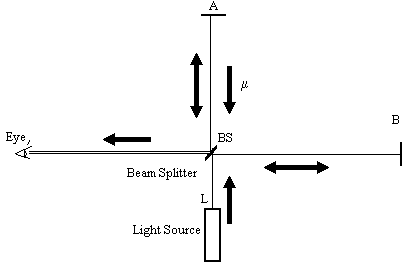
Figure 16-1 The Michelson-Morley Device
Burying the Flag of Faith
CHALLENGE EVERYTHING THAT IS WRITTEN OR STATED, USING COLD SCIENTIFIC LOGIC AND SIMPLE MATHEMATICS! As the aim of this chapter is to callously seek-out the truth, many people will find the contents, upsetting.
In 1957, the physicist R.T. Birge, after lengthy analysis, determined from statistical appraisal of all previous experiments, "his best" value for "c" the speed of light. In determining the speed of light, both the speed of radio signals and light were amalgamated in such a way that the results scientifically removed the speed of light, so that it no longer conformed to any valid scientific principle in any known science. This value is now accepted as the ultimate truth, treated by all, in lectures and reference books with the emphatic, stressing the finite and absolute speed of light, placing Einstein's Special theory of relativity above Science, Nature and God. It is even put above Einstein's General Theory of Relativity in this situation, a theory which normally holds the most prestigious position in the hierarchy of Science.
As a consequence of Birge's work and the Special theory of Relativity, the accepted belief is reflected in various texts, where it is stated, "All electromagnetic waves travel at the same speed, which is the speed of light. This is 186,283 ± 0.6 miles/second or 299,793 ± 1 km/sec in a vacuum and less in material substances." (Astronomy :Fundamentals and Frontiers Jastrow & Thomson).
It will be shown that accepting this absolute and finite value without challenging it experimentally, is assisting in the promotion of a scientific falsehood. Don't accept "the faith", demand the truth! Begin by putting the Birge estimation to one side. It will be treated as "historically relevant" but his results can be shown to be statistically irrelevant.
An exercise for the reader: As Birge treats all radio and light observations to that date as one and the same, it is necessary to separate all previous results, so that these are not considered as a single set of amalgamated results. If one argues that different people used different techniques to determine Light speed, then that is a valid reason for rejecting Birge's methodology and the conclusion drawn. It is necessary, to group light observations together, as distinct from electrical and radio observations. Scientifically, each must be considered separately.
This will present three separate sets of results (the data tables), three different pictures, as illustrated in the following listing where optical, radio and other transmission speed determination mechanisms are treated uniquely. On a single sheet of graph paper, plot on the vertical scale the speed (a range from 298,000 to 304,000, so each 1,000 value equals 2 centimetres), against a horizontal scale being the year (so that one year = one millimetre starting at 1720). Graph the data (from table 16-1 below) as three or more graphs on the same graph. Use a different coloured pen for each type of observation and join the dots. Any data errors will stand out. Marks will not be deducted for neatness. Once this is done, look for any obvious trends. Are the lines curved? Is there a line of "best-fit"? Also, if one knows the method, determine the experimental accuracy and compare this to Birge's claimed accuracy. If it is different, one must challenge the number of samples used in Birge's analysis and his conclusion drawn. Determine the mean, standard, average and maximum variations. One is simply attempting to confirm Birge's estimation as true, but the graph shows something else.
Observations made to determine the speed of Light directly, through radio and Molecular Resonance (denoted as *)
1675 Roemer 200,000 miles/s. ... The Earth to Jupiter through a Vacuum.
The following are all measured in Km/s and were completed in the atmosphere.
| 1729 | Bradley | 304,000 |
| 1862 | Foucault | 298,000 |
| 1876 | Cornu | 299,990 |
| 1880 | Michelson | 299,910 |
| 1883 | Newcomb | 299,860 |
| 1883 | Michelson | 299,853 |
| 1926 | Michelson | 299,796 |
| 1928 | Karolus and Mittelstaedt | 299,778 |
| 1932 | Michelson, Pease and Pearson | 299,774 |
| 1940 | Huettel | 299,768 |
| 1941 | Anderson | 299,776 |
| 1950 | Houston * | 299,775 |
| 1952 | Rank, Ruth and Ven der Sluis * | 299,776 |
| 1954 | Rank, Shearer and Wiggins * | 299,789 |
Those using Radio and microwaves
| 1950 | Essen | 299,792 |
| 1950 | Bol and Hansen | 299,789 |
| 1951 | Essen | 299,790 |
| 1951 | Aslakson | 299,794 |
| 1954 | Florman | 299,795 |
Other means: - Electromagnetic Theory, Geodimeter (denoted *) and electrical wires ( #)
| 1906 | Rosa and Dorsey | 299,781 |
| 1923 | Mercier # | 299,782 |
| 1950 | Bergstrand * | 299,792 |
| 1952 | Froome # | 299,792 |
| 1956 | Edge * | 299,792 |
Having completed this part of the exercise, amplify each graph, on a separate piece of graph paper, by altering the vertical axis scale. The new vertical axis needs to be from 299,700 to 300,000, so a distance vertically of two centimetres equals an incrementing the value in steps of fifty. This will remove most of the odd-ball observations, those that are out-of-range. The purpose of this second series of graphs is needed because Science categorically accepts the value 299,793 ± 1 Km / second. Find this figure on the vertical scale and draw a horizontal line across the graph. Believe it or not, using this scale, the width of the line just drawn will be in the order of the accuracy stated by Birge, that is ± 1 Km / s. Since this horizontal line does not conform to any of the graphs, ask the questions "Is this value of the speed of light, a guess, an approximation, a gut-feeling or the flavour-of-the-month acceptance of Special relativity? Then ask, "just which set of observations did Birge accept?" Einstein's Special theory states that the graphs drawn must be absolutely straight, and all must exist on top of each other. So how then does Einstein's theory explain the beautiful curves with dips around 1950 and 1955? Is this data fabricated? No. The data is sourced from Halliday & Resnick's "Physics" John Wiley & Sons,Inc..
If one challenges the author's use of this technique to attack Birge's conclusions, then one must challenge Birge's unscientific approach. THE ACCEPTED BOTTOM LINE figure is not an amalgamation of all the results, not an average, not a best fit solution, for the analysis excludes most light-speed observations and presents an order of accuracy that is impossible to accept. Amazingly, the accepted result is taken as precisely 299,792.4 Km/s when radio observations are apparently higher by approximately 15 Km/s. The trends and deviations are too great. It is obvious that many are using the radio value for the speed of light.
To emphatically state an accuracy of ±1 km/s is deluded and wrong. There is an obvious error due to the small sample set. It would be more deluded to accept without question the 15 Km/s difference. Further experiments are demanded. One cannot accept this 15 Km/s value as other "fudge factors" may have been used. So much for the value of light's speed "c" when it is obvious that this is radio's speed. Ask the question "What justifies the absolute acceptance of Birge's findings?" Such an established "limited belief" has stopped many researchers examining Light speed any further to confirm or deny the accuracy, or to note whether these peculiar trends continue today. But what was said about the Tired Light Theory earlier? Radio waves travel faster than infrared and infrared travels faster than light due to the conservation of energy in the interstellar medium.
Other points:- Not known is the accuracy of the time or distance determining methods used in all the measurements of "light's speed". Have these experiments been repeated at the same site, with the same equipment since the original observations were made?
In 1675, with primitive clocks, Roemer obtained the light speed estimation of nearly 200,000 miles/s. Unfortunately, many authorities defame Roemer by incorrectly plageraising and replicating a stupid error, without quoting his 16 minute 16 second observation for light crossing the Earth's full orbital diameter, without doing the sums, gutless bastards attack Roemer. How difficult is this....
Michelson's 1930 experiment used a stroboscopic beam of light that travelled EAST from Mt. Wilson to Mt. San Antonio, a distance of 22.5 miles or 36 Km, whereupon it struck a mirror and reflected back through the same stroboscope into a telescope. As the stroboscope turned the light on, then off, and stopped the observers view at the same rate, the speed of light can be determined from the rotation of the stroboscope. As the path travelled Eastward, then returned on the same path, the effects that would be caused by the Earth's rotation should cancel. But the Earth is also travelling around the Sun on a specific orbit at 30Km/s. This rotational speed should impinge on the observations for it would cause variants with latitude and time of day. Think of the reasons why this would be the case...
The question that has never been asked is "does the rotational velocity of the Earth vary light's speed? The answer must be "Yes", because the light is travelling through the atmosphere, in fact, every test conducted to determine light speed has measured the speed of light in the atmosphere. Special relativity demands that the speed of light is constant in free space, in a vacuum, free of gravity. No experiments have been conducted in free space, so this is an unfounded speculation! The atmosphere is not free space. The atmosphere has a specific refractive index for each frequency travelling through it, due to the laws of refraction. The speed of light and radio waves in the atmosphere must differ. The Earth's atmosphere forms the classic chromatic lens at Sunset. Certain radar signal frequencies refract over the horizon to reveal events occurring in another nation's air space. As winds move and heating changes the atmosphere's density, the optical path changes due to differing densities and general atmospheric effects. Therefore, the motion of the Coriolis wind structures moving across the Earth's surface should cause a marked difference between the North-South and South-North speed, as well as between the East-West and West-East speed, over long base lines.
The Earth's orbital direction should also alter the day and night observations due to other reasons. Any mechanism that affects the atmosphere must alter the transfer of light because the atmosphere is loaded differently in every direction. The same should be evident for radio propagation where such variants will give a variety of results. The greatest change must occur to both light and radio speeds in the atmosphere at Sunrise, where the atmosphere is suddenly warmed by the Sunlight causing a rapid change to the optical and radio density of the atmosphere and this must alter the relative propagation speeds.
In both the vacuum of space and in air, light experiences a range of refractive indexes. This fact is true in Science if one cares to look. Simple experimental tests prove this "fact" as true, but the facts are ignored due to relativistic beliefs taught as fact, when they are no more than idle speculation without basis in science or Nature. The refractive index is relative from one medium to the next for each particular frequency. The air is not uniform in composition, so many refractive barriers occur in the atmosphere, especially over the long base lines.
To attack this experiment, one must be very astute and accurate, considering ALL the contingencies that "warped scientific minds" will come back with, when this fundamental proof is rejected or explained away as the expected result. The mind-set can be "warped" through propaganda and false truths taught as the truth. Unfortunately, many of Einstein's followers treat this experiment sycophantically without the necessary understanding of its innermost workings. Some know and word perfectly recite the mathematics backwards and forwards, but they don't understand it, for they cannot see the error. The adage "you can't see the forest for the trees" is true due to the propaganda and the fixed mind-set caused by gullibility. The Æther is said to be a hypothetical medium which fills all space and matter, through which energy and light are carried. The aim of this experiment, first conducted in 1881, is to determine the velocity of the Earth moving through the Æther. Science said that the Æther wind blows through all matter without any resistance, so Michelson sought to prove that fact.
This simple experiment (Figure 16-1) works on the interference of a single light beam of monochromatic light (from L) at the focus. The beam must enter a beam splitter (BS) forming two perpendicular beam paths. Each strikes a mirror (A and B) returning back through the beam splitter into the observer's eyepiece. When focused, this creates a particular type of effect called a fringe interference structure. When rotated, Michelson argued, that if there is any change in light's speed across the perpendicular path to the wind direction and its velocity "u", then it must be seen.
So, as the apparatus is rotated to 45° and onto 90°, Michelson argued that there must be a change in the interference fringe structure, where the maximum deviation occurs at the 45° mark. Michelson and Morley were quite confident that they could observe a shift equivalent to 0.01 fringes, if not 0.4 fringes based on the orbital parameters and rotation of the Earth. They set up the apparatus in a deep basement. But they had to concede defeat where the interference effects between the two light beams remained absolutely constant, no matter the amount of rotation of the apparatus or the time of year.
The obvious question to the scientific community, became "why?" This question "Why?" should never be asked in Science because it is an open question that does not point to any answer or solution. As a question,"Why?" often means, "we are willing to accept any explanation." The question that must always be posed when confronted by any mystery or negative result is "what process or mechanism would be responsible for such a negative result, or has something obvious been over-looked?" Invariably, the answer will reveal the truth or 10,000 other questions.
Because the question "Why" was asked, Einstein used the Lorentz notion, to squash time and matter to achieve the desired end; an end that is not necessarily true. This gave credibility to Lorentz when other factors are involved which Lorentz could not explain in his experiments. His squashing of matter and time is no more than a wonderful fudge-factor that appears to work, for it is an easy way out of a difficult problem; a problem that once the mechanism has been determined, produces a solution with a simple explanation. But one must care to look for that mechanism.
Einstein explained away the negative results with the postulation that the speed of light always has a value of "c" no matter the state of motion of the light source, the apparatus or the observer, so the motion of the Earth around the Sun and the rotation of the apparatus have no effect on the speed of light, outside or within the confines of the interferometer. To do this Einstein scrapped all notions of vector addition, by eradicating all frames of reference, even when the Doppler shift is a known fact. Einstein further used the beliefs of Lorentz to squash the apparatus and to modify time itself, so that no matter what speed one is travelling, the results will always be the same. Is this an acceptable explanation? Accepting this explanation and not realizing that there are observational errors caused by experimental design errors, is a bigger problem.
But History seems to repeat itself. The astrologer Tycho Brache sought to detect the motion of the Earth in orbit around the Sun, but the level of technology (although amazing for the time) produced negative results. Tycho's hand-eye observations (before the invention of the telescope) were accurate to just four seconds of arc. He argued that close stars must show movement. Tycho could not determine any motion, so he concluded there was none. The Sun goes around the Earth. With technological improvements in clocks and telescopes, it still took another 250 years to prove that the Earth actually moved. Amazing is the fact that Tycho obtained such accuracies without the use of a Chronometer. It is far stranger to note that the modern archer must take Coriolis effects into consideration to strike the target. The proof of the Earth's rotation has been observed since the caveman invented bows and arrows. But no one looked for the obvious.
In relation to the Earth's orbital diameter, when the parallax angle of the first star was finally detected (150 years ago) it was found to be less than a arc second. Due to the distances involved, from the Earth to the closest star, the greatest Solar Parallax measurement of any star was found to be just on one second of arc. The closest neighbouring star is just that far away, four light years. It was Tycho's experimental procedure and the equipment that produced the error of just four seconds of arc, that gave him the negative result. But a negative result does not always mean that the result is negative and conclusive. Despite the observational error, Tycho's assistant, Kepler, used much of Tycho's observations to formulate the laws of planetary motion using the parallax of Mars.
The Michelson-Morley experiment asks a question with preordained answers. This is scientific suicide. Failure to show this particular answer means the experiment fails, even though the experiment works. This is not good research methodology, so the experiment from this perspective is badly designed; breaching the scientific method. The conditions which must be established are not entered into, not even considered. This experiment therefore has several major experimental errors, so one must challenge the credibility of the experiment, the researchers and especially those who promote it to prove Relativity as being absolutely true. There are many effects which the experiment must show, if indeed it was designed to work at all; the Michelson-Morley experiment is not to be simply questioned, it must be attacked with cold scientific logic.
In figure 16-2 , the light must pass through the beam splitter with an incident angle of 45° , so the refractive index of the beam splitter is going to change the path length, so any motion in the Æther will increase this effect. Having said that, the relativistic explanation is along the following lines.
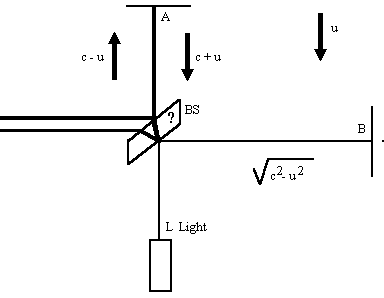
The Earth and the device are claimed to be moving through the Æther with a velocity "u", so when stationary, the interferometer is still moving through the Æther with a velocity of ( -u ). According to their use of the Æther theory, the speed of light on the paths BS - A and A - BS will be (c + u) and (c - u) . The distance between the beam splitter and the mirror is d1 . So the time taken to complete the round trip will be :
| d | d | 2c | 2d | 1 | ||||
| t1 = | ------ | + | ------ | = d . | -------- | = | ----- | ---------- |
| (c+u) | (c-u) | (c2-u2) | c | (1-(u/c)2) |
On both legs of the path BS - B, the velocity of light is given
as  ( c 2 - u 2 ) .
(N.B. Someone needs to teach physicists basic geometry. Pythagoras says something different!)
This means that the time taken for perpendicular trips (where the distance d2 is made as a variable) will be:
| 2d2 | 2d2 | 1 | |||
| t2 = | -------------- | = | ( ---- ) . | (---------------) | |
| (c2-u2) |
c | (1-(u/c)2)) |
 T) for the two identical paths
is given as T = ( t 1 - t 2 ), so,
T) for the two identical paths
is given as T = ( t 1 - t 2 ), so,
| 2d | u | u | ||||
| T = |
------ | { [ 1 - (-----)2 ]-1 | - | [ 1 - ( | ----- | ) 2 ]-½ } |
| c | c | c |
The Binomial theorem is applied to the elements of the equation in square brackets, so that
| 2d | u2 | du2 | |||
| T ~ |
------ | - { ½ ( | ----- | )2 } = | ------ |
| c | c2 | c2 |
Accordingly, the change in time difference between the base lines
should result in a fringe shift of 2t/T where it is claimed
that as T =  /c, the phase shift should be
| 2t |
2tc |
2d | u | |||||
| N = |
------ | = | ----- | = | ---- | ( | ---- | )2 |
| T | |
|
c |
Although the mathematics look impressive, if one cares to look, one will find an intrinsic mistake in the above mathematics. And the mistake is replicated in almost every Physics book, so to some, it must be true. Resnick and Halliday give a hint as to the position of the mistake in the description of their Figure 43-16 (Physics) "The wave velocities shown are on the basis of the (incorrect) ether hypothesis." The replication of the error proves that few educators have an understanding of the trivial workings of this experiment, for the mistake is copied along with the truth. It is so obvious, and yet so basic. So, where is it? Engage that mathematical mind. The error, (although hidden) will be disclosed shortly. Although such a mistake may be considered as a minor knowledge virus, it becomes very significant.
Einstein explained away the negative results in the Special Theory of Relativity with his second postulation called the principle of constancy of the speed of light. Here, the speed of light always has the value of c, no matter what the state of uniform motion of the light source or the observer. Educators often attribute this to Einstein's theory of relativity, (is that the one published around 1917?) But it is all relative, and as both theories are theories of relativity, then relatively speaking, one must define which relativity the relative arguments relatively refer to. In this special theory, light propagation could be likened to the workings of sound in the atmosphere, where the speed of sound is a constant with respect to the stationary environment and the frequency, where the motion of the observer or the source, does not change the environmental speed of sound, rather the relative motion changes the perception of sound due to the Doppler shift.
In Einstein's 1917 General theory, that light is particle in nature, not wave. This is a theory of gravity, and as such it affects light particles, because they have energy, and therefore they have mass. Gravity applies to light leaving or passing over a gravitational body. It is from this theory, that blackholes, neutron stars, and other obvious speculations abound, because the velocity of light is a vectorial resultant, that is, Vp = V1 - V2 , or Vp = c ± V1
In the first postulation in the Special Theory of relativity, the principle of relativity, identifies that all the laws of Nature are the same in all inertial reference frames, where the laws of Nature are invariant, and do not change when the coordinates and time of one reference frame are replaced in it with the coordinates and time of another frame. It follows that the velocity of light is a universal constant. Einstein was led to the conclusion that Newton's equations need refinement, so he introduced modifications within the laws of Mechanics, that would agree with the principle of relativity, hence relativistic mechanics was borne. To discuss this in depth is well outside the range of this work, and is a distraction to explaining the Michelson Morley experiment, although this is where time and space are distorted through the use of the Lorentz transformations and space-time.
The beauty of such mathematics is that since matter is used to measure matter and time, there is absolutely no way of proving anything as true and equally, no apparent way of disproving it. This produces a bit of a paradox, because as Time changes, then the speed of light in a given time also changes, over the distance. To get around this crazy situation. Einstein does the dirty where the speed of light always has the same value of "c" in a vacuum, no matter what the state of uniform motion of the light source or the observer".
But Michelson and Morley performed their experiment in the atmosphere. But now comes the crunch. As Einstein made the famous clock prediction, it was tested with three atomic clocks, where two portable models were flown around the world. One flew East, the other West, with the result showing that one clock gained speed and the other lost speed compared to the clock that stayed at home.
The results of the atomic clock experiment must dispute the accuracy and results obtained by Michelson and Morley! The atoms in the clock are responding to something causing the clocks to be loaded differently, something that has altered the clock's accuracy, not time itself.
Here is the problem. If the Æther is moving, the Michelson-Morley experiment must show this effect. But the experiment does not! Obviously there is something intrinsically wrong with the inherent design of the experiment if such movements cannot be seen, or was the truth seen and we could not see it? To solve this problem, it is necessary to think differently. Ask the questions "What are the observational possibilities?" and "What is this experiment showing us?" To this end, the problem can be attacked from several different directions.
The experiment anticipates that the Æther is streaming through all matter as the original experimenters wanted to find. The observational possibilities can include that we are flying in the Concord, holding a conversation at twice the speed of sound, and therefore, as all the local Æther is moving with us, the effect is local to us, giving zero results, so one can talk in the Concord without weird audio distortions. The effect may be due to other variables not contemplated in the experiment, such as the place where the observations were performed, or the effect of the changing refractive index in the Beam splitter, perhaps the medium, or something else. Is the answer seen in the Geometry of the Beam splitter and its refractive index?
In figure 16-3 below, all the construction lines are shown. The distant mirrors "A and B" are not to scale. The Beam splitter has a front surface BSF and a back surface BSB. To simplify the illustration, rather than messing up all the calculations with Light speed or Sound, the substitution technique will be used. The real world equivalent to this is to have a swimming race. There is a river, a boat, a diagonal reef mid-stream and a buoy upstream. For the chosen course route, there is an amazing similarity to the illustration (Figure 16-3). There will in fact need to be two races owing to a protest situation, whereupon the tables will be upset. One at high tide and one during the ebbing tide. The course is such that the two swimmers Mr. Aye and Mrs. Bee must swim from the boat, to the reef, and onto either starboard shore (to the right) or to the distant buoy. Mrs. Bee has chosen to swim to the shore marker buoy, while Mr. Aye will swim to the buoy marked A. Both swimmers must then swim back to the reef, and then onto the Port shore (the left hand) side. This is a fairly long race, for each race length is 1,000 metres. Both Mr. Aye and Mrs. Bee are equally matched swimmers.
Who will win each race? It is on the radio now, so the sport's commentator can take up the story.
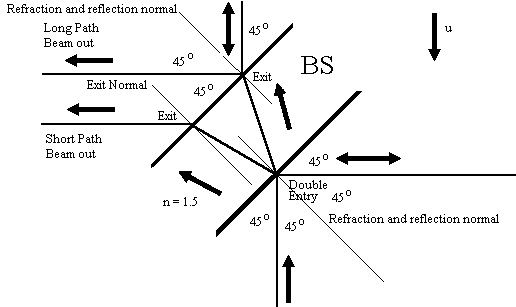
in the Beam Splitter.
Sports Commentator: Hello viewers, this is Applied World of Sportz for Honest Ernie's el-cheepo Car Lot, and I am Creek Waters for the off-line network. Today, we have got a fabulous swimming race Live, yes, absolutely Live from the Turbid River and a host of other exciting event, so stay tuned. The race is expected to begin at any moment. The judges are just waiting for the river to turn. Hang on...Yes, that was confirmation,.The tide on the Turbid River is turning. It will be safe to swim. there are only two competitors, and the bookies are giving Mr. Aye an eighty metre start. I really don't know, but I reckon it will be a close race. We'll now throw to the real action on the river. What a beautiful day it is on Turbid river, one of the most dangerous rivers in the state. It was first crossed by Michelson about a hundred years ago and this race celebrates that day, following the race course that he had against Morley. Look at all those cars parked on the beaches, it reminds me of Honest Ernie's el-cheepo Car Lot in Main Street, an absolutely fabulous sight.
The gun has sounded and the race is underway.The two swimmers have launched themselves into the water and they are neck to neck. Neither is gaining or losing. What a pair! Magnificent athletes. They are nearing the reef marker. Yes it is Mr. Aye against Mrs. Bee. I can recognize those Honest Ernie's Fashion House costumes anywhere as the two swimmers are negotiating the reef. Mr. Aye has jumped onto the reef, treading very carefully. Mrs. Bee has opted to follow the across the river course while Mr A. is going to swim upstream. Both must swim to the marker buoys and return. Yes, they are both in the water again and ploughing their way to victory or loss. Mrs. Bee is quite ahead as Mr. Aye launches himself into the river again. There is no apparent difference in the lead at the moment that I can see. This is so close. Stroke for stroke. Their pace is remaining constant. Mrs. Bee reaches the shore marker and in a tumble turn begins the return leg. Gee whizz, Mr. Aye has done the same already. Who is leading. This is so close.
This is a stupendous race! The Bookies will be very upset. Mrs. Bee could be in the lead; no, she is getting onto the reef. Mr. Aye is fast approaching the reef, but he does not need to get on the reef this time, but he must touch the reef. Mrs. Bee is treading very carefully over the jagged reef. This is fantastic!!! As Mr. Aye turns shoreward for the final leg, Mrs. Bee launching herself from the reef. They are neck and neck heading for the finish line. What a race!!! It is so close. It looks like a tie. Yes, Yes, yes, they are both on the beach together. It is a tie!!! Both crossed the finish line at the same moment. Unbelievable. Two perfectly matched swimmers. We'll be right back after these fabulous few words from Honest Ernie's el-cheepo Car Lot. He has a new consignment of company cars to sell. According to the previous happy owners, these vehicles do zero to a hundred in 4 seconds, require no water, no oil and no maintenance. As you know ex-company cars are really great cars because they are survivors. Just add fuel and drive them into the ground. Love it. Honest Ernie also has some demonstrator cars, confiscated from the demonstrators that caused the reactor melt down last year. These cars don't need headlights, for they glow in the dark, and they are really cheap, buy one and get one free.
20 minutes later (lots of commercial adds and trivia).
Sports Commentator: Hello again listeners, Creek Waters here again, and there has been a major development at the race site on Turbid river. as the previous race was a tie, the judges have decided to run the race again. They said that they must have a definitive winner. But the tide has turned and soon the reputation of Turbid River will be reaching its ferocity. This river is treacherous. The tide has turned and is flowing quite rapidly down stream to the sea. There is also an on-shore wind, coming from upstream at is travelling with the same speed as the river. This is live. Only really great swimmers could manage to swim in these conditions. We may even witness a tragedy. The air speed will slow the progress over the reef. Both contestants have elected to swim the same course. And. Yes, they are ready. This will be an exhausting race, for they are both swimming the first leg against the river flow. Yes the race is going ahead. The gun is being raised. And they're off !
Ladies and gentlemen, this is a breathtaking moment for the world will be watching this race. Oh its fantastic. Normally, they would both would make twenty strokes every twenty metres, but now with the fierce current flow, they are working really hard. Yes, I can feel the strain. It is taking a gruelling thirty strokes to cover just twenty metres. The judges should have called this race off. The current flow is too fast and the river too dangerous. But they are neck and neck, fast approaching the reef, what amazing champions these swimmers are. I don't like that reef. It looks really rough already. All Mrs. Bee has to do is to touch the reef and swim shoreward to the buoy, while Mr. Aye must continue this gruelling swim upstream.
Mr. Aye is on the reef and moving very slowly, about half as slow as he should be. Mrs. Bee has turned. Yes, she is gaining distance quickly. That wind is slowing Mr. Aye down as Mrs. Bee races ahead, but she is not making good time even though I can see her thrashing her way through the water. She has to swim across the treacherous cross-current. This must be difficult for her. She must swim a great deal upstream against the current to get to the buoy that is just across the river. I know what she is thinking, she must swim to that shore marker. That is her immediate goal. So she is putting every effort into it. Mr. Aye is powering his way slowly towards the distant marker. These must be agonizing minutes in the race for him, I can feel the pressure he is under. He is exhausted but still maintaining his arduous pace, powering his way ever so slowly against the current. Mr. Aye now knows he has a race on his hands from the previous race. The is trying. Every gram of energy, he can muster, he is using to catch up to the lead that Mrs. Bee is establishing. Mrs. Bee is almost at the mark, Yes, she has made the turn and is heading back. What a lead she has! She is pushing herself against that vicious cross current and nearing the reef. What a ripper of a swimmer, champion material. Look at her battling. Now she must swim diagonally up-river again to get to the reef which is directly between the marker and the commentary position here beside the finish line.
This is gruelling. Every muscle must be screaming in abject agony at this moment. Mr. Aye is approaching the upstream buoy. Yes, Yes, Come on, You can do it. Yes he has turned, but look at him gain speed. The down stream flow is assisting his every stroke. He is gaining fast. Mrs. Bee is on the reef, but she is having difficulties in that wind. It is taking Mrs. Bee only a few seconds longer to cross the reef than before. She is not in any difficulty with that wind, but you can feel how it is affecting her. This is a marathon event, a gripping decider, yes, Come on, come on Mrs. Bee. Yes, Yes, Mrs. Bee has thrown herself back into the water, yes, she is definitely in the lead. It is in the bag I reckon. Mr. Aye is gaining but not as much as he would like. He is gaining, but he must touch the reef. I don't like the chances because the reef is creating an enormous bow wave as the river surges onto the reef.
What a race!!. Look, at his speed, about thirteen strokes every twenty metres. He is nearing the reef and is deflected by the reef. Yes, confirmation. He struck the reef and rebounded towards the shore. I know the frustration he is feeling seeing Mrs. Bee so far in front, about 180 , possibly 190 metres between these two champions. Mrs. Bee is on the beach and running. Yes, she is crossing the finish line. She has won!!! This is a truly memorable event. What a race, Mrs. Bee has won the race! Yes, she is yelling out "woman power rules" .Never before has the race been run in these dangerous conditions. What a champion she is. Look at her breathing. It must have been really gruelling out there.
She looks exhausted but I can only tell you of the excitement here. Its a real spectacle, just like our sponsors super specials this week, at Honest Ernie's el-cheepo Car Lot for cars that are not that hot and not that cheap. Mr. Aye has crossed the finish line and is speaking to the judges. Oh golly, the protest flag is raised. Yes, Yes, it is a matter to do with uncertainty. Mr. Aye has lodged a protested concerning the course-length.. We must wait on a judges decision, so we'll return to the studio for a few quick messages.
Such is the romanticised view of the experiment. In this situation, it is easy to be the judge, since the set-course is the Michelson-Morley course, where by design, the Length L-BS-B-BS is the same as BS-A-BS-Fin as shown in figure 16-4. But the results are different to those expected using the mathematics of the experiment. What then must be the cause of the error in the mathematics.
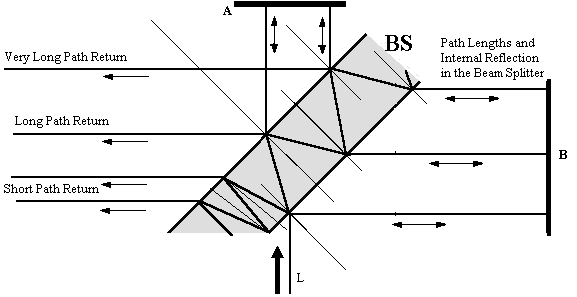
Facing the appeals tribuneral, Mr. Aye drew all the construction lines to show the differences in the course lengths. But one judge stated "In every respect, the journey over the region is identical as was illustrated in the first race". Mr. Aye pointed out that the difference is now an effective length because the river is now flowing. He explained it this way, "Both swimmers use 20 strokes to travel 20 metres in still water. Against the current, this was increased to 30 strokes per 20 metes. The first 2,000 metres took 3,000 strokes, not including the slow patch over the reef. The downstream current should give him an advantage as he was swimming at 13.2 strokes every 20 metres, That's only 660 strokes. The final leg, at 20.6 strokes took 1,030 stokes. This means that Mrs. Bee swam just 1,500 stokes for the first leg, then in three subsequent legs, only 1,030 stokes a leg, or a total of 4,500 stokes, compared to his 4,690 strokes, a difference of 190 strokes."
Not resting there Mr. Aye pointed out the problem of the reef and this has a considerable impact increasing Mrs. Bee's lead. The stroke frequency, in the quiet conditions is 20 for 20 metres. The slow down (N) of 1.5000 and for 100 metres into the wind and against the current took twice as long again than it would have been to swim the distance That is another 200 strokes. That is almost 4,900 strokes compared to Mrs. Bee's 4,620 strokes. The river and the wind must be flowing at a rate of about five metres per minute. That speed may appear very slow, however the relativity of this velocity to the swimming speed greatly changes the effective speed, the frequency of the strokes in a given distance and the overall length. To any person standing upstream, the number of strokes counted in any given time frame will appear identical to the view seen across the stream in the same period of time.The effective distance is changed, however the frequency remains unchanged.
One of the judges was not impressed with the upstream swim, claiming it was too slow. The course is 1,000 metres, so that would normally take 50 twenty metre periods, however because of the current flow, the upstream distance would be 1,250 metres, and the downstream flow must shorten the course to 750 metres, effectively giving a 2,000 metre round trip. "Not so", Mr. Aye said "for the river flow is calculated by my relative speed. To move 20 metres, I am swept downstream 5 metes, so I only travel 15 metres in the same time frame. To swim a full 20 metres takes me that much longer. This means swimming 1,333 metres to swim 1,000 metres. Downstream, the time is faster but not fast enough. Instead of swimming 37.5 lengths as you suggest (750 / 20) , I swam 40 lengths, that is close to 800 metres, not your 750 metres. Effectively, this part of the course is 2,133 metres long, without even considering the slow patch. The total swimming course at this point is already 4,497 metres".
So, how does Mrs. Bee's course vary? "Well, this is a consequence of Pythagoras, for the distance required to swim 1,000 metres means swimming upstream continually for one is pushed downstream by 20 metres. Pythagoras says
((1,000) 2 + (250) 2 ) = 1030.7 metres
and so three legs equals only 3092.1 metres added to the common 1,000 metre initial leg of 1,333 metres giving a total length of 4,425 metres, a difference of 72 metres in the water alone."
But what about the reef, you crossed it so slowly. It is only 100 metres wide. "Not so, it is much wider than that. The shortest route forces one to travel about 114 metres. Even Mrs. Bee followed that path, a deflection of about 28 to 30 degrees, but her path was completely different to mine. She ran slightly up wind while I ran into the head wind, where it slowed me down by a further factor of 1.5 effectively making me run about 230 metres as compared to Mrs. Bee running only 120 metres. That is 110 metres longer. Add this to the the 72 metres in the swim and the difference is around 182 extra metres"
So, you lost by about 180 metres, let's see, the effective distances involved by each participant is 4,497 + 230 = 4,727 and 4,425 + 120 = 4,545. Point taken. There is a 182 metre difference, and as you lost by 182 metres, it is a tie. Protest upheld. Next time we will change the course, and run it downstream or across the river in the same formation. "No way, different mathematics apply in those situations. The only fair method is to use diagonal legs that go upstream and downstream, at 45° to the direction of flow. That is where the effects are absolutely equal in terms of length, but again, the frequency will not change in a given time frame as viewed by any external observer counting strokes. Check this out for yourself. You now have the mathematics and all the knowledge needed to show that this race will not work, and will not prove anything different unless the travel time is actually measured.
This story has created a problem for the mathematics of the Michelson-Morley experiment, showing quite clearly the longest path, being the in-line direction as subject to the greatest variation. It further shows that although the experiment is sensitive to change, it is not a good experiment. On the positive side, the analysis of the experiment identifies another method of detecting change in the Æther speed, that is, providing there is any change on the Earth, or in the Solar System, or in the Galaxy. The experiment points out that the frequency does not change in a given time frame, therefore, there will be no interference fringe changes detected even though the length of the light path is dramatically increased. Please note well, that this effect is not compressing matter or time. It is not stretching matter or time. It is a refractive index effect and as such since the Michelson-Morley experiment is not looking for that change, the experiment is invalidated. It is wrong! It is examining a totally different effect.
To rub salt into this open wound, this last point must be stated clearly. Any change in the Æther's motion must exacerbate the refractive index of the beam splitter, introducing refractive index changes that affect the path lengths, without promoting a change in output frequency. The use of "1881" scientific knowledge and poor logic must be challenged. This experiment provides a proof for the principle of relativity itself and the fact that things must be measured from an absolute stopped frame of reference, as distinct from the theories of relativity where such a stationary frame is abandoned and made relative to the observer, irrespective of motion.
The obvious problem with Einstein's special theory of relativity is when two frames of reference are examined. Suppose one is stationary, and the other moving at 0.9c. A light beam from the moving frame must travel in all directions at c, with respect to that object. With respect to the stationary frame, the light speed measured from that moving object would range from 0.1c to 1.9c! This is in contradiction to the Special theory, because in that stationary medium, the Special theory states that light must travel at c in all directions. A very interesting paradox.
When the medium has a maximum transmission speed, no matter what speed a moving frame is travelling, the speed of the energy-form through the medium is with respect to the Universal Stationary Reference Frame, so it is that light would travel at c in all directions from a stationary frame, but not from the moving frame! Assuming the moving frame to be travelling at 0.9c, in the forward direction light's maximum speed would be 0.1c, while light travelling in the opposite direction would reach 1.9c with respect to that moving object. Only with respect to the stationary frame would light be measured to be universally travelling at c from the moving object, until that object reaches light speed whereupon there would be a light boom, much like a sonic-boom. Inside the moving frame, irrespective of motion, light would travel at c in all directions, until it leaves that moving frame into the medium of the external reference frame, whereupom light would be subject to the maximum speed for the particular frequency in the stationary medium, thus presenting a Doppler shift depending on relative motion.
The race analogy shows conclusively that the negative results are negative because the frame of reference to external observers remains unchanged, therefore no Æther wind will ever be found from position to position, day to day, or season to season within the Michelson-Morley testing environment. It is a bad experiment and doomed to always give negative results, because relative frequencies are measured, not time!
All matter on the Earth, in the Solar System, in The rotating Galaxy, in the confines of the apparatus, will present the same effect, as everything is in the local region and moving at the same speed, irrespective of the external frame of reference (the universe). More so are the local effect in the confines of an enclosed laboratory. This is stating that the moving Earth is enveloped by a protective shell, much like the passengers inside that supersonic jet airliner. The Earth would therefore carry its own Æther wind with it. The Æther wind is not flowing as a wind through all matter as an external wind. The original Æther hypothesis is wrong, but this does not disprove the means of propagation in the Æther, where matter's magnetic fields transfer energy-forms across the Universe. The question demanding an answer at this moment is "How would one detect such a wind in the Æther?" The simple answer demands logical thought. It is mentioned in the tedious swimming race analogy.
There are important ramifications introduced in the super-sonic jet illustration, where conversations inside the aircraft travelling at twice the speed of sound, travel in that environment at the normal speed of sound. Relative to a stationary point outside the craft, the sound inside the craft travels forward at three times the speed of sound! In the aft direction, the speed of sound is at the speed of sound but travelling with respect to the ground at the speed of sound in the wrong direction, following the aircraft. All the internal sounds would be travelling forward. Relative to a stationary point above or below the craft, the external sound travels at the sound speed away from the craft. All sound leaving the craft will subsequently form a "V" structure, as a sonic boom. Normal atmospheric sound dispersion will take place, as the almost square wave pressure front is separated into its constituent sounds, to be heard as a sonic boom at first, then with greater distance as a strong wind puff.
As all the molecules on the Earth are travelling at about the same speed, this experiment is taking place inside a supersonic aircraft moving through the Æther. So, it is necessary to attack the very basis of the famous Michelson-Morley experiment once more, because certain considerations and observations, resulting from the many frames of reference and the nature of light, were not understood at that time. The results of this tragic experiment are reinforced by the dogmatic maintenance of false beliefs. Tragic, because Michelson and Morley set their goals to prove that there is an Æther wind flowing through all matter. The assumptions made in the experiment proved to be invalid, so they dismissed all wind effects, when their experiment was not designed to measure wind. The experimental design is wrong. Unfortunately, Einstein married the Lorentz fudge factor into the special theory of relativity, and in accepting this as a fundamental truth initiated a virulent knowledge virus into Physics and the sciences, treating observational illusions as fact. Mr. Einstein copied Lorentz' errors along with his theory, which is now attributed to Mr. Einstein as Einstein's Time Dilation Effect, when really, it should be called THE Mind Dilation Effect due to the problems that it too has initiated.
Each Apollo lunar landing mission placed a laser reflector on the Moon's surface. These surveyor mirrors stand as the absolute visual proof that mankind actually walked on this barren outpost. These special reflectors cannot be used to perform the Michelson-Morley experiment because it is claimed that observations suffer from atmospheric distortion, for there are just so many atmospheric variables. It may be that it is actually working. Unfortunately, because the mind-set is cemented with so many false beliefs, few people will accept the results, since such results, the truth, would be heartbreaking to many. The problem is that Michelson and Morley were looking for a stream of Æther flowing through the apparatus. This device will not detect such a stream unless situated in free-space. The reasons for the failures can be observed in sound, for propagation presents some interesting effects that one should observe in light's spectrum.
Consider the stationary steam locomotive 25 metres long standing at the station. The train whistle is 10 metres from the cabin and the funnel. When the whistle blasts, its frequency is 800 Hz reaching the funnel and cabin 0.0302 seconds later, a wavelength of 0.41425 m. This wavelength is calculated from the frequency and the speed of sound. Everyone hears the same sound, however with distance the sound mellows. If one could view the sound waves from above, the sound would be seen as a series of expanding concentric spheres where the wave lengths are accelerating away from the sound source. If viewed in two dimensions, the concentric spheres would appear as concentric circles.
The train has left the station and is now travelling at 90 km per hour (25 m/s) in figure 16-5, so the locomotive's cabin makes the "local" frame of reference. Any sounds initiated inside the sealed cabin are unchanged. Although the locomotive's whistle and the funnel exists on the same moving frame of reference, the sound coming from the whistle is propagated in another frame of reference, a stationary frame of reference.
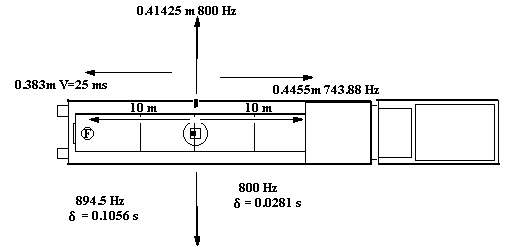
Due to the fixed speed of 800 Hz sound produced by the whistle blast in this stationary frame of reference, the atmosphere, an interesting illusion takes place, where the sound seems to radiate outwards from the whistle in a concentric egg-shaped structure. The faster the locomotive travels, the more tear-drop this structure becomes. The whistle and cabin establish a third frame of reference while the funnel to the whistle is seen as a fourth frame.
In the "stationary" world about, the sound travels at 331.4 m/s, so the Doppler shift caused by the 90 Km/h (25 m/s) speed produces a shortened wavelength of 0.383 metres in the forward direction ( O to x) with a lengthened wavelength of 0.4455 metres, in the trailing direction (O to y). This is the normal Doppler shift that such moving noises produce. In the forward direction, the frequency (at x) would be heard as 865.27 Hz while in the opposite direction its frequency would be 743.88 Hz (at y). In the cabin (C) , the frequency is 800 Hz, though the propagation time ( ð ) is much quicker, around 0.0281 seconds. The sound heard at the funnel has a much higher frequency, 894.5 Hz, with a much longer propagation time, 0.1056 seconds.
The perception of the signals with respect to time is distorted because of the Doppler shift, relative motions, frames of reference and the conservation of energy. The sound is measured at the points of maximum deviation. In the cabin the reflected sound from the funnel is not changed. Only at the position of the funnel is there going to be a noticeable change with respect to the motion, yet there is a change in the cabin if one knows where to look and what to look for, (the time signature and the propagation delay would reveal the motion). In air, the speed of sound for a precise frequency is constant and limited by the medium. Extrapolation of this steam locomotive experiment not only shows the fault in the Michelson-Morley experiment but the method needed to determine the true speed in the vacuum of space. Using the steam locomotive concept, it is easy to remove that nasty beam splitter and the mirrors in a much better, much more sensitive design. The wind detector can be made using the technology of 1980, by the home electronics hobbiest, with the minimum of fuss and very little calibration.
The theory behind this device can be tested with an Audio signal. The wiring system is designed for the light system so that critics cannot use the Lorentz argument that matter is squashed by speed. The device can be made so sensitive that the draught caused by a house fly walking nearby can be detected. Don't believe this claim, test it.
There are two possible systems, and several alternatives. The principal system uses a central vertically mounted transmitter or transducer. The signal source is directed onto a reflecting vertically mounted 45° pyramid or cone so that the wave motion is deflected from the vertical direction to travel horizontally across the surface of the device to a detector or group of detectors mounted at identical distances. Each detector is either fixed or mounted on a vernier set carriage. Each geometric design has two principal types as illustrated in Figure 16-6 In the square device, the detectors are mounted at the corners (type A) or mid-points (type B) of the square with the vertical reflector mounted at the centre. The wiring to each detector uses connection pathways involving double redundancy, whereby, each detector connects along two lines to the central processor so that any speed deviations caused by the wire transmission speed cancel.
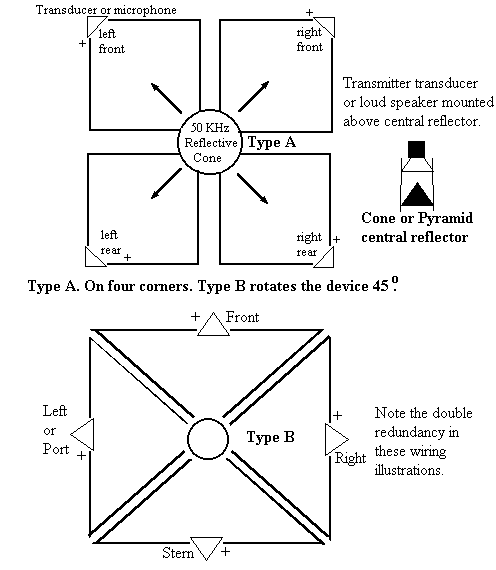
In the type-A system, the wiring runs from the corners to the mid-points of the adjacent sides and then to the centre. The type-B device situates the detector at the mid-point and uses the diagonals to take signals to the centre. Both of these systems introduce noticeable time delays in the light and radio spectrums, resulting from the length of wire. (When the followers of Lorentz realize that matter has not shrunk, this wiring can be rationalized to the most direct path. Electronic tricks are used in the higher regions of the magnetic spectrum to reduce the propagation and delay times.)
Again, a swimming race is a good starting point to explain the workings of this device. All the swimmers start at the centre, but there is a heavy fog, so the judges decide to give each swimmer a note stating the exact time the swimmer left the blocks. Each swimmer is then timed externally and each carries their note to tell the judges at the race's finish exactly the moment that the swimmer left the block at the centre. The goal is simply to swim from the centre to the nearest detector. The judges don't know the moment that any swimmer actually left the block, until they read the note carried by the swimmer. The judges do know the moment that the swimmer completed the single leg, for confirmation of the start time is delivered by the official boat at the first available opportunity. This is a hideous scenario for any swimmer.
In the Type-B version, consider each swimmer as being 20-20 quiet water pacer, like the two swimmers in the previous example. The river flow "u" is slightly askew. Each leg is 1,000 metres. Who wins?
There is no trick to this. It is obvious. Those that win are carried with the current, while those that lose swim against the current. The winners in the above race are First North, Second West. Third East, and last is South. Having said that, is there any effective path length change? Determine the number of strokes. Give the arrow "u" an arbitrary pair of values, like one metre to the left, and 5 metres towards the aft. This is the figure determined.
From this, if the winners are given as ties for first and second places, so what direction is the current flow? (i.e. First West and South tied, and in Second place East and North). Try this one. What is the approximate prevailing wind direction when the following winning order is seen, S,E,N,W? If the time durations are observed, the direction of the disturbance can be immediately detected and measured to accuracies that are unbelievable.
This device has numerous applications where the wave motion in a medium not only strikes each detector in a certain order, any wind in that medium will be detected, with direction and velocity. This interferometer uses the central transmitter to create a reference or timed marker signal (a datum point) that self-calibrates the system giving rise to a signal that allows analysis in a very-close-to the real-time situation. Nothing can be measured in real-time.
There are just so many applications using this device from Geology, Navigation and the weather to Astronomy that the list seems endless. An audio device mounted on the top of a small van can be quickly calibrated to give wind speeds, and directions with just five moving parts, (the diaphragms of the four microphones and the cone of the speaker). Many applications and the actual electronics will be discussed shortly. The device does not need to be square or fixed. It could be triangular, rectangular, circular et cetera. It can be fitted inside a yacht's winged keel, with another sitting at the top of the mast on a gimbal. The size of the device is not that critical in slow mediums like rock, water, air, oil, fats, unless one is measuring light frequencies. There are minimum sizes depending on the medium's transmission speed and the resolution of the electronics package.
Finally, it must be said, that the positive results obtained through the Michelson-Morley experiment are accepted as being proof that matter affects and influences all other matter, for it illustrates that in the terrestrial frame of reference, no motion should be seen unless there are changes in atmospheric refraction due to wind and pressure changes. So, how does it fit into relativity and why is it so important?
No experiment has yet been conducted to accurately determine whether or not the speed of light does change, as two different mechanisms can be used to explain Doppler shifts. It can be additional as illustrated in Einstein's General theory where c = c1 ± c2 or it is absolutely fixed as in Einstein's Special theory of relativity. If the perception of light is a count rate per second, there is no simple way of determining which is true, where the velocity of the source adds to the speed in the medium, so the count rate for Green light will be green at the source and Blue at the observer's position, OR, as the speed in the medium is fixed, then the sonic boom event applies where the wave fronts bunch up, so that the green light appears Blue.
With Einstein adopting "photons" then the general theory of light is true. With Einstein adopting a fixed and absolute speed of light, in the Special Theory of relativity, Einstein is promoting the Æther theory. To get around this contradiction, one must laugh and cry, because Science adopts a wave-particle theory, to agree with the contradiction, so that the photon is a wave and a particle at the same time. In real terms, the failure of the famous Michelson-Morley experiment serves to confirm that light does not need to have a finite or fixed speed, however for a given frequency in our environment, light speed may be fixed with respect to the universal reference frame. Humanity exists inside a moving space craft, (beneath the Earth's ionosphere and shock front) so everything around this planet will appear normal, since all things and measurements, are made and are relative, to the rotating orbiting Earth and to matter.
Looking back in History, Rene Descartes introduced the corpuscular theory of light, a theory that Newton embraced with open arms. This theory would later be the basis of both photon theories of light (Quantum theory and General relativity). John Mitchell (an Eighteenth Century amateur scientist and Rector of Thornhill Church in England) took Newton's view of gravity, together with the corpuscular theory, calculating the size of the black star; a star so massive that it was capable of pulling the light back to its surface. Mitchell did not know the mass of a light corpuscle. The known speed of light was vague. Up until 1729, the speed of light was 200,000 Km/s, when Bradley increased it to 304,000 Km/s. Mitchell calculated the size of the body, where its "g" value, (the attraction due to gravity) equals the speed of light. He estimated an object around a hundred million solar masses in size.
Because Newton made a fundamental mistake, failing to realize the power of rotational energy, he pushed the belief in linear momentum as the quality of all motion on this rotating, orbiting spheroidal planet. This gave Newton an absolutely incorrect notion about gravity. This false belief is where gravity, (an unexplained force) draws all matter together, becoming the most powerful force in Nature, especially when both Einstein and the Quantum Mechanics marry.
Einstein took the Newtonian concept of gravity and rather than treating the Universe as simply three dimensions of position, to which he added the fourth dimension, time, creating a Universe of space-time. He equated gravity as a force due to the bending of space and time. This is the concept of curved space. Where there is no gravity, space and time are represented by a flat plane. Where gravity exists, there is a "dip" in the curvature of space. Einstein places gravitational objects in the Universe at a moment of time, existing at a particular location, hence the Universe has four dimensions, a 3-D spatial location and time.
A limiting belief is now introduced as a ploy to allow all manner of sins. It is stated frequently that because our sensory experience of the Universe is that of a three dimensional Universe, length, breadth and depth, then few can understand and contemplate space-time. This is invalid, because all motion is a change in position with respect to time. Such a false belief is promoting an "us against them attitude". Most people understand concepts like motion, rotation, stopped, stationary, movement, displacement, speed, velocity, acceleration, energy, and force, where anything moves from point "a" to point "b", in or over a specific time frame. To describe the points "a" and "b", each is seen as a 3-D position in the Universe. To describe motion as simply moving from one point to the next, takes time. Is that is what space-time is?
Not exactly. Basically, the special theory denotes everything as having 4 coordinates in the Universe, which means that the forth coordinate "Time" is a variant, when it is not a variable in the strict sense. This means that the three physical dimensions are mixed with an abstract, something that has no definition, a period of aging. This abstract is an ordinant in the Universe, and should not be confused with the period of time when an event took place. Einstein's notion means that time travel is possible, because time is considered as a variant, yet no one can decipher or rationalize any mechanism that will reverse the aging process. Perhaps, one could fill the Universe with anti-aging cream to the delight of some advertiser. But that would only remove the wrinkles in time. It would not be a feasible answer. Rotation does not open the doorway, nor does linear motion. Gravity only drags the wrinkles out further. Ask any jogger about gravity's effect on their body after a healthy jog down the side of a car filled busy expressway. Gravity exacerbates the problems, and the healthy jog in the smog quickens the on-set of death.
If Einstein is accurate, and there exists a fourth dimension, then it is expected that the first time traveller will return to this position in the Universe and will stop this work from being published, for the author, in making these comments, could be effectively putting an end to all research into time travel. It is the author's hope that time travel is possible, for it would make things so much easier. Unfortunately, Einstein made the explanation so complex, that many have the wrong belief about space-time and fail to appreciate the Universe, accepting as truths, blatant speculation and falsehoods. Due to other problems with space-time and the effect of Lorentz, this mind-dilation need to be re-examined shortly.
Einstein's space-time is warped by gravity and linear energy because Einstein destroyed the universal frames of reference. The Foucault pendulum, Foucault's gyroscope and the Coriolis force prove the existence of the Universal "stopped" position. It would be from such a point that the speed of light, as a wave motion in the magnetic medium, would be fixed in all directions, however, in this region of the Milky Way Galaxy, the Solar System is a space craft moving in the galactic arm, so the speed of light in this region is relative to the motion of this spiral arm at this distance from the galactic centre. Everything has rotation until rotation ceases, and everything contained in a rotating system is moving as a whole with respect to the stationary universal positions. No matter which way the detectors face on the Earth's surface, local variants will be detected in the speed of light, even over relatively short base lines. Thinking of the Universe in terms of linear physics must be abandoned. It is just so wrong. The Universe must be accepted as it is in Nature, as a 3-D rotating Universe that is aging ever so slowly due to its enormous size.
-------------- End Chapter 16 --------------
