The Spirit of Giving !
In this Holidays Season, parents and children sometimes forget about the Sprit of the Season to engage in shopping spree. Recently, I read an article about parents giving to EBay auction the presents meant for their kids on Christmas.
Parents not only want their children to be successful, but also to have a happy and moral life. It is meaningless if their children, despite their wealth, are still ridden with suffering or living a life of vices. I know that it is not easy for us to live a moral and happy life these days. Youngsters need to be immunized against all kinds of “unwholesome behavior” around them. Children also need to learn to think by themselves and be responsible for having a meaningful life.
Knowledge helps children to be smart and to avoid the wrong direction. In America, Europe as well as in Cambodia knowledge has the same effect: putting you in the right direction in life. But if you wish your children to be happy and “good” you need to teach them boon or merits, because merits can help stave off all sorts of problems and vices from anybody including children. Generosity practiced by children can help them solve and manage life’s problems as well as nourish them spiritually with inner peace and happiness.
In all religions, merit (boon for the Buddhists) cleans one’s deeds so one can live a moral life that benefits both oneself and others. Secondly, it is the cleansing of one’s mind from “desire” and “attachment” that can cultivate a wise mind that is not driven by emotional impulses. Boon also means the blissful feelings that come from doing something good and useful for others.
Boon starts when we know how to give. Giving or “Dana” helps erase our self-centeredness. The mind that is always on the take is narrow and selfish, making that person unlikable and making it difficult for that person to be happy. Look around you, people who are not generous very often show their unhappiness and suffering.
Children grow up safe and sound because they receive what they need from others, from time of their birth. If children do not learn how to give, they will believe that they are always entitled to get things from others. Kids should learn that life is about give and take. They can learn from trees, for example: The trees take nutriments and water from the soil, but they also give back humidity and oxygen. Their dry leaves nourish the soil in return.
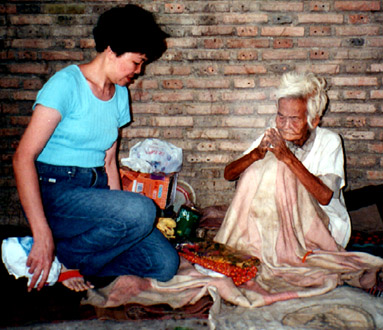
But giving does not mean an exchange or a duty. For giving essentially gives us happiness. Teaching kids to be generous therefore amounts to teaching them to be happy from their own generosity. The truth that the givers get happiness is what all children should learn by experience. This is why in Cambodia and some other Buddhist countries, parents bring their children to the temple to give alms to monks so they will want to do that on their own when they grow up.
One is blessed by giving alms to monks, but the blessing from boon also comes from giving to the distressed. Children can make merits just by giving away their toys to poor children or by donating a helping hand to the handicap or elderly. Apart from money, giving can be the giving of life to an animal by freeing a fish that is stuck in the mud or a starfish on the beach returning them to the waterway or the sea.
Teach your children that what they give or how much it costs is not as important as the thoughtfulness itself. One day, I was begging alms in front of a temple. People entering the temple dropped a dollar or two into my bowl, most of the time without paying much attention except that the monk was “Caucasian”. Then, a very old lady came by, stopped in front of me and got ten cents from a pocket in her purse. Then she looked to me, made a prayer and gave me the alms with such thoughtfulness that I will never forget her face or her alms. You can teach your children that our qualities are not measured by age, success or fame, but the quality of our hearts.
Putting in one’s time and energy to help others is also a merit-making deed. Children should learn that they can do this kind of boon everyday in their daily life. For example, picking up litter, helping a younger brother or sister with school chores, carrying thing for the elderly, helping the blind to cross the street, growing trees, etc, are all boon-making deeds.
Non-exploitation
To help others, we must start by ensuring that our own conduct does not cause harm to other people. Harmful acts include taking life, supporting the ones who take life, stealing, supporting the ones who steal, corruption or supporting corrupted people, and violating what is cherished by others. The merit making activities from refraining from these acts is called sila (morality virtue) by Buddhist. By teaching children not to exploit others, you give your kid a fence to ward off possible harm. Parent should not remain passive if the children commit what seem to be trivial mistakes, such as stealing their friends’ pens, copying others’ homework, cheating on exam. But the most important is for the parents to understand that children are learning from their parents’ behaviors. A child who witnesses his parents lying or exploiting others will surely copy that behavior.
Make merit with your heart.
You can make merit at all time wherever you are whether or not you have money. We can do merit without doing anything if we train our mind properly so that it generate positive feelings such as admiration for others good deeds. Teaching your children to be happy for other will give them the seeds of good-heartedness. Children can also be instructed not to go alone in their good efforts but to give an opportunity for others to join in. Wishing others to share the blessings from one’s good deed is also a boon in itself.
Training for a calm mind.
Meditation calms the mind by effectively extinguishing anger. Meditation is not practiced only by Buddhist and other “oriental” philosophies. Meditation is used in anger management therapy and by people who wish to perform better in their professional lives. To teach children meditation one need to practice first. The most common way to teach meditation is to teach breathing. Everybody tried once to breathe in slow a deep breath fore to five times when one feels anger coming up.
The majority of people have “tried” meditation at least once in their life; without much outcome. For meditation to be effective one must put in as part of a daily life and practice regularly. The methods vary quite much depending if you are from western or eastern influence, if you know Buddhism or not, if you have an experienced teacher or not. Focusing one mid on the breathing in and breathing out, or to walk slowly and mindfully are the most well know forms of meditation. To teach children meditation it has be part of the daily life and practice together with the parents. One does not need to sit cross-legged or to have had a meditative retreat. Only five minutes a day of this practice in family will do wonders in your mental development and the one of your children; where you will notice better school results and better behavior rapidly.
One does not need a special environment to practice meditation. I used to teach children to be mindful when brushing their teeth, washing dishes, or doing homework. Meditation is about doing ONE thing at the time while being focused. Not eating and reading at the same time, doing homework and listening to music. This can help strengthen one’s ability to be focused.
Bedtime is a good time for the children to practice meditation. This can be done by simple prayers or mantra. Paying a mindful homage to the parents, teachers, etc is a good practice. Meditation calms the mind before going to sleep and is especially useful for people who work under a lot of stress.
Projecting compassion, loving-kindness and universal brotherhood and sisterhood is an effective mental practice that protects oneself from anger. It also put us in a compassionate state of mind. Being thankful to the parents and the teachers is a way to develop generosity. One can also learn to be thankful to the nature: the tress, the flowers the animals, this help instill gentleness and concern for the environment.
After training the mind to be calm, the next step is training the mind to be wise or to have the right thinking. Most crime committed today finds their roots in the wrong thinking or the thinking that the action committed is necessary for the development of good. Right thinking can be cultivated by exposing oneself to useful information. Teaching your children to read appropriate books, and to listen to appropriate teaching and finally can help them to have right thinking. Teaching your children to do good deed is itself a merit making activity. If they follow your teaching and copy your actions you also become a better person avoiding wrong under any form.
Right thinking leads to the right action and the right boon is one that makes one’s mind pure, clear, calm and most important with true Happiness.
What a great inheritance you can
give to your children.
If you wish to communicate with me and discuss about your story, your concerns and your solutions you can do so just . . . mailto:[email protected]
Last revised December 25, 2004