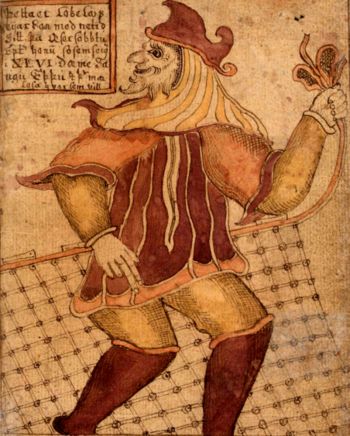
Loki or Loke is the mythical Fire-giant/deity of mischief in Norse mythology, a son of the giants Fárbauti and Laufey.
Loki also had two brothers (Helbindi & Byleist) of whom nothing is known. He mixed freely with the gods for a Despite much research, "the figure of Loki remains obscure; there is no trace of a cult, and the name does not appear in place-names."1 Sources inconsistently place him among the Æsir; however, this may only be due to him being a journey man of sneak and his close relation with Odin and the amount of time that he spends among the Æsir. Like Odin (though to a lesser extent), Loki bears many names: Sly-God, Shape-Changer, Sly-One, Lopt, Sky Traveller, Sky Walker and Loftur among others. The trickster character is a complex character, a master of guile and deception. Loki was not so much a figure of unmitigated badness as a kind of celestial con man. He would often bail out the gods after playing tricks on them, as illustrated by the myth in which he shears Sif's hair and then replaces it, or when he is responsible for the loss of Iðunn's apples of youth and then retrieves them again. Loki is an adept shape-shifter, with the ability to change both form (examples include transmogrification to a salmon, horse, bird, flea, etc.) and sex. In some stories, Loki is conceived of as a fire spirit, with all the potential for good and ill associated with fire. However, this view may be due to linguistic confusion with logi "fire", as Loki's primary role is predominantly associated with Odin, typically as Odin's wily counterpart. That said, there is a story in Gylfaginning in Snorra-Edda where Loki competes against a jotunn called Logi in an eating competition, and loses miserably when Logi has not only eaten all the meat, but the bones and the tray as well. Later, it turns out that Logi was in fact not a real jotunn, but wildfire given a lifelike appearance by magic. Yet another explanation of the name and hence the character, is not that the word Loki is related to the old german verb lukijan, connected to the closing of a ring (to lock it). Thus, the word is connected both to the action of "locking" circlets, and hence to "travel by crooked paths", something that might well be an apt description of a trickster god. 1Encyclopædia Britannica, 2004 Taken from http://en.wikipedia.org/wiki/Loki |
||||||||||||||||||
| ||||||||||||||||||
 long time,
even becoming Odin's blood brother.
long time,
even becoming Odin's blood brother.