 Camp
4 Materials
Camp
4 MaterialsCamp
4 Materials
As a layout, Camp 4 did not seek to break any new ground for model railroading. However, as the competition specs suggested a small lightweight design, the opportunity to try something different was too great to pass up.
Art supply stores have been selling Foamcore for a while now, usually for the purpose of mounting pictures in frames. For those who have not heard of Foamcore, it is a sandwich made up of a core of expanded polystyrene foam, faced with thin cardboard on either side. Here in Australia, it is generally available in 3mm and 5mm thicknesses. Sheet sizes may vary, but common sizes appear to be 20" X 30", and 40" X 60".
As a material, it carves with a sharp X-Acto knife or similar, takes acrylic and spray enamel paint well, and can be laminated together using regular PVA glue. (Just as with paper products, weight the laminations down flat with heavy objects such as books while they are drying).
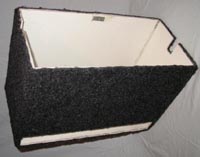 In
the case of Camp 4, the entire layout, transport box, and equipment drawer is
built of 5mm Foamcore The box was quickly put together in one night, (pretty
much designing as it was built ;-) ), using a hot glue gun to join the pieces.
The carpet was mounted by gluing one of the edges with hot glue to anchor the
carpet, smearing a thin layer of PVA glue over the Foamcore surface, and then
carefully laying the carpet down, ensuring that the carpet was kept taut, and
that there were no air bubbles or wrinkles.
In
the case of Camp 4, the entire layout, transport box, and equipment drawer is
built of 5mm Foamcore The box was quickly put together in one night, (pretty
much designing as it was built ;-) ), using a hot glue gun to join the pieces.
The carpet was mounted by gluing one of the edges with hot glue to anchor the
carpet, smearing a thin layer of PVA glue over the Foamcore surface, and then
carefully laying the carpet down, ensuring that the carpet was kept taut, and
that there were no air bubbles or wrinkles.
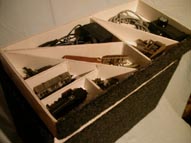 The
equipment drawer was similar in construction. The base, and 4 walls were assembled
first. The location of the throttle and power supply were then decided, and
smaller pieces of Foamcore strip were cut to length and hot-glued in to form
dividing walls. From there, the other pieces of equipment were test fitted until
a suitable arrangement was found. Guidelines for dividing walls were drawn on
the inside base of the drawer, and measured for length. Suitable strips of Foamcore
were cut and mounted with hot glue. A strip of carpet was then mounted on the
"front" face of the drawer, and it was finished.
The
equipment drawer was similar in construction. The base, and 4 walls were assembled
first. The location of the throttle and power supply were then decided, and
smaller pieces of Foamcore strip were cut to length and hot-glued in to form
dividing walls. From there, the other pieces of equipment were test fitted until
a suitable arrangement was found. Guidelines for dividing walls were drawn on
the inside base of the drawer, and measured for length. Suitable strips of Foamcore
were cut and mounted with hot glue. A strip of carpet was then mounted on the
"front" face of the drawer, and it was finished.
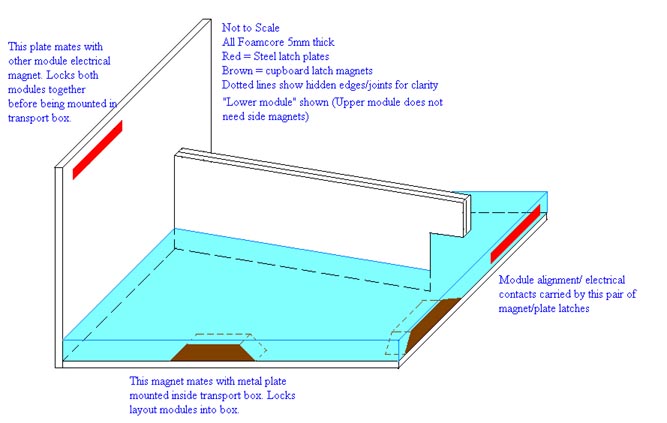 The
rough diagram at left, (Not to scale), shows the basis of the module design.
The centre viewblock, formed with 2 layers of Foamcore laminated together, acts
as a gusset, giving the base/end Foamcore joint it's overall strength.
The
rough diagram at left, (Not to scale), shows the basis of the module design.
The centre viewblock, formed with 2 layers of Foamcore laminated together, acts
as a gusset, giving the base/end Foamcore joint it's overall strength.
The light blue area represents a sheet of 20mm thick extruded foam, which was used to give some space for below-track-level "earthworks".
All Foamcore joints were made with regular hot-glue. If deemed necessary, some light 20mm wooden square doweling could be used to reinforce the base/end 90 degree joint.
For information on the electrical and mechanical technology behind Camp 4, click HERE