 Designing
Camp 4
Designing
Camp 4 Designing
Camp 4
When designing any small layout, everything has to work together. Every idea has to be a good one, simply because you do not have the space to waste. I have a personal bias towards logging, so the theme of the layout was pretty much a foregone conclusion. But how to get a decent amount of interest into a layout that had to fit into such a small space?
The "Eureka" moment came when the idea hit that anything above visible eye level was wasted space, and could be used to "interleave" the modules together for packing. With this also giving an instant doubling in length of the layout, and railroads generally being better suited to fitting in long thin spaces, the stage was set.
The overall size of the box was constricted by the competition rules, and once the decision was made on what the theme would be, and thus what equipment had to be carried, provision was made to house said equipment. The drawer idea was taken directly from the Pro Sound and Lighting world, where sleeve type drawers, mounted in 19" rackmount cases, are a regular feature.
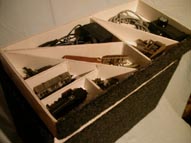 The
size and design was dictated by the dimensions of the throttle and power supply
primarily, as they were the biggest and heaviest items. Locos, rollingstock,
and assorted other items were then "jigsawed" around until a nice
fit was found.
The
size and design was dictated by the dimensions of the throttle and power supply
primarily, as they were the biggest and heaviest items. Locos, rollingstock,
and assorted other items were then "jigsawed" around until a nice
fit was found.
So, a box of known dimensions, minus the room required for the drawer, equals the space available for the layout. Final dimensions were 8" wide X 10 1/4" tall X 18 1/2" long. 2 modules, interlocked together, fit this space, and unfolded to give a layout 8" wide X 37" long. The space is set, let the trackplanning commence!
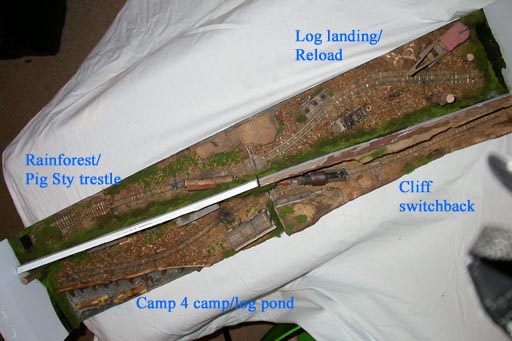 Being
unashamedly small in real estate, Camp 4's trains are equally so. One loco and
two 24' cars are a full train. In HOn30, that meant that the layout was around
3 train lengths from one end to the other. Just enough room for a train length
switchback, and a pair of points ;-)
Being
unashamedly small in real estate, Camp 4's trains are equally so. One loco and
two 24' cars are a full train. In HOn30, that meant that the layout was around
3 train lengths from one end to the other. Just enough room for a train length
switchback, and a pair of points ;-)
A question still nagged at me though. How could I plausibly explain away soo many tracks in such tight proximity? To build this layout as one scene would destroy any illusion of going anywhere. The donkey winch could haul the logs to the log pond, why would we even need a railroad?
The solution to this problem lay in a concept already proven by Broughton Vale Tramway, and espoused by many US modellers. By breaking a small layout up into smaller scenes, deliberately viewblocked off from each other, the small layout designer can force the viewer to concentrate on one scene or another, but not both simultaneously. This means that to see everything, the viewer must actively pay attention, move around to get the best vantage point for each scene, and all the while be blissfully unaware that the scene they have just viewed, depicting some geographically far flung location, is actually no more than a few inches from his or her current viewpoint. This technique is especially suited to layouts which are displayed at or near the eye level of the intended audience.
So, with the ground work done, the "usual" modelling tasks of selecting buildings and structures, handlaying track, trying new scenery techniques, and tuning rollingstock commenced. But that's another story... ;-)
Click HERE to learn about the lightweight materials used in the construction of Camp 4