 Broughton
Vale Structures
Broughton
Vale Structures Broughton
Vale Structures
Here is a detailed overview of the structures of Broughton Vale. Apologies for
it's length and load time. Enjoy.
When your layout is as small as Broughton Vale Tramway, you quickly realise that space is at a premium. This can cut two ways. If you let the lack of space hinder your planning, the frustration can be intense. (Many modellere have exercise books full of trackplans designed to fit in double garages, basements , and barns, that may never happen). On the flipside, If you accept the limitations and, instead of packing EVERYTHING in, try to model a few structures as well as you can, the results can be very rewarding. Small space modelling offers the builder in all of us the chance to make every model an eyecatcher, because the time you DON'T spend building LOTS of general things can be put into modelling a few specific things to the best of your ability.
 When
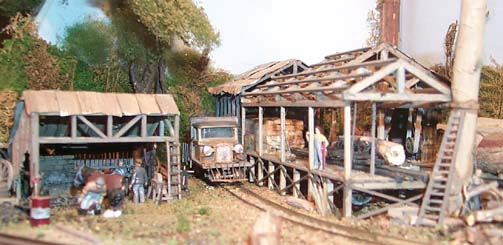
it came time to fit a sawmill into this alcove, it was obvious even a small
one was going to be a squeeze. The Keystone Danby mill is one of the smaller
kits available, and fit right in. However, it did require extensive rebuilding
to replicate the "open air" architecture of so many Australian Bush
industries. A extension, built from the remains of a junked european brewery
structure, was also added to the rear, and acts as a drying area for the freshly
sawn lumber.
When
it came time to fit a sawmill into this alcove, it was obvious even a small
one was going to be a squeeze. The Keystone Danby mill is one of the smaller
kits available, and fit right in. However, it did require extensive rebuilding
to replicate the "open air" architecture of so many Australian Bush
industries. A extension, built from the remains of a junked european brewery
structure, was also added to the rear, and acts as a drying area for the freshly
sawn lumber.
By the way, the limbed tree supporting the end of the sawmills centre beam was a "happy accident", some prototype examples of which were recorded in period photos.
The Blacksmith's, on the other hand, was a case of, "I've got the details, where can I put them?". Trying to "see in my mind's eye" what a Australian bush machine shop/blacksmiths would look like always resulted in a caricatured version of reality. Then, one day, out of one of the scrap buckets came this log drying deck. With a little imagination, it's stepped roofline and overhead framing suggested a small shed and lean-to combination. So, off came the plastic roofing, to be replaced with some scale 12" roof beams, and some scale corrugated iron. Over the plastic molded planking walls I glued scale 1" X 12" planks. Then to finish the whole thing off, a general wash of India Ink/Isopropyl alcohol mix was applied to weather the wood, and a mixture of "Oil Wash" and chalk was applied to simulate the rust on the iron roof .
 The
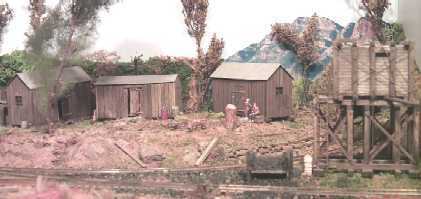
bunkhouses in Broughton Vale were all kitbashed from kits by Master Creations
and John Rendall. They were reasonably easy to build and look good. Tissue paper
was applied to the roof panels to simulate tarpaper, and the roofs were modified
to be removable for future detailing. One of the bunk houses in this scene already
has full interior detailing, including double bunks, clothing and storage chests,
and a pot belly stove. The other two are awaiting these details.
The
bunkhouses in Broughton Vale were all kitbashed from kits by Master Creations
and John Rendall. They were reasonably easy to build and look good. Tissue paper
was applied to the roof panels to simulate tarpaper, and the roofs were modified
to be removable for future detailing. One of the bunk houses in this scene already
has full interior detailing, including double bunks, clothing and storage chests,
and a pot belly stove. The other two are awaiting these details.
The centre bunkhouse is equipped with a potbelly stove built from a plastic 44 gallon drum. This contains two L.E.D.s connected to a fire circuit. The left bunkhouse is equipped with a small yellow L.E.D. shaped to represent a hurricane lantern. Surrounding the bunkhouses are details such as woodpiles and wood stacked in 44 gallon drums, buckets, and other tools. There is also the two loggers enjoying a beverage after a hard days work, and four of the camp children playing around the tree to the left.
The Loco water tank in the foreground was scratchbuilt from O scale plans of the Los Pinos/Cosumnes Lumber Co water tank in a copy of the Narrow Gauge & Shortline Gazette. It features a positionable water spout, and detailing down to the water level indicator and associated pulleys on the end of the tank. The coal staithe was scratchbuilt from the cab sides of the Bushmill Climax after a particularly nasty accident at an exhibition.
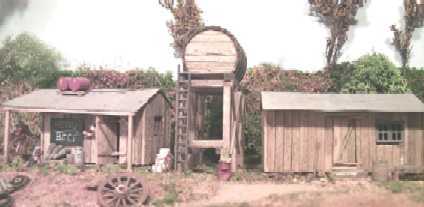 The camp dining room, water tank,
and kitchen were ably scratchbuilt by Nicole from wood left over from the John
Rendall kit. Believe it or not, these structures represent her first ever efforts
at scratchbuilding. Again, with such a small scene, opportunities to add detail
abound. Exhibition goers never get tired of finding Sadie, the mill foreman's
dog, trying to scam some food from the camp cook. The menu board on the kitchen
wall is removable, and gets changed regularly during the course of an
exhibition, just to keep the viewers on their toes. Check some of the other
photos of this structure on this site, and you may see some of the other menu
boards. Basic weathering on these building was achieved by treating the wood
with Oil Wash prior to assembly. Plastic and metal window frames and detail
parts were painted a basic grey or black as was appropriate, and then colored
with various combinations of Humbrol Wine Red, Tamiya Sky Grey, Dark Earth,
or Buff, pencils, and rust colored chalk powders. All of these were mixed with
Oil Wash.
The camp dining room, water tank,
and kitchen were ably scratchbuilt by Nicole from wood left over from the John
Rendall kit. Believe it or not, these structures represent her first ever efforts
at scratchbuilding. Again, with such a small scene, opportunities to add detail
abound. Exhibition goers never get tired of finding Sadie, the mill foreman's
dog, trying to scam some food from the camp cook. The menu board on the kitchen
wall is removable, and gets changed regularly during the course of an
exhibition, just to keep the viewers on their toes. Check some of the other
photos of this structure on this site, and you may see some of the other menu
boards. Basic weathering on these building was achieved by treating the wood
with Oil Wash prior to assembly. Plastic and metal window frames and detail
parts were painted a basic grey or black as was appropriate, and then colored
with various combinations of Humbrol Wine Red, Tamiya Sky Grey, Dark Earth,
or Buff, pencils, and rust colored chalk powders. All of these were mixed with
Oil Wash.