




Uranium Weapons in Yugoslavia, Afghanistan and Iraq
(Don Nordin's interview with Leuren Moret)
Hello, this is Don Nordin. You're listening to
the Monday Brownbagger (Vancouver Cooperative
Radio - 102.7 fm) of February 23, 2004 and I will
have on the line in a moment a guest from
Berkeley. Her name is Leuren Moret. She is an
independent scientist and international expert on
radiation and public health issues. She is on the
organizing committee of the World Committee on
Radiation Risk, an organization of independent
radiation specialists, including members of the
Radiation Committee in the EU parliament, the
European Committee on Radiation Risk. She is an
environmental commissioner for the City of
Berkeley. Ms. Moret earned her BS in geology at
U.C. Davis in 1968 and her MA in Near Eastern
studies from U.C. Berkeley in 1978. She has
completed all but her dissertation for a PhD in
the geosciences at U.C. Davis. She has traveled
and conducted scientific research in 42
countries. She wrote a scientific report on
depleted uranium for the United Nations sub
commission investigating the illegality of
depleted uranium munitions. Marian Falk, a
former Manhattan Project scientist and retired
insider at the Livermore Lab, who is an expert on
radioactive fallout and rainout, has trained her
on radiation issues.
(Don) So let's get into it. I'll ask you to tell
the folks what depleted uranium is.
(Leuren) Depleted uranium basically is the
radioactive trash from the nuclear weapons and
the nuclear power plant programs, and three
isotopes of uranium occur in nature, so when it
is mined those three isotopes are extracted from
the ore. The DU is about 99.9% U-238, 0.72% U-235
that is the fissionable isotope used in nuclear
bombs and reactor fuel, and there's just a trace
of U-234 left in a tenth of a percent of the
remainder. So what they do is they make a gas
out of it, and they extract half a percent of the
U-235 and what is left, which is 99.95% of what
they mine, is called depleted uranium because it
is depleted in U-235. It does not mean that it
is depleted in radioactivity; it's actually very
radioactive.
(Don) What kind of a half-life do these
constituents of the depleted uranium have?
(Leuren) The half life of U-238, which is the
majority of what we're talking about, is 4.5
billion years and it's actually a component of
meteorites, planets, stars, space dust and it is
distributed throughout the earth at about 2.4
parts per million, and because it is radioactive,
it releases tiny amounts of heat over time and
that is why we have a liquid or molten interior
in the earth. It's from the decay of U-238.
(Don) Do you have any idea of how much depleted
uranium the U.S. has in its national inventory?
(Leuren) Yes, the U.S. has about a million tons
of depleted uranium. Most of it is stored in
canisters as uranium hexafluoride, and it's just
really an environmental problem. There is no
place to dispose of it so in 1974, against the
advice of the Department of Energy, the
Department of Defense began testing and
manufacturing weapons made out of DU and the
first system was manufactured by Hughes Aircraft.
It was called the Phalanx System developed by the
Navy and within six months of the Navy testing
it, they had sold it to 14 branches of the U.S.
military and other countries. We have now sold
DU weapons systems to 29 countries.
(Don) In what kind of weapons is this DU used?
(Leuren) Well, depleted uranium is made in every
caliber [and used in projectiles] for handguns,
tanks, cannons, all the way up to large bombs
weighing more than 5,000 lbs [and also used in
the body of] the Warthog airplane. So everything
from handguns to bombs practically has...many
have conventional weapons for ammunition but they
also have them in depleted uranium. A lot of
systems are interchangeable. You can put a DU
warhead in a bomb or a conventional warhead in
the same bomb.
(Don) Did I hear you say they're using depleted
uranium in the actual airplanes themselves?
(Leuren) Oh, yeah. The US Air Force and the US
Army are the largest users of depleted uranium.
For instance, [DU is] very, very frequently used
in the A-10 Warthog, but other [military] planes,
and weapons systems carried by many planes, have
DU.
(Don) Now why would they use it in the construction of an airplane itself?
(Leuren) Oh, depleted uranium or uranium metal is
nearly twice as dense as lead and so instead of
using larger amounts of a dense material like
lead, they can use smaller amounts of depleted
uranium as ballast in planes, so they use it in
commercial planes and in military planes as
ballast along the wings and the tail to balance
the plane. [It's] very similar to the lead lugs
they put on tires when we go and get our tires
balanced.
(Don) Well, I guess, anyway, the DU being in the
wings and tail wouldn't be of any significant
threat to the occupants of the plane itself.
(Leuren) It's not to the occupants of the plane;
it is to crash site investigators when a plane
crashes. There was depleted uranium in whatever
hit the Pentagon on 9-11 and I'm the only
journalist in the world who even wrote an article
about it. The German science journal Nature
picked up my article and actually wrote its own
[article] based on the interviews I did. It's
used in golf clubsSit's used in many, many
surprising things and because there is so much of
it, which the Department of Energy has, they're
trying to find ways to dispose of it. And there
are proposals now to put it inside building
blocks to construct buildings with. So if this
continues we'll be living in radioactive
buildings and then the terrible thing is that
when the aluminum from planes or the metal from
planes is recycled, the DU is not removed, so the
metal that is re-manufactured will contain
radioactive DU mixed in with it.
(Don) Now, of this one million tons of depleted
uranium in the United StatesShow is that stored?
(Leuren) Oh, it's stored at, for instance,
Oakridge, Tennessee. There's a big nuclear
weapons lab facility there and it's stored as
uranium hexafluoride gas in huge drums, and
they're just stacked outside on top of each
other. It's also stored at Portsmouth, Ohio and
other locations -- Hanford in Washington State.
(Don) So the storage issue itself must be quite problematic.
(Leuren) It's very problematic and the canisters
that it's stored in, the big drums, are subject
to corrosion on the outside and the barrels that
are stored closest to the ground and subjected to
moisture and heat and bacterial action corrode
faster.
(Don) Now, in the bombs that were dropped on Iraq
and Afghanistan, what percentage of depleted
uranium would be typically used in those bombs?
(Leuren) That's a classified piece of
information, but I would suspect that much of
[the bombs' weight] is the depleted uranium
ballast, and because it's so dense and heavy, as
it falls there's a lot of kinetic energy
[produced] and when it hits the ground or when a
uranium shell hits a target, that kinetic energy
is converted into heat. So when the bomb hits the
ground, you can actually identify depleted
uranium bombs because the uranium is very hot.
Probably some of it is liquid or molten and there
is a shower of tiny pieces of depleted uranium
that are on fire. It splutters all over the place
and at least 70% is aerosolized into particles
and fumes and dust of radioactive depleted
uranium oxides that are smaller than bacteria or
viruses. These [particles] are hundreds and
thousands of times smaller than blood cells, so
it's inhaled by anyone in the contaminated areas,
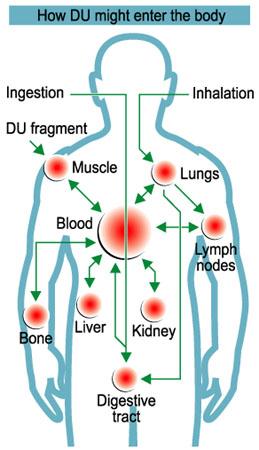
both enemy and our own soldiers. And [those
particles] go directly into the bloodstream and
are distributed like fairy dust throughout the
body. And it's insoluble so the body cannot
excrete it and it just destroys a person's body
over time.
(Don) So it's likely that practically all the
individuals, let's say in Baghdad including the
U.S. Marines, are contaminated with depleted
uranium now.
(Leuren) Anyone within 1,000 miles of Iraq;
anyone within 1,000 miles of Afghanistan is
potentially contaminated now. It's not just the
people [living] in the country. Anyone going to
Iraq or Afghanistan now will become contaminated.
There's no way to escape it.
(Don) Now, for the average soldier over there,
what types of reactions would this likely be
causing in the body?
(Leuren) In the first Gulf War they used an
estimated 340 or 350 tons of DU and the amount
used is increasing every year. So there were
terrible effects from that [which people know as]
the Gulf War Syndrome. In Afghanistan a thousand
tons were used, three times as much. The entire
country, the water supplies, the infrastructure
were bombed, and now in last March and April
they used at least 2,200 tons, which is eight to
ten times more than what they used in Gulf War
One, and like Afghanistan, they bombed the whole
country, the towns, the cities, the villages, the
water supplies, the whole infrastructure of the
country. So civilians and soldiers will be
experiencing skin rashes, which is the heavy
metal effect; they will have dental problems,
respiratory problems. It's causing heart damage
and brain damage. The effects will be much more
severe and much faster now than what we know of
in Afghanistan or the first Gulf War in 1991.
In Kuwait, which is downwind [of Iraq], and DU
was used in Kuwait, doctors are reporting three
times the number of congenital heart problems
with newborn babies. Those are the birth
defects. Gulf War soldiers who served in 1991
had normal babies before the Gulf War. [In a
study of 251 Gulf War veterans by the Department
of Veterans Affairs, it was determined that 67%
of the babies born to soldiers after the Gulf War
had severe birth defects]. They were born without
brains, without eyes, [with] organs missing,
without legs or arms, or they had terrible
radiation related blood diseases for instance.
(Don) How many years is this effect likely to go on?
(Leuren) It will be forever. The half life of
depleted uranium is 4 and a half billion years,
but even worse, over time as the Uranium-238
decays, it transforms four times into much more
radioactive daughter products or daughter
isotopes and they are more radioactive than
uranium-238 by millions and billions of times, so
the level of radioactivity will increase over
time, and that's why we call depleted uranium the
Trojan Horse of Nuclear War. Depleted uranium is
a nuclear weapon and it is a weapon of mass
destruction under the U.S. government definition
of WMDs.
(Don) Now you have done some comparison, I
believe, as to the radiation effects from the
bomb dropped on Nagasaki in relation to the
radiation in Iraq and Afghanistan. Would you
like to talk about that?
(Leuren) Yes. In October 16 to 19, 2003 there was
a very, very excellent and very important world
conference on depleted uranium weapons held in
Hamburg, Germany. Two hundred people from 20
countries and five continents attended
[including] scientific, medical, legal experts,
organizers, and activists and there were also
Iraqi medical doctors and scientists there. And
I've never been to a conference like that. It was
very, very interesting, very informative and
sometimes difficult to have all of the affected
parties involved. But some of the talks
presented very important facts, and a Japanese
physicist, professor Yagasaki from Okinawa,
presented one of them. He had calculated the
atomicity equivalent of the Nagasaki bomb to
depleted uranium, and the atomicity means the
number of radioactive atoms. So he calculated
that 800 tons of depleted uranium is the
atomicity equivalent of 83,000 Nagasaki bombs.
So [the total atomicity], roughly estimating the
amount of depleted uranium weapons used in
Afghanistan and Iraq and former Yugoslavia, is
approximately equivalent to 400,000 Nagasaki
bombs. In all of the testing by the nuclear
states during the Cold War, the [atomicity]
equivalent of only 40,000 [Nagasaki] bombs was
[produced], so this is roughly ten times the
amount of radiation that was released during
nuclear weapons testing. This is just an
absolutely horrendous amount of radiation.
The U.S. has staged a nuclear war in Iraq and in
the Middle East and Central Asia, and the
northern half of India all the way through Turkey
and Iran and the Russian oil-rich states, the
Caspian oil region, and half of Egypt, Israel and
the Saudi Arabian peninsula. These areas are now
all contaminated.
(Don) There are measurable signs of depleted uranium in those countries?
(Leuren) There was before. There was in the
Saudi Arabian peninsula, Kuwait, Hungary, Greece
-- this was all reported after the 1991 bombing.
Over time, [with] these very dry climates, the
extreme dust storms and wind storms transport the
radioactive material. The dust, as atmospheric
dust, [is] scattered all over Europe. It's
transported across the Atlantic to North Carolina
and the southern United States coastal areas, the
Caribbean, and these dust storms carry sand all
over Europe. I've lived in England in the 1960s
and 70s, and sometimes Sahara dust was on our
windshields in the morning in the streets. It's
known from mediaeval times.
(Don) So it seems to me that, especially now and
in future years, not so future either, with the
lowering of our quality of food and of our immune
system, that even in the fringe areas and areas
around the world where there's not so much of
this dust, that DU is going to have an effect on
[the number of] cancer deaths.
(Leuren) Well I am a geoscientist, so I study the
earth and earth processes. [I do] research at
U.C. Davis -- I haven't finished my dissertation
yet, but my research has been on atmospheric
dust. I was studying the ice record, glaciers on
the top of the Andes and Greenland and Antarctica
and on top of the Himalayas, Mount Kilimanjaro in
Africa, and [the study of] these ice records on
glaciers are like the study of tree rings. They
have an annual record of the dust transported
around the world and also atmospheric gases, and
the radiation released each year is preserved in
each layer of ice. So we know from volcanic
eruptions, like Mount Pinatubo in the
Philippines, that the dust from volcanoes, the
volcanic dust and ash, is globally mixed
throughout the entire atmosphere in one year. So
whatever they have been bombing with is, in one
year, globally mixed throughout the entire
atmosphere. And right now the world is in a
global cancer epidemic and other radiation
related diseases, which is a result of the Cold
War weapons testing. We've added ten times as
much radiation to the Middle East and Central
Asia. Much of it will remain in the area
recycling through the waters, the dust, the food,
and the air. It's inescapable. But a lot of it
will also be transported throughout the world.
And remember that cancer starts with a single
atom of uranium, a single alpha particle or gamma
ray released from one atom under the right
conditions. So it doesn't just affect humans, it
affects all life. Everything will mutate, will be
affected, if it's exposed under the right
conditions.
(Don) Well, the question that comes to mind is:
Do the people who are waging war against the
world in the United States and those that are
releasing depleted uranium to be used in these
weapons, realize the effects of depleted uranium
on the environment and on people?
(Leuren) Of course. The United States has since
spent 300 billion dollars-that's a conservative
estimate up to 1995-on nuclear weapons
development. I worked at two nuclear weapons
laboratories: The Lawrence Berkeley Lab, and the
Lawrence Livermore Lab. This entire time they
have conducted detailed and very extensive
studies on the biological effects of radiation.
They absolutely know everything about the impact
on the environment and on human health of what
they are doing, and when I worked at Livermore
from 1989 to '91, [before] I finally walked out
one day and became a whistleblower, I watched
teams of radiation experts leaving that lab
monthly, weekly, yearly traveling to radioactive
contaminated sites all over the world, taking
collections of plant materials and living
materials like the fish out of the rivers or the
lagoons. [They also studied] the human guinea
pigs, people at Chernobyl, at the Pacific Islands
where nuclear weapons were tested and even
Americans [in the] the nuclear weapons program
and the nuclear power plant program. They have
special laboratories at Los Alamos Nuclear
Weapons Lab and Livermore. They have special
units with instruments to measure the radiation
and samples, freezers to keep the samples in, and
in the labs that I've worked in, there are charts
with defective sperm on the walls. I remember
walking by them every day. They know everything.
(Don) So if they know the effects of depleted
uranium on people, does that not then make them
the highest type of war criminals?
(Leuren) These are the highest types of war
criminals. These people have developed weapons
of mass destruction knowing full well what the
health and environmental effects are, and they
have spent tremendous amounts of money and effort
to hide this from not just the American people,
but from the global community. They have
constructed a huge and a very connected apparatus
of scientists, scientific journals, medical
professionals, academic institutions, secret
radiation labs, and nuclear weapons laboratories.
We have over 550 national laboratories in the
United States-I think the number has been reduced
maybe to 250, but there were over 3,500
facilities in the United States, which functioned
as part of the nuclear weapons complex. There's
no way that they don't know everything and the
international nuclear-I call them the nuclear
Mafia-has mostly been controlled by the United
States. It's all to hide the health and
environmental effects.
(Don) They seem not to be only the highest types
of criminals, but they seem to be insane. I mean
only an insane...
(Leuren) It's a culture of insanity! You're
absolutely right. I worked at the Livermore
Nuclear Weapons Lab. I saw people go to work
every day. Their friends were dying of cancer.
Some of them had cancer. You know that a nuclear
weapons lab paycheck is about 30 to 40% more than
scientists would make in a private sector
academia. So people get addicted to that money
and their wives die of brain cancer. Their
children die of leukemia and they still go to
work every day.
(Don) Yeah, George W.'s son and progeny are going to be affected for all
time.
(Leuren) George Bush Jr., our president now, he
and all of his siblings have learning
disabilities as a result of being exposed to
nuclear weapons testing fallout during the Cold
War. And his toddler sister died of leukemia
when she was just a couple of years old. His
whole family has been affected by nuclear weapons
testing. This is the insanity of it. They do it
anyway.
(Don) Yeah, it doesn't bode very well to be ruled
by people that are brain cell deficient, that's
for sure.
(Leuren) Well, it's had a tremendous effect on
the I.Q. and the learning ability of all American
children. The SAT scores, the average SAT scores
for the entire population of 18 year-olds,
teenagers in their last year of high school when
they are given the SAT tests, declined from 475
which was the average score for 20 years before
bomb testing started and it started in about
1946. By 1963 the SAT scores for children born
that year, [those children] exposed in utero to
the radiation and receiving brain damage,
[declined nationwide] to 425. As soon as the
test ban treaty was signed between the U.S. and
Russia in 1963, SAT scores started going up
again. But what the United States did was
sacrifice an entire generation of children to
test nuclear weapons. The same thing is
happening now because of nuclear power plants and
one out of twelve children have learning
disabilities in the U.S. What cost is that to our
society?
(Don) Hasn't Baghdad, and maybe even the whole
country of Iraq, been made virtually an area that
is not suitable for living in now?
(Leuren) Oh, and the regions within a thousand
miles. The Middle East and Central Asia are
radioactive. People shouldn't be living there;
nothing should be living there. And I began to
read-I couldn't believe it-when I started
researching it, I just couldn't believe it. I
couldn't believe what had happened. I couldn't
believe they were using depleted uranium in the
amounts they were using. And when that Japanese
professor calculated the atomicity equivalent of
Nagasaki bombs, I started making maps of the
areas contaminated and when I saw the map with
circles drawn around Afghanistan and Iraq with a
one thousand mile radius, I knew there was a
deeper purpose. But I still couldn't understand
why they'd used it. No other country has used
it. The U.S. broke a 46-year taboo in 1991 and
used it. No other countries have used it since
then. There has to be a reason, and I began to
read The Grand Chessboard by Brzezinski. Anyway
he, Zbigniew Brzezinski -- it's called The Grand
Chessboard: American Primacy and Its
Geo-strategic Imperative -- wrote it in 1998 but
it's a blueprint, absolutely, for U.S. foreign
policy being carried out in Central Asia and the
Middle East. And they have basically bombed the
major oil rich regions in the Eurasian area.
This is not going to stop. It's going to continue.
Call-in portion of Interview
(Caller #1) Listening to your guest. Great
topic. Good guest! I've just got a few things
to say. I was just thinking about this. I think
you are absolutely right when you say that the
people who are doing these kind of things to
humanity, there is no other reason: they must
either just be insane or incredibly sinister and
perhaps another reason exists that maybe we don't
really think about. Has anyone ever thought that
maybe these leaders, these mad bombers and serial
killers such as George W. Bush and his father --
what about the theory that these people are
really reptilians from another dimension or
planet perhaps who have invaded our human areas
and who are carrying out their own agenda?
(Don) Well I don't know if I'd like to degrade
the reptilian race by saying they're reptilians.
(Laugh)
(Caller #1) OK. I don't know what other reason
exists other than I didn't realize people are
[so] completely sinister and I throw in a guy
like George W. Bush, of course. But I'll just
hang up now and listen to your comments and
perhaps your guest's comments. Thank you.
(Caller #2) Well, I'd just like to discuss for
example Helen Caldicott, who has been active in
struggling against nuclear weapons proliferation,
and there are groups out there struggling against
radiation and all different types of
organizations fighting to reduce the amount of
damage done through militarism and international
aggression and so on. But there seems to be a
real lack of democratic decision-making processes
within these organizations.
(Don) That's for sure.
(Caller #2) Yeah. There is very little in the
way of public involvement and there is virtually
no democratic decision-making that is taking
place just based on the empirical information
relevant to the decisions to be made, rather than
the persuasive, coercive influence of leadership
elements and PR firms, advertising agencies,
media organizations, and different groups within
these organizations. I wonder if maybe she
could speak to that, if there is any organization
she's aware of that are more democratic?
(Caller #3) I just had a question for Leuren. I
was wondering which countries in Europe would be
safe from contamination? Where would it be safe
to visit?
(Don) I think she's said that basically the whole
world is contaminated but it's just to a lesser
degree. I would imagine that there's a gradual
[reduction] of radioactivity away from the
central bombing areas, but we'll go back to
Leuren.
(Leuren) In terms of less contaminated areas, I
would think Europe would be OK. Turkey is in the
region of potential contamination and, if you are
going for short visits, you have a better chance
of not becoming contaminated. Of course there is
no safe level of radiation exposure, but the
people living in these regions, chronically
exposed 24 hours a day to air borne [and] water
borne [radiation], and [to] food contaminated
with radiation, will be the most affected. It's
just everywhere. It's really, I think, the
greatest tragedy that humanity has faced. So I
feel terrible about people who went to Iraq as
human shields, to media who were there-they're
all contaminated. And when I was in Japan last
summer I met the human shield people from
Japan-they're sick with depleted uranium exposure
and over time it just continues to act in the
body. So people really need to think about where
they are going and be aware of the potential
risk. Now the other question the gentleman had
about this need for openness and democracy in the
decision-making process [concerning] the nuclear
weapons program, nuclear power plants, and now
the DU, because it's all the same-it's alpha,
beta, or gamma exposure internally whether it's
coming out of nuclear weapons, nuclear power
plants, or depleted uranium or the radioactive
weapons. The problem is that the secrecy has
allowed these programs to be developed when they
do tremendous harm to human health and all
species, as well as the impact on the
environment. And right now the United States is
gearing up for a nuclear war. We now have
nuclear weapons spending at the highest level
ever-even [than] during the Cold War. It's
higher now than during the Cold War and the
United States has no enemies. This is causing
other countries to also increase nuclear weapons
development and what I was shocked to discover in
my research is that Japan and Germany are now
tied in second place. They have passed Russia in
nuclear weapons development. And the deeper
purpose for all of this is to play nuclear
blackmail and to frighten other countries into
developing their nuclear weapons and thinking
they need them. For instance, India is afraid of
Pakistan. Pakistan is afraid of India. Japan is
afraid of North Korea. North Korea is afraid of
South Korea. So everyone is developing nuclear
weapons and what's really happening is the US is
manipulating these countries rimming China to
develop nuclear weapons programs and we are
enticing them to be our nuclear partners with
China as a common and the real enemy.
(Don) I have so many more questions to ask you.
One of the ones I wanted to ask is, what about
the groundwater? Is that going to be
contaminated for all time and how far away [from
the areas of conflict] would it be contaminated?
(Leuren) The groundwater is contaminated of
course. Over time, as the leftover bullets and
ammunition that did not burn degrade and weather
with the heat, and [with] the cold and seasonal
changes-rain, snow, and the wind-[depleted
uranium contamination] migrates into the
groundwater. So there's just a constant new
supply of depleted uranium oxides and metal which
will be released into the air and migrate through
the ground into the groundwater. A study that the
United Nations Environmental Program released
last March 2003 reported that 25% of the bare
metal, uranium bullets and weapons in the soil in
Yugoslavia, had dissolved since 1998. So if 25%
of the munitions buried in the ground dissolved
in four or five years in a wet climate, it will
be slower in desert areas, but it's going to
continue contaminating groundwater, soil, food
and air.
(Don) And I think-you have mentioned that these
particles go down into very fine sizes, so [I
would imagine] there's no way they can be
filtered out of the water.
(Leuren) There's no way to filter it out. It
goes through all gas masks. It goes through all
filters. These particles are a tenth of a micron
or smaller. A red blood cell is seven microns
and a white blood cell is about ten microns, so
they are much, much smaller than even blood cells.
(Don) Before we wrap it up, I would like you to
give us contacts on the website where people can
find more information.
(Leuren) People can go to an excellent website:
<http://www.mindfully.org> and just do a Google
search on my name, Moret.
They can also go to:
<http://www.traprockpeace.org>. That's the
Traprock Peace Center in Connecticut. They have
an excellent website. Lots of people get a lot
of good information from it and they have a lot
of information on depleted uranium.
Those are probably the two best websites that I
know of. There's a letter to Congressman
McDermott that I wrote. They could do a Google
search on "letter to McDermott". He's a
Congressman from Seattle, Washington who has
introduced a bill in Congress, and I wrote him a
letter with a lot of details. The attachments and
the references are also on the website with a
letter. That's on the mindfully.org website, and
then [there's] my testimony for the International
Criminal Tribunal for Afghanistan of December 13,
2003, which is also on the mindfully.org
website. That [testimony] has fourteen questions
that the prosecutor sent me to answer, and there
are questions like: What does the U.S. government
know about DU? (My answer was twelve pages long).
What is the connection between depleted uranium
and fourth generation nuclear weapons? And then,
what are the environmental and human effects?
(Don) What I think has to happen is [that] some
organizations in Vancouver have to get together
and bring you into Vancouver for a large meeting.
(Don asks remaining callers to give comments only)
(Caller #4) Well I was wondering about the
possibility of certain plants being used to
decontaminate the human body and [the] possible
development of bacteria that might be used for
that purpose also?
(Don) I was asking for comments. We don't have time for questions now.
(Caller #4) Well my comment is that it is one big
inhumane, parasitic, military-industrial,
ecocidal and social atrocity.
(Don) Thank you. `
Last comment of Leuren Moret:
(Leuren) I would like to read a quote from Henry
Kissinger. "Military men are just dumb, stupid
animals to be used as pawns in foreign policy".
This is what the elite believe about our
military. I am now working with an
international group of scientists and radiation
experts. We are forming a World Committee on
Radiation Risks comprised of honest researchers
to help citizens, elected officials, affected
populations and individuals to learn the truth
about radiation, and to work toward an
international moratorium on depleted uranium and
other radioactive weapons. So watch for us. The
European Committee on Radiation Risk, within the
European Parliament, has just published an
excellent report on low-level radiation and you
can get it at: <http://www.euradcom.org>
And now the citizens of the world, the scientists
of the world, the radiation experts of the
world-we have to all work together and it's not
hopeless. But people need good information.