| Our Travels |
|
Auckland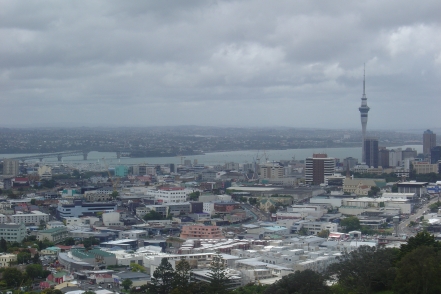 We had three days to plan our trip around New Zealand before crossing to the South island via the ferry on the 14th of December. We had booked this on the web in the UK as the ferry tends to get booked up early. We had also heard that public transport to some parts of New Zealand was non-existent, so we had a car hire organised a few months beforehand. Tourist information is in abundance in New Zealand, and together with their tourist web site
we managed to get a pretty good idea where to go. So Auckland... Its a bit quiet here, where are all the people? Five million people in the whole of New Zealand compared with 14 million in Beijing alone - that explains it. This is going take some getting used to.
We had three days to plan our trip around New Zealand before crossing to the South island via the ferry on the 14th of December. We had booked this on the web in the UK as the ferry tends to get booked up early. We had also heard that public transport to some parts of New Zealand was non-existent, so we had a car hire organised a few months beforehand. Tourist information is in abundance in New Zealand, and together with their tourist web site
we managed to get a pretty good idea where to go. So Auckland... Its a bit quiet here, where are all the people? Five million people in the whole of New Zealand compared with 14 million in Beijing alone - that explains it. This is going take some getting used to.We took the couple of days in Auckland to get into the pace of life in New Zealand. Coffee is good; espresso is colloquially named a "short black". There appears to be a strong coffee culture here together with a strong support for "home grown" produce and products. There are lots of companies that announce "NZ owned" or "proudly made in NZ" here, which establishes their independence. There is also a lot of support for local artistic talents, and most music shops have a good selection of Kiwi music. Maori culture is celebrated with several Maori language radio stations, together with a Maori language competition every year similar to the Welsh Eisteddfod. The start of our trip in New Zealand was a bit cold and grey so lessened the resolve to explore, and merely increased our intake of coffee in warm cafes! What we did see was Mount Eden, an extinct volcano. From there we took the rather grey picture above. The tall structure on the right is the "Sky tower", the tallest man-made structure in the southern hemisphere. For the city of sails we didn't see that many, a oversight we will rectify when we return on the final day of our stay in NZ - perhaps I'll have a better picture to post then! :: posted by Lliam 12/12/2004 Bay of Islands 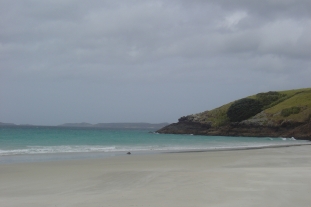 After leaving Auckland we headed north east to a town called Kerikeri. This town serves the agricultural community here and does a good job at coffee too! Kerikeri was our base for exploring the picturesque coastal areas situated not too far away. The area reminds me a bit of Southerndown and Ogmore in South Wales, i.e lots of coastal greenery and sheep! Having only one full day we took a drive up to look at several beaches to the north of Kerikeri. After several blind ending gravel tracks, including one beach track closed for maintenance, (how much does it take to keep a dirt track in tip-top condition?) we found Puheke beach on the remote Karikari peninsula, and forms the north western end of Doubtless bay. Despite the overcast and slightly damp weather this beach has lovely white sands and aquamarine coloured sea, easily competing with those we'd seen in Mauritius. The picture here is a bit washed out but you get the idea!
Rotorua 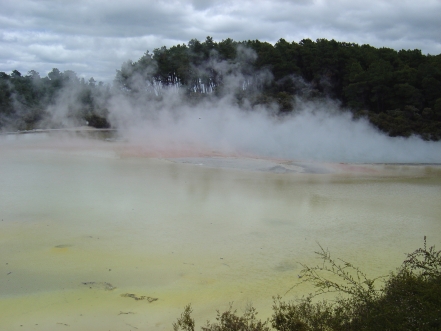 The area around Rotorua has a great deal of geothermal activity. As a result there are a lot of hot water pools and hydrothermic vents pushing out lots of sulphurous gases. Driving into the town we realised why the guide books refer to Rototua as Sulphur city. Rotorua is situated next to lake Rotorua and has a rich Maori cultural heritage. Near the lake is a large boat carved by local Maori artists using traditional ideas and motifs - very impressive.
We decided to go to Wai o Taipu the next day. This has been made into a selection of short walks for the benefit of the visitors, where the environment has created lots of colourful deposits, bubbling mud pools and sulphur plumes. At one point on the already hot walk, we passed across a bubbling hot water lake, enveloping us in sulphur-smelling steam! After the steam bath we thought a visit to another geothermal area called Hell's gate. This is smaller and less impressive geothermal "park" but has a greater selection of bubbling mud pools. Interesting stuff but not really a place for a quiet aroma friendly picnic! Wellington I This was our overnight stay to get the ferry in the morning. After driving for most of the day we arrived with enough time to walk through the botanical gardens, down the steep hill via cable car to the city. We had a few hours meandering through the city, which we really liked. The guest house we stayed at was on Tinakori road, supposedly one of the older streets in Wellington. It has a really good feel to it with lots of large Victorian style houses and smaller wooden houses all sitting well together. There are also a few good restaurants there which further add to the appeal! We both were grateful that we had a couple of days on the way back to take in a bit more of New Zealand's capital. South island - Nelson 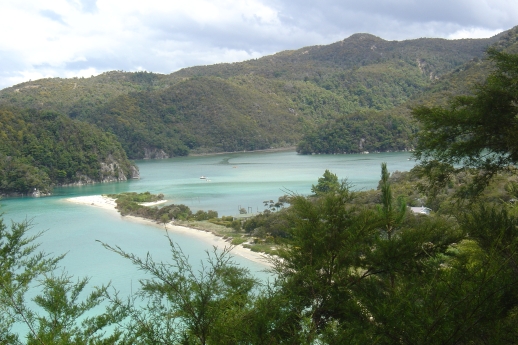 Getting to the South island we drove a couple of hours to the north-west town of Nelson. This is a launch pad of several scenic tramps (walks as they are known here), and much outdoor activities. The most well known is the Abel-Tasman national park, and not wishing to brave the elements too much by camping opted to take an eight kilometre walk from Bark Bay to Torrent bay. We got to Bark Bay by one of the sea taxis that run up and down the coast. This gave a few hours to walk down to catch the boat at the end to take us back to the car park. It was a lovely day and we had some great views of the bay from the forested cliff side walks. We met several trampers walking the other way en-route to various camp sites up the coast.
We also took a trip up via Takaka to Collingwood. Takaka has a large artistic community making all kind of crafts from jade and bone to wood and pottery. We had a good couple of hours looking around there and taking in a few good homemade muffins and some good coffee. This place does feel a bit out in the sticks, and yet there are a large number of artists here apparently making a living. From reading about some of the artists they spend their time farming and making their crafts. Driving further north we came to Collingwood which has some lovely coastal scenery beyond this is the Farewell Spit which is an archipelago that makes up the north point of the bay. We stayed in an Edwardian villa whilst in Nelson, owned by a well travelled lady originally from South Africa. It transpired that she and her husband had had to leave there in the 1960s due to their political activity! She was a very useful source of information of the surrounding area and had several interesting stories to tell. Due to the relatively remote nature of some parts of the Golden bay area, one bright spark thought it could be his retirement ticket. He grew a few acres of "herbs for recreational use". Unbeknown to him this was a popular activity and the Police had some past experience. They eventually arrested him on one of their helicopter fly-overs, which occur on an regular basis looking for "herb" harvests coming to fruition! Kaikoura 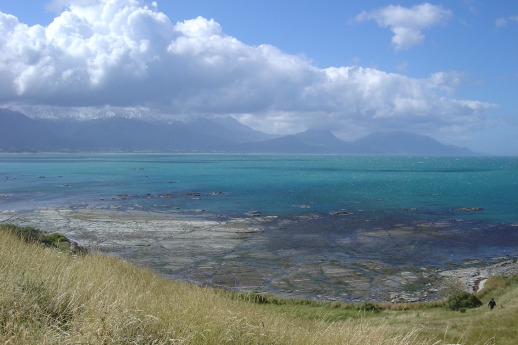 The main idea for staying in Kaikoura was for the world class whale watching expeditions that are run from here. Apparently National Geographic have filmed here in the past and hence this place has the watching kudos. Well the weather struck again and cancelled all the bookings that we had for our time in Kaikoura so no whale watching until we came back whilst in Christchurch. With no whales on the cards, Dee decided my to test my severe childhood reaction to horses. Booked in for a four hour dusk ride across the Fyffe mountains, I managed pretty well - that defined by the fact that I didn't fall off or swell up like the stay-puff marshmallow man (Ghostbusters fans anyone?). Horses are clever... they make you think you control them but really they are just following the tail of the one in front. Horses butts aside we had some great views from the hills and the surrounding countryside.
A few moments drive from the town is a fur seal colony. We went up to take a look and almost got blown over by the gale that was coming from the sea. Literally leaning against the wind we said hello to the seals from a safe distance - the seals smell pretty strongly of old lard, and I was very glad of the strong upwind. On another note, think twice about running near the coast. I took it upon myself to run a loop across the beach, thinking I was some kind of marauding penguin, the seagulls started dive bombing me, allowing me another attempt at the land speed record. Christchurch Christchurch was where we had decided to spend Christmas. We had read that it was a lovely city with some old and new features worth seeing, and that it was also a good base to see the surrounding area. Of course it goes without saying that Christmas without good coffee is not worth thinking about. Christmas day was a really relaxed one, lying in until about 2pm and having lunch consisting of a Villa Maria red and some good crackers and pate. We were both working through gripping novels started earlier in the week, so by the time we got into town for a Christmas dinner it was fairly late. Knowing what good Buddhists the Japanese are, we found a Japanese restaurant open to supply us with our Christmas dinner. Teriyaki Chicken, rice and miso soup washed down with Kirin was a great way to finish our Christmas - I think we may repeat it next year (in Japan?). 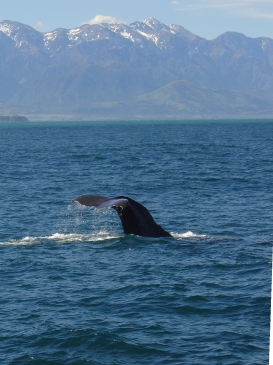 Before leaving Kaikoura we had booked a few places on the Whale watching. Finally the seas were calm enough for the tour company to take us out to see some Whales (the fish not the singing shepherds). The tour company in Kaikoura use GPS derived coordinates to work out where whales were seen last, this coupled with the fact that whales on average dive for 45 to 60 minutes means they can work out where they will surface next. They use hydrophones which are underwater microphones to locate them when the coordinates are reached, since apparently sonar can disorientate whales to the point that they drown, so these tours stay away from these devices.
Well persistence pays off in the end and we managed to see three giant Sperm whales resurface for re-oxygenation before diving for more food. About one hundred years ago this would have been closer to fifty to one hundred whales during our two and a half hour trip! According to our guide there are still 28 countries still engaged in or allowing whaling in their waters (UK is one). Seeing these creatures fairly up close I have a much deeper respect for them (I think I'm becoming a bit of a hippy in my old age). I will vow to turn in my whale bone umbrella stand and take Dee's Whale skin handbag off her ;-) We went to an area known for walking called Arthur's pass (stop sniggering at the back). There are several short and long day walks there including some 2-3 day tramps which lead through some impressive scenery. Being short on stamina we decided on a short three hour return trip along a track called Temple Basin. This goes up to ski huts at the top and then further on if your orienteering skills are up to it. It was fairly hard going walking up rock-strewn paths, but there was plenty of wildlife on the way to distract us. Reaching the ski shelters the weather was starting to get bad with fog moving in. We didn't quite reach the paths end but had some great views of the ski fields, snow covered peaks and water falls. On one of the final days in Christchurch, we went to see the Banks peninsula which is a scenic route and lead us to a small town called Akaroa. The style there has been influenced by the French who were there some time ago; as a result many of the street names are in French. Appart from that there is little else gallic about Akaroa but was worth the visit none the less. :: posted by Lliam 29/12/2004 Dunedin Dunedin is regarded as the Edinburgh of the South island, as it was modeled on the Scottish city. It is the second largest city in the South island after Christchurch, situated on the Otago peninsula, well known for its wildlife and the rare yellow eyed penguin. Summer is still not here and it has rained quite a bit since we've been here which has limited our plans. Undaunted, we took a trip down to the south to an area called the Catlins; named after a British fellow Edward Cattlin, who bought the massive strip of coastland from local Maoris in 1840. There is a great deal to see along this stretch between Dunedin and the more southerly city of Invercargill. The route really deserves much more time to see it all, but time and the weather were against us. We decided on several areas to see, the first being Nugget point. This is so named as the sea weathered rocks resemble gold nuggets. It is a 47 hectare reserve protected in 1986 and home to a large variety of animals. Yellow eyed penguins, elephant seals and fur seals can be seen here, and provided is a hide at Roaring Bay to do some wildlife spotting. Well we saw nothing, and keen not to make this into another Dee-style geisha stakeout we cut our losses and headed for the next point. 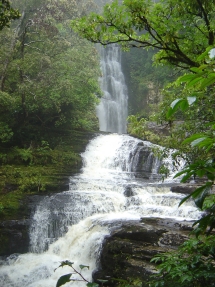 The Pounawea nature and bush walking track is a short 45 minute walk that leads through podocarp forest and back via a saltmarsh and estuary. I'm still not too sure what a podocarp forest is but apparently there is abundant food for birdlife here. The weather had driven them to the trees and walking along the trail we heard many different birdsongs. To my ears very different to that in the UK but beautiful none the less (see I told you I was turning into a hippy). The walk finished via a salt marsh on an estuary, which was accessible due to the low tide. A few wading birds were out poking around in the soggy ground. So soggy that Dee almost lost her shoes due to the suction on the mud!
The next place was McLean falls which was a short forest walk to a water fall. The roar and speed of the water was pretty sobering! The final place on our drive was Curio bay. This is home to a petrified forest and more wildlife. This part of the coastline was joined to what is now South America before continental drift created the continents that we now know. The forest was fossilised 180 million years ago, and you can make out tree stumps and logs in the rock formations! :: posted by Lliam 2/1/2005 Te Anau 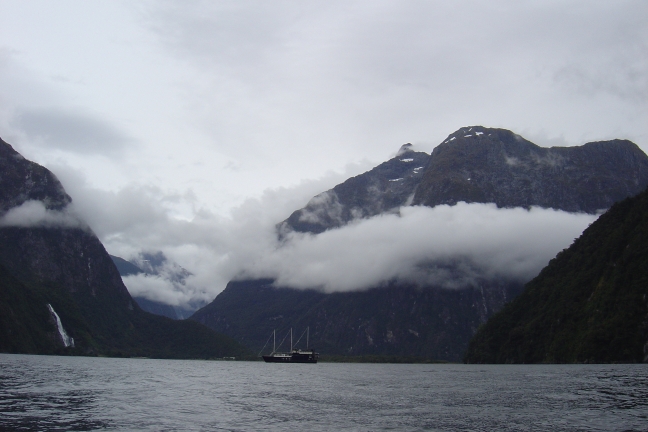 Te Anau is town built next to the Te Anau lake, and is one of the lakes that is part of the hydroelectric power system in the area. We planned to use Te Anau as our base for going through the Fjordland national park to Milford sound. After some research we decided to Kayak around Milford Sound with Milford Sound Kayaks, and as it turns out this was by far the best option. We got picked up at 0600h and driven through the national park, our kayak guide and driver stopping at various points along the way to show us interesting spots. Kayaking was great fun and after changing into stripy long-johns and purple life gear were launched into double kayaks, with the top sealed with a rubber skirt that keeps your lower half dry (until you get out at the end!). Our tour took us along a fourteen kilometre loop allowing us to get great up-close views of the tree lined walls of Milford Sound. The water had some large swells but fortunately we didn't capsize, although we came close on several occasions! It was tough going at some points but really good fun, to the point that we may take it up when we get back to the UK.
Taking us back, our guide told us about the naked Homer run which was set up by his boss Roscoe a few years ago. The Homer tunnel is a 1.2 km tunnel carved through granite and allows Te Anau and Milford to be linked by road, and took about fifty years to complete. Its engineering accomplishments are now celebrated each year as runners strip to just torches and trainers and run the 1.2 kilometres in their birthday suits! :: posted by Lliam 7/1/2005 Queenstown 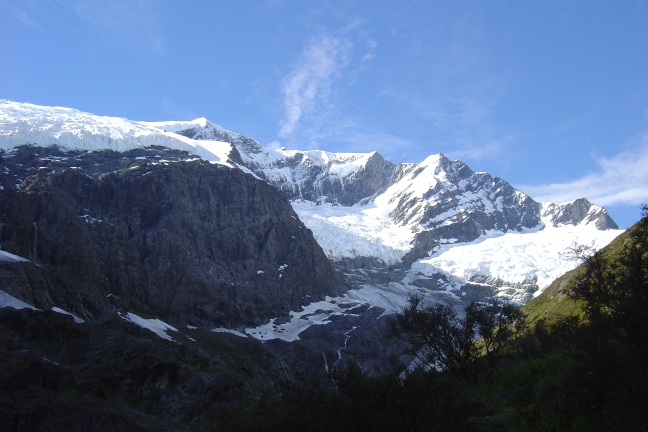 Arriving after our short two or so hour journey from Te Anau, this is a bustling place. I think it explains where all the people who weren't on Auckland are! This town is geared up for all the outdoor activities you could possibly imagine. From bungy jumping from a paraglide to tramping a 5 day route in alpine scenery. Wanting to keep our retinas attached we opted for more sedentary pursuits whilst in Queenstown.
The first walk we did was a five hour trek through "sub-alpine forest" up a valley to see the Rob Roy glacier. Getting there was almost as much of a challenge as the walk, with several fjord crossings looking almost that they would beat the car! Eventually getting to the start the walk was enjoyable but sometimes difficult trek to the viewpoint. At one point the path became extremely narrow with huge rocky outcrops overhead and steep slopes dropping to the white water river below - not a place to lose ones footing! Eventually getting to the top we had some great views of the Rob Roy glacier. Occasionally the sound of the nearby waterfalls were interrupted by soft thunder cracks of parts of the glacier sliding - pretty impressive but reminding us that this remote spot although breathtaking could also be life-taking! The next day, knowing that my life insurance would pay off the mortgage Dee took me on a further horse trek, the trek taking place where the scenes of Isengard and Lithlorien were filmed for Lord of the Rings. The stables also supplied horses used in the first fifteen minutes of the last part of the trilogy, there were about two hundred horses riding the day of filming and computer tinkering later increased them to the numbers that we saw on the screen. Well it was again a pleasurable and uneventful ride for me, the horse went where he wanted letting me think I was in control. In fact Dee said that night I was mumbling "no, that way!" in my sleep, and I do recall dreaming of horse rides! To be fair to the little glue pot, he did stop and turn when I needed him to, particularly during several river crossings where he started to drift down-stream a bit, until I gave him some help! In our final night in town we came across a Japanese restaurant that served Sukiyaki - a very pleasant reminder of Japan! :: posted by Lliam 9/1/05 Franz-Josef 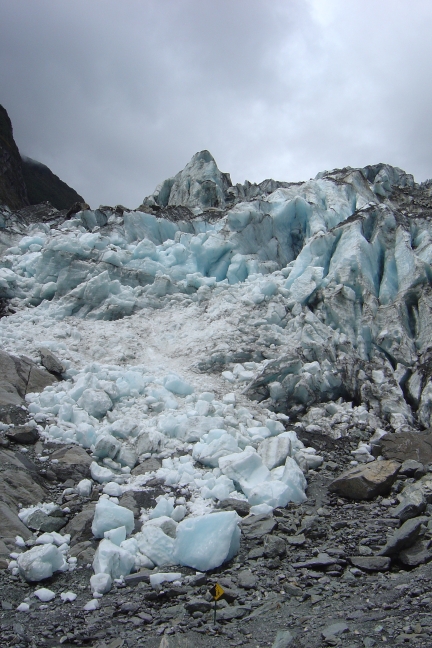 Further north again takes us to another interesting geological feature - glaciers. These have been instrumental in creating some of the topography of New Zealand, and carved out Milford sound many millenia ago. There are two glaciers where you can easily get to their terminal faces - the Fox glacier and the Franz-Josef glacier, each taking about an hour to walk to over very rocky dry river beds. You can also opt to hire a guide to take you walking on the glacier but viewing these magnificent ice cubes from afar was enough for us (although Dee did go up to talk to one). These pictures don't really give you much idea of scale but the one at the bottom is Dee, talking to the cube, with the picture at the top a zoomed out version without Dee.
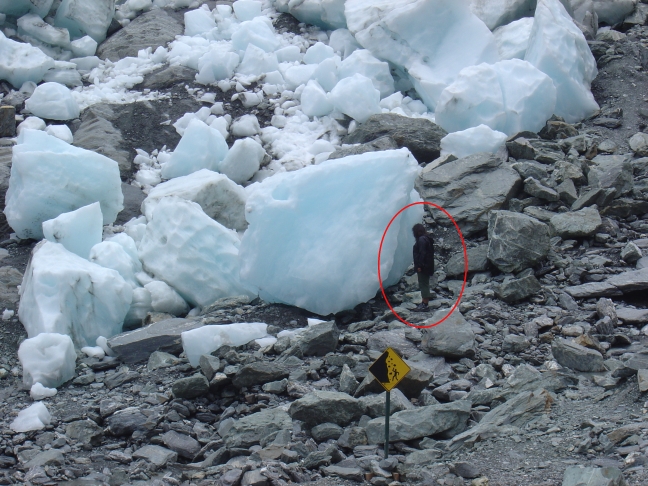 The glacier extends further upwards allowing helicopters to land when conditions are good.
:: posted by Lliam 12/1/05 Punakaiki This place further north again is a very pretty area with interesting geological features. We had booked a place to stay which was a bargain price until we got there. I pranged the hire car on their invisible tree-lined drive and our bed for two nights was ironically called "The Palace". I realised that the "'s potting shed" had dropped off the end of the sign as soon as we saw it! I therefore have too much negative vibes man about this hippy colony that I will not write anything further (the rest of the lodge was very nice however). Ok just a little. The Pancake rocks which are layers of rock formations that baffle the geologists as to quite how they formed are along a section of the Punakaiki coast. On the very hot day of viewing we also saw pods of Hector's dolphins swimming in the sea by the cliffs. It just shows holidays are not perfect all the time! :: posted by Lliam 13/1/05 Blenheim Right, new place and we were staying at the splendid Chardonnay lodge with not a potting shed to be seen. Blenheim is in the heart of the Marlborough wine making area with easily forty wine makers here. These range from large international wine exporters to more small production "boutique" wines. As a result we thought that Blenheim was ideal for a wine tour by bike. Picking us up in the morning we were kitted out with a bike with panniers for holding wine, a bottle of water each, a map and a leaflet on how much you can drink safely and still ride! After Ray, the fellow who runs the business with his wife, marked a few good wineries to try, together with a really good restaurant for lunch on our map we were off. Cycling around the vineyards is such a great way to see this part of the country as many things go by too fast in a car (not to mention the idiocy of drinking and driving). The ordered rows of vines conjures up many different emotions for me - an imaginary childhood spend in the vineyards of France, the freedom of the road, being at one with nature and harnessing its grapes for the good of mankind.... Oops too much slurping of the good stuff! By the end of our trip we had accumulated six bottles of wine, 2 slices of quiche and one hokey-pokey flavour ice-cream. All in all, hic! you're my best mate, goodbye for now. :: posted by Lliam 14/1/05 North island - Wellington 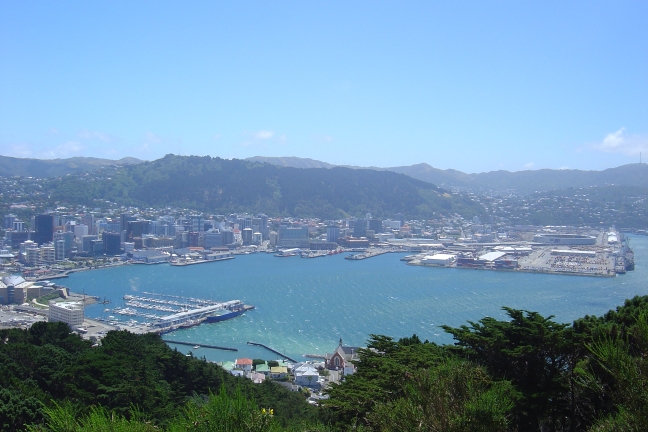 Returning to Wellington we were fortunate to be put up by some of Dee's parents friends. They have been in Wellington for 17 years and so have a great local knowledge. They took us on a good tour of the main sights around town, the parliament building also known as "the beehive" because it looks er, like a beehive, the largest wooden building in the Southern hemisphere which was saved from demolishment refurbished into law offices. The Prime Minister has her residences on Tinakori road, without it being pointed out I would have assumed it just another nice house. The fences were about five foot tall no barbed wire, and no obvious security, without wishing to test the hidden military protection I kept on the safer side of the road! Apparently a lot of the politicians can be seen out an about in Wellington, can't see that happening in the UK on a regular basis!
We got a look around the museum - Te Papa, which happened to have a retrospective on 1970s New Zealand; groovy baby, yeah! There was a was a lot of civil rights activity for the Maoris and the feminist movement during this time. Interestingly in 1971 a much respected Prime Minister Norm Kirk sent a Navy vessel to a French atol where nuclear testing was being conducted as a "silent accuser". He also pulled troops out of Vietnam and stopped the South African Rugby tour because they were not "racially integrated", pretty impressive stuff. We finished off the day taking a walk through the botanical gardens which are lit up at night, and through the summer months of January and February there are free concerts in the park. There were plenty of people with picnics and deck chairs in prime positions for the music - looked like a great way to spend an evening! :: posted by Lliam 16/1/05 Napier The town of Napier is regarded as one of the finest examples of an Art Deco city and rivals Miami for this style of design. A huge earthquake in 1930 raised many buildings, and the subsequent rebuilding work led to the city's unique marque. :: posted by Lliam 18/1/05 |