.
K as in SKIT, SKILL: Even though most
English speakers may not be aware of it, there is in English a difference
between the K at the beginning of words (KIT, KILL) and the K preceded by an S
(SKIT, SKILL). The former is said to be 'aspirated'. The 'unaspirated' K after S
is a more accurate Esperanto pronunciation.
R as in the American pronunciation of D or T in LADY, BODY,
BETTY, COOTIES, SHUDDER, SHUTTER, WADING, WAITING
.
P as in SPOT, SPIN, SPEAK: Even though most native speakers may not be aware of
it, there is in English a difference between the P at the beginning of words
(pot, pin, peak)
and the P preceded by an S (spot, spin, speak). The former is said to be 'aspirated'.
The
latter would be a more accurate Esperanto pronunciation.
ENDINGS
Notice that all the verbs in this list end in -AS.
In Esperanto all verbs in the PRESENT TENSE have this ending.
|
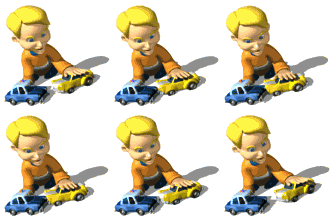
VOCABULARY IMAGES |
|




|
|
VOCABULARY QUIZ
Before continuing with the quiz, make sure you can
pronounce every word in the lesson.
The images displayed above will appear randomly.
At first it may seem that they are appearing and disappearing too quickly.
Do not panic.
Go at your own pace, pronouncing the words out loud, as clearly and as
accurately as possible.
Within a few minutes you will be able to identify most of the images that
pop up, at which point you will be ready to move on to the next step, the
MODEL SENTENCES.
Click here for VOCABULARY QUIZ |
|
MODEL SENTENCES |
|
 Say
what each animal is doing. Say
what each animal is doing.
|
| La hundo naĝas. |
La bovino ludas. |
|
SPEECH
MARATHON |
|
TOPIC: |
|
Greet the animals and say what they are doing. |
Saluton, ĉevalo. La bovino ludas. La simio ludas. La simio
ploras. Saluton, bovino. Saluton, ĉevalo. La hundo kuras. La
ĉevalo ploras. La bovino naĝas. La bovino kuras. Saluton,
hundo. La hundo ludas. La ĉevalo naĝas.
BACK TO
LESSON 01
BACK
TO LESSON MENU
ON TO LESSON 03
This page hosted by

Animated 3D graphics provided
by Animation Factory.
