|
VOCABULARY |
||
|
|
English |
Mnemonics |
| saluton! | hi! | salute |
| ĉevalo | horse | cavalry |
| bovino | cow | bovine, beef |
| hundo | dog | hound |
| simio | ape | simian, The APE is similar to humans. |
|
LECIONO UNU |
|
VOCABULARY |
||
|
|
English |
Mnemonics |
| saluton! | hi! | salute |
| ĉevalo | horse | cavalry |
| bovino | cow | bovine, beef |
| hundo | dog | hound |
| simio | ape | simian, The APE is similar to humans. |
|
NOTES |
PRONUNCIATION
(To hear the pronunciation click on the sound icon above, next to Esperanto)
In Esperanto words are pronounced as they are spelled and vice versa. In essence, every letter represents one sound and every sound is represented by a single letter.
STRESS: The stress always falls on the next-to-the-last VOWEL.
(Make sure to stress the second i in simio.)
VOWELS : There are only five vowels and therefore only five vowel sounds. The phrase "Are there three or two?" can be used
as a mnemonic device. Spanish or Italian vowels are a perfect model. Try
pronouncing the vowels
in front of a mirror. Your mouth and lips should not move from beginning to end of each vowel
sound.
This means that they are all pure vowels, uttered with an unchanging sound from beginning to end.
A: ARE. Try pronouncing the first sound in the
word EYE (as if you started saying it but were cut off). NOT as in CAT or SALUTE.
E: THERE, BED, SAID. NOT as in
SAY, or MEET.
I: THREE, or as in MACHINE. As in SEEK
(not SICK) and EAT (not IT).
O: OR (Be careful not to add a glide. In other words,
don't move your mouth or lips.)
U: TWO, or as in SUE, FUTON. NOT as the short vowel in PUT,
FOOT or SOOT,
but rather as in NOON, FOOD or SUIT.
CONSONANTS: B, D, H, M, N, S and V as in English.
C as TS in BATS, POTS
Ĉ as CH in CHECK, CHEAP
L as in LEAVE: Even though most native speaker may not be aware of it, there is in English a difference between the L at the end of a syllable (bell, mall, pill, etc.) and the L at the beginning of words (leave, let, lose, etc.). The former is described as 'thick tongued'. The latter would be a more accurate Esperanto pronunciation.
T as in STOP, STEP, STAND: Even though most native speakers may not be aware of it, there is in English a difference between the T at the beginning of words (top, tall, talk) and the T preceded by an S (stop, stall, stalk). The former is said to be 'aspirated'. The 'unaspirated' T after S is a more accurate Esperanto pronunciation.
|
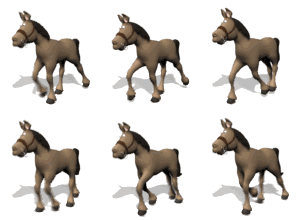
VOCABULARY IMAGES |


 
|
|
VOCABULARY QUIZ Before continuing with the quiz, make sure you can pronounce every word in the lesson. The images displayed above will appear randomly.
Click here for VOCABULARY QUIZ. |
|
MODEL SENTENCES |
|
|
|
|
| Saluton, ĉevalo! | Saluton, simio! |
|
SPEECH MARATHON |
|
TOPIC: |
|
Greet each animal. Pretend there are many of each species. |
Saluton, hundo! Saluton, bovino! Saluton, bovino! Saluton, ĉevalo! Saluton, simio! Saluton, hundo! Saluton, ĉevalo! Saluton, ĉevalo! Saluton, simio! Saluton, ĉevalo! Saluton, hundo!
BACK TO LESSON MENU ON TO LESSON 02
This page hosted by

Animated 3D graphics provided by Animation Factory.

