 |
| Return to Scotland - National Covenant Livingston resumed his preaching in Ireland, albeit in a furtive manner, for some months after the aborted sailing to New England. However, he was warned that he was to be apprehended and taken to Dublin. Both he and his friend fled to Scotland in February 1637. He was given shelter and protection in Irvine. Blair remained there while Livingston went on to Lanark to stay with his father for awhile. He returned to Irvine the following month where he was joined by his wife and baby son., John. A shortwhile later they all continued on to Lanark. There they would stay before he took up his first parish in Scotland, Stranraer. Janet was later to return to Malone, Ireland to visit her mother who was dying. She was accompanied by Samuel Livingston, her brother-in-law. All the while at this time, Archbisop Laud was determined to have his liturgy foisted on the populace. On 23 July, 1637 he decreed that the new Service Book be invoked. This resulted in a huge cry of protest from the people, none more so than in St Giles Church, Edinburgh. The old minister, with tears in his eyes preached his own retiral service to the large congregation. Then the Dean of Edinburgh entered and took his place in the pulpit. He began to preach from the new Service Book before the hostile crowd. None were more vehement in their shouts of disapproval than the lady whose name has been perpetuated in Scottish history to this day, Jenny Geddes. Unable to control her wrath, she jumped up and threw her stool at the wretched Dean with a shout, "Out, thou false thief! Dost thou say mass at my lugs!` Her words acted like a lit match to a fused powder keg.. Immediately a riot erupted and the miserable bishop was almost torn to pieces. Jenny`s deed reached far outside the church in its symbolism, for the whole presbyterian movement was stimulated throughout the country. This and all other grievances against the King resulted in the renewal of the National Covenant.This was signed by the noblemen and senior churchmen in Greyfriars Churchyard on 28 February, 1638. Copies of this were despatched all over the land. John Livingston was commanded to carry several copies to London to distribute among sympathisers at the Court in Greenwich. |
| London A journey by horseback to London could last up to ten days, breaking off each evening to rest up in friends` houses or Inn Houses. So this what was faced Livingston as he set off accompanied by a guide. Cloaked in "ane grey coat and ane grey montero cap, to avoid discovery", he had the unfortunate experience of falling off his horse while riding late one night. He fell to the ground where he "lay about ane quarter of an hour as dead". The first thing he discerned when he came to was to find his companion by his side weeping, but it pleased the Lord he recovered. On reaching London, he took rooms where he was visited by Mr Eleazar Borthwick. On account of the state of one of his eyes and part of his cheek being "blood-shott", Mr Borthwick delivered the letters for him. He was visited by certain of the English nobility who wished to be informed on all matters. A few days later Mr Borthwick returned with news from the Marquis of Hamilton. The Marquis had overheard the King discussing Livingston`s arrival and purpose in London. The King had issued orders for his detainment and for him to be fettered about the feet. Alerted to this, Livingston made haste his retreat. "Fearing to be waylaid on the post-way, I bought ane horse, and came home by St Albans and the Westerway". He had returned to Lanark when the congregation of the parish received the Covenant, and he later recalled: ".....a thousand persons all at once lifting up their hands and the tears falling down from their eyes, so that through the whole land, except for the papists and some few, who for base ends had adhered to the prelates, the people universally entered into the Covenant of God for reformation of religion against prelacie and ceremonies".` |
|
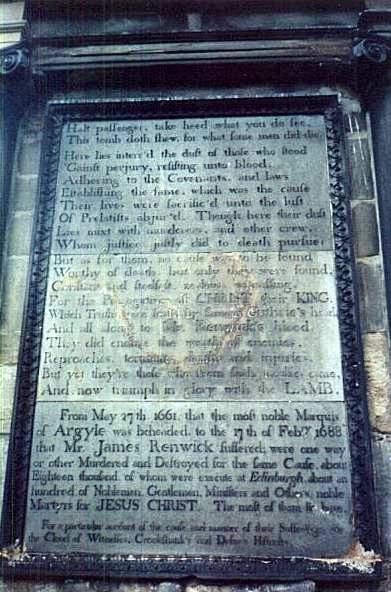
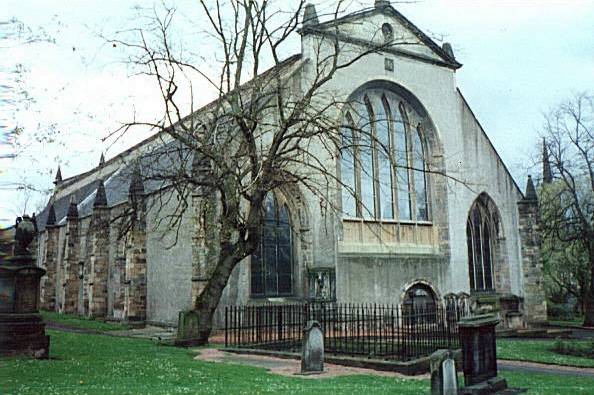
| Above: Greyfriars Church, Edinburgh. Site of the Signing of the National Covenant on the 28th Feb 1638 Right: Memorial stone in Greyfriars Churchyard commemorating many who died in defence of the National Covenant. They were known as Covenanters |
 |