In the
earlier page we saw, the traditional vision of force. We also noted that there
are many inherent flaws in the traditional vision of force. [we would see more of it].
We visualized a form of flexibility in force in the previous page. That is,
force can expand on one plane by contracting on the other. The
ruling out of the optimum invariably means the force should be in favor of the
vertical or the horizontal plane. However, this flexibility alone is not
sufficient to explain nature we witness. Our nature is basically a
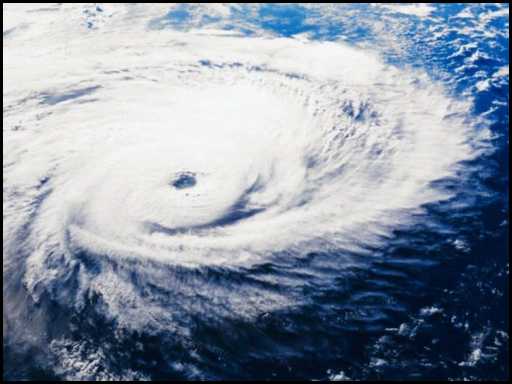
revolving one. It is a system that is some how winding and unwinding in
three-dimensional space and has fourth dimension called time. It is a system which moves in a curved paths [Our
system exist in one of the state at any given time; winding or unwinding.
If we take winding and unwinding together then it exists in
six-dimensional space, when one of the state winding or unwinding is in a state of expression the other is
in passive state vice-versa. Absolute space has 8 dimensions, it is
non-existent . This winding and unwinding picture becomes quite evident the
moment one cares to observe nature.
The
winding and unwinding basically means that the force also should be
structured in a curved manner such that
it adds or negates the winding. When we speak about winding then there are two
choices; one left to right the other right to left. The fact that forces are
created in pairs invariably means both these choices are mutual and acts on two
different system; one is wound left to right and the other is wound right to
left simultaneously. Thus in the new vision of force, we visualize force it self
as curved winding or unwinding phenomenon. All actions could be viewed as the transmission of winding and unwinding
force. Force
here
has two components, one, acting from left to right or vice versa and the other
to the center or away from the center. For every force
acting left to right, there exist pair, which is acting right to left. This also
means there should exist three principle systems- One producing the force and
the other two being the recipient. One
of these systems [force producing
system] gets unwound and the other is wound vice versa at any given moment of
time. See fig. –12
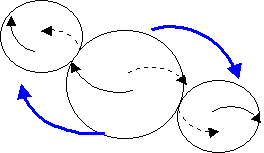

Fig.-
12: Mechanical
winding force acting on two different systems on the left and
right. In heat induced winding force is applied on both planes
occurs
The law of
equal and opposite force invariably means that the force producing system should be
bigger than the force receiving system. Other wise
equal opposite force would cancel out. One
can visualize a simple reaction process here that is when the force is applied
on the horizontal plane the system reacts from the vertical plane vice-versa.
This reaction could be immediate and direct and could be distanced in time and
mediated by other systems. We will come to it in detail later on. The winding
and unwinding here goes through certain steps. These steps explain the quantum
world. It differentiates the qualitative and quantum world.
In
traditional thinking, we can imagine force acting on one component pushing out
the opposite component and eventually ejecting it out. However, in the new
vision it is viewed as a winding one. The component system is twisted and pushed
to the center. This twisting and pushing goes in three
quantum steps, which in turn are divisible into nine steps. These steps are
invisible and contribute to quality. To understand it let us return
to Fig.- 4
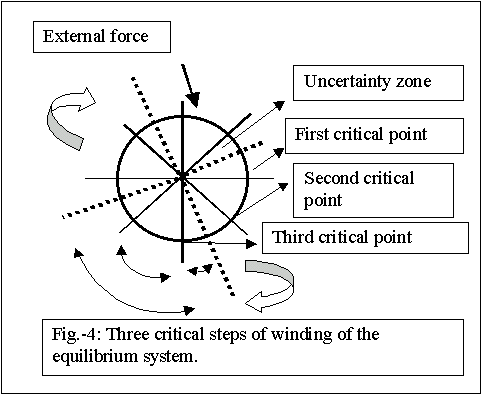
The
component, on which the force is applied, undergoes a twisting displacement to
the center. This movement has two-component directions- one moving left to right
or vice-versa in a zigzag manner, the other the winding or unwinding component
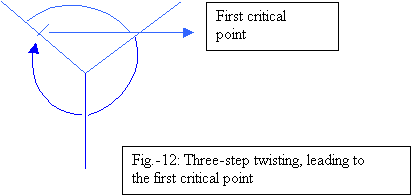
directed to the center or away from the center.
See Fig. – 12. When it completes one circle moving six times in a
zigzag manner, it under goes a unit winding or unwinding. Here it reaches the
first critical point and the system collapses into First
Order of Non-Equilibrium.
In the first order of non-equilibrium, the system is compressed by a unit on
one plane and is expanded on the other. Here it looses one frame of left and
right equilibrium. This system is reversible because the action and
reaction force is 3:1. In fact, this is a non-existing step. Absolute
systems never exist. They are simply transitory states. I am taking you along
this step for the sake of understanding.
When
the twisting is further continued, it undergoes another winding as above and
reaches the second critical state and collapses into Second
Order
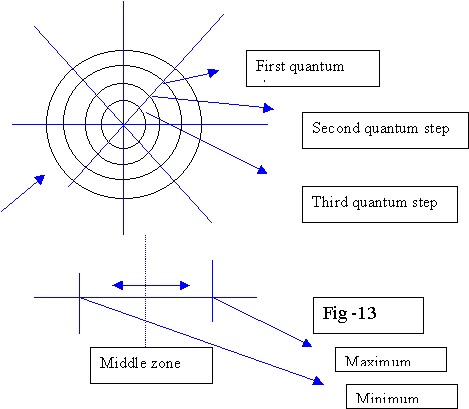
of Non-Equilibrium. This order is quite stable. It is flexible between the first
critical and the third critical point. With an uncertainty on either side before
the critical point is
reached.
See Fig.-13. Here the system looses two frames of left and right
frames and comes to exist one frame of left and right. A new frame is added,
that is it can wind and unwind by a unit. It is
flexible to the external force pushing it to third critical state and to an
external force pushing it to the previous critical state. In other words, it can
wind and unwind by a unit. I call these stable systems or Relative
Equilibrium Systems.
All the systems we deal in nature are of this type. The ratio of action and
reaction here is 1:1
When
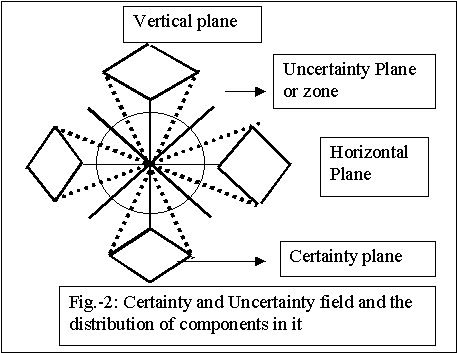
one more of step of winding is done then it reaches the third critical point. Here
the system looses all its left and right frame existence. The
winding and unwinding force takes the value 2:1 in favor of winding or unwinding
depending on the direction of the force. The system now breaks down, inverses
and rejoins on to a new plane [Uncertainty plane. see fig-2]. In the
process, it expels the force acted upon it back to the nature and its left turns
right and vice-versa. The
reaction that we see is a resultant of this break down and reorientation of the
system in space .
Let
us review it again.
We
must note here the cause for the breakdown. When the component is twisted and
moved, the component shifts its relative position from directly opposite to
vertically opposite. The motion here is always from one plane to the other in
zigzag manner. The system now is flexible between two limits, with an
uncertainty zone on the left and right. As
it is twitched to the third critical state, the component comes to take directly
opposite position to the original position. Here the system collapses into First
Order of Non-Equilibrium. The system reverses
to initial state if the external pressure is removed.
In
contrast if the
winding process is continued the system collapses to the Second
Order of Non-Equilibrium. This state
is stable, any attempt to reverse it to the initial state need application of an
equal and opposite force to the previous one.
Further
winding take it to third critical state [Third
order of Non-Equilibrium
] and the whole system collapse and goes into reorganization. The process of
reorganization left turns right and vive versa. This process causes the the
reaction. The whole process has nine steps of movement form left to right and
vice versa.
The
force applied on the system has two-component directions one; acts left to right
or vice versa, the other to the center or away from the center. [The latter
causes the unwinding]. What this means is that there are two choices to the
action, left winding or right winding. When
we apply force on an absolute system the ratio of force of action to reaction is
1:3. This ratio invariable means the action cannot take place, thus to the
assumption of existence of fundamental non-equilibrium.
It also means we have to deal with only relative equilibrium systems
The
action of force here can be viewed as centripetal or centrifugal force. This
means the shifting into first critical state, second critical state, and third
critical state is a three-step spiral twisting, which is decreasing [or
increasing] by certain unit. Each of these spiral twists in turn is made up of
three twisted curves, which are decreasing [Or increasing] by a unit. The
movement is such that it always moves from one plane to the opposite plane. The
collapse occurs when the component reaches the directly opposite frame. This
means the system collapses into left winding or right winding state.
[We will see more about it when we deal with the formation of matter particle]
This
means absolute systems have in reality 4 paths. The first order of
non-equilibrium reduces the path into three, the second into two and the third
to one path in which it is forced to move. The fact that there is
non-equilibrium invariably means the system we deal with has only three paths
the fourth is concealed in the winding.
The systems we deal with
exist in a stable path comprising of two paths and has an uncertain path shared
on either side, with the path in the uncertainty plane. Thus, the first and
fourth paths are transition paths to higher or lower level.
{ To understand How paths are related to motion go to - Paradox
of Friction - Relation between quantum motion and the Path]
What
this means is that there is qualitative actions before quantum action we
witness. When the qualitative quantum action-taking place within, reaches third
critical stage the external quantum action is presented to us. The
action here could be expressed as winding or unwinding depending on the
direction of the external force. Here it becomes important that we understand
different types of winding and unwinding. This in return calls for better
understanding of force
Click
here to go to -
Secret
Structure of Force and Quantum Action
Vital
Ratio Guiding Action and Reaction of the Fundamental Particle.