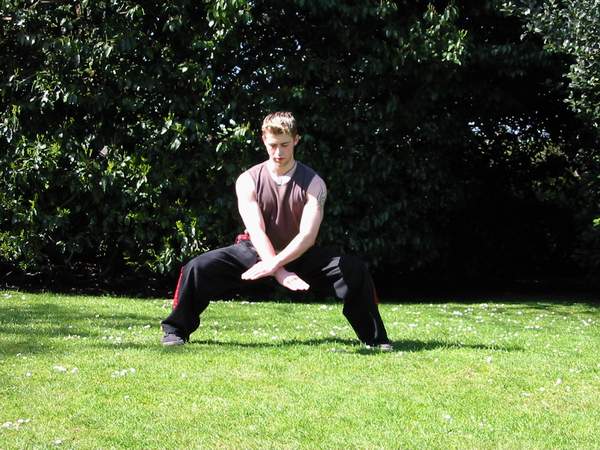
The learning syllabus in Hung Gar is based around the famous (or should that be infamous) �horse stance.� This stance is said to �ball-up� your inner energy or �chi� in your center-point giving balance, posture and a strong base. Even if you don�t believe in �chi� the strength of posture practiced is undeniable. �Horse stance� is a common term you�ll hear and a stance you�ll practice a great deal in Hung Gar as it is represented in every grading up to black belt.
It can basically be broken down like this:
White 1 = 0 Minutes
White 2 = 2 Minutes
Yellow 1 = 3 Minutes
Yellow 2 = 5 Minutes
Green 1 = 7 Minutes
Green 2 = 10 Minutes
Brown 1 = 12 Minutes
Brown 2 = 20 Minutes
The second requisite for grading is an understanding of the 7 Forms of Hung Gar. The Forms can be loosely termed as �All-purpose defence practice� as they involve a series of set movements created as an aid for the self-defence aspect of Kung Fu. Practice of the Forms enables a great deal of body-awareness and you�ll be surprised at how many of the Form techniques you�ll find yourself employing in sparring without even thinking about it.
White 1 = The 7 Stances
White 2 = Tai Sing Kune (The Small Idea Fist) = 30 moves
Yellow 1 = Kum Kong Kune (The Shaolin Superman Fist) = 30 moves
Yellow 2 = Mui Far Kune (The Plum Blossom Fist) = 30 moves
Green 1 = Faat Gar Kune (The Buddhist Family Fist) = 40 moves
Green 2 = Ling Faan Kune (The Continuous Attack Fist) = 50 moves
Brown 1 = Kung Jie Fook Fu Kune = 190 moves
Brown 2 = Fu Hok Seung Ying Kune = 150 moves
�Kung Jie Fook Fu Kune� and �Fu Hok Seung Ying Kune�
Of all the forms in Hung Gar, these two should be mentioned in a little more depth. It is these two Forms that make up the core of Hung Gar as they have played key roles in the development of the �Tiger-Crane� style.
The first, translated as the �Taming the Tiger� Form. It was the first ever Form in the Hung Gar style created by Hung Hei Guen himself. It is the longest and most difficult Form to master containing over 190 internal and external moves. It is a graceful form that nevertheless contains strength and speed. It can also be interpreted in many different ways; firstly, it can be seen as mastering the art of Hung Gar, thus taming the Tiger Style itself; another translation is that it is mastering the external power in your body (The Chinese word �vigour� is literally �Tiger energy.�) while the use of the many Crane movements in the form masters the internal, meditative skills in Hung Gar. The �Taming the Tiger� Form is not as wide-spread as the �Fu Hok Seung Ying Kune� as it was not often practiced in demonstrations.
The second, the �Tiger-Crane� Form was created by an extremely famous practitioner of Hung Gar, Wong Fei Hung, whose efforts finally ended the �Manchu� in China in the early 1900�s. Like the �Taming the Tiger� Form, the �Tiger-Crane� Form is valued for its beauty and accuracy and is, without a doubt, the most beautiful Hung Family Form in the Martial World.
Wong Fei Hung himself was famed for, among other things, performing his Form perfectly on the first-ever broadcast Martial arts demonstration on Hong Kong TV. Many of his other stories have been made into films, his character being played by such famous artists as Jet Li and Jackie Chan.
Even though the other Forms are not as widely recognised as the two mentioned, they are excellent practice for the many techniques that are learned in the self-defence syllabus. The �Mui Far Kune,� � Plum Blossom Fist � for instance, practices defence in five directions (A Chinese plum tree blossom has five leaves) and is the first actual Hung Family form learned in this style.
In this manner, it is possible to see that the forms are not merely set movements designed to give you something to do between Horse stance. Each form tells the story of its inventor's life. Imagine wanting to condense all the good Kung fu you had learned in your life into a series of movements that people would learn and read like a book. It was a Martial Artist's method of immortalising himself.
In this respect you can understand that the 'Faat Gar Kune,' for instance, is actually taken from the style learned by Low Han, the 'One-armed boxer' who cut off his hand to prove how much he wanted to study Kung fu.
Then there are the weapons. The range of weapons in Kung Fu is literally massive. Anyone who�s seen �Crouching Tiger, Hidden Dragon� or a range of other Kung Fu movies knows that there is a weapon for every occasion. All of these weapons have Forms in Hung Gar and although they tend to be reserved for those studying for their black belt, Paul and John tend to be willing to teach those who show enough interest.
Those taught are the Broad-sword, Butterfly Knives, Daggers, Spears, Kwan Do, Staffs and many more besides.