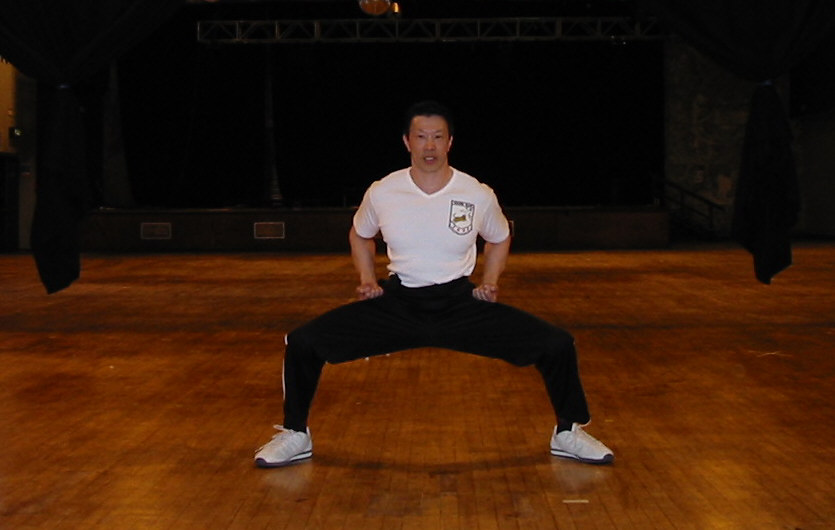
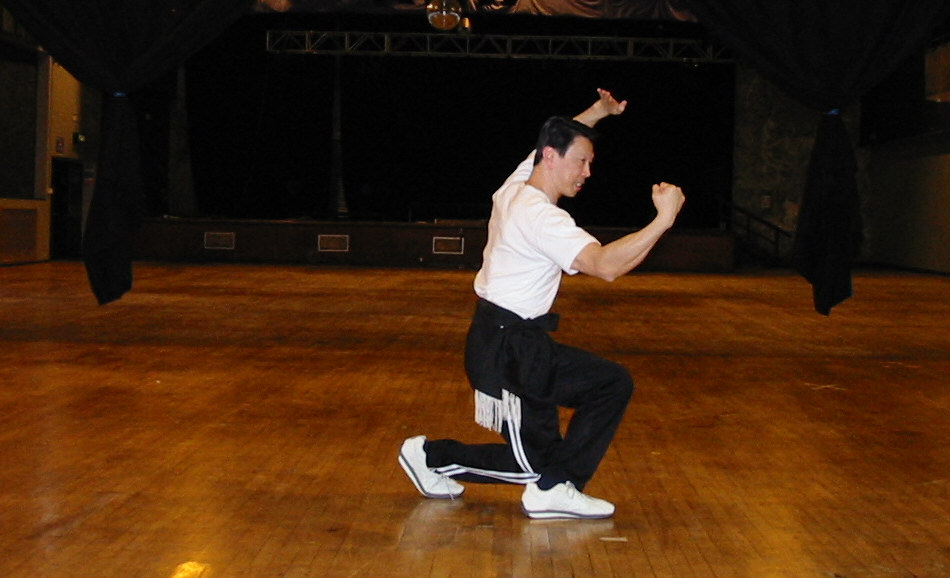
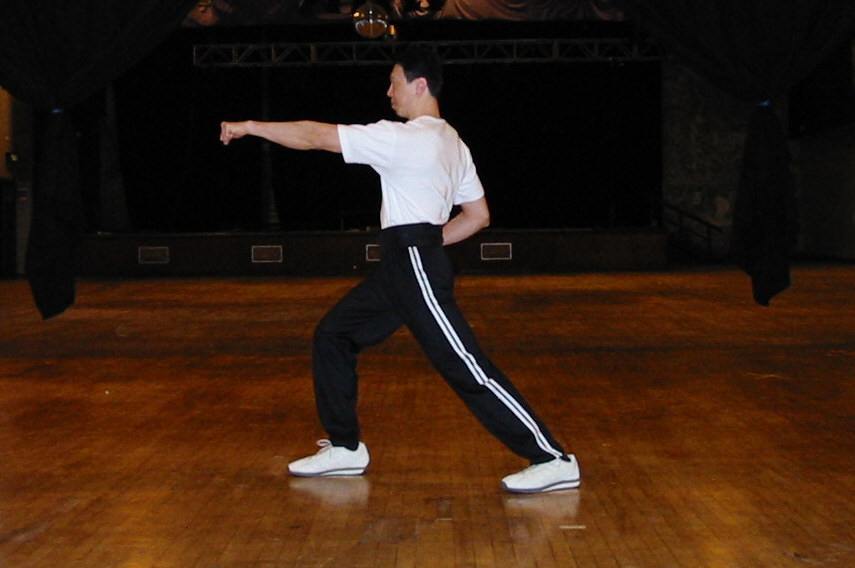
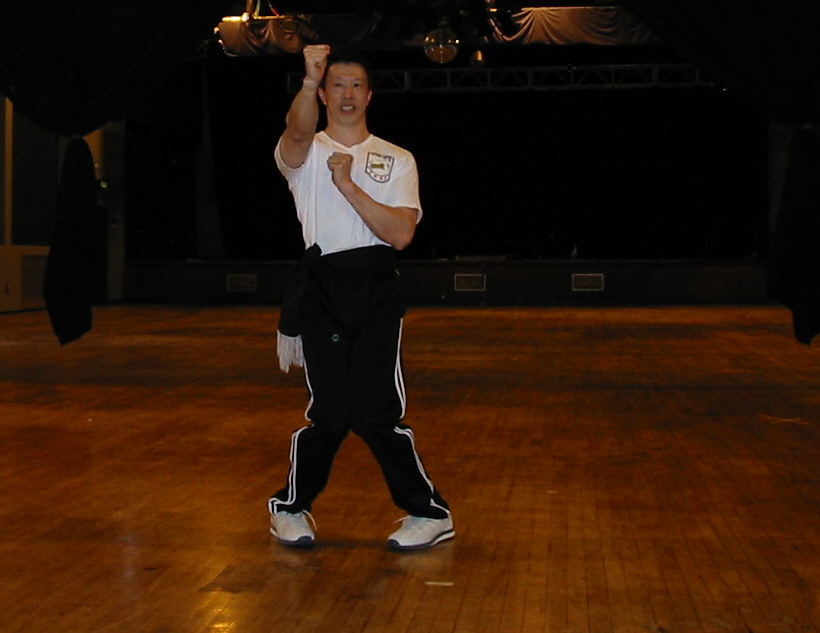
There are seven stances practiced in Hung Gar Kune. Each Stance exercises a different part of the leg, providing an excellent work out by simply standing up.
The stances were developed by the Shaolin Monks as a form of 'over-training.' Over-training is a term that describes the process of practicing what is difficult to make everything else easy, put simply.
If I haven't described that very well ('If,' he says...) It's like running as fast as you can with weights strapped on to your legs. As soon as you take them off, your muscles will be able to contract and expand quicker without the pressure - they are geared-up to put in extra effort for the weights - and so you will run faster and jump higher. Simply put, it gives the body new limitations that it must break and, once they are broken, the old limitations seem very easy.
The stances themselves are:
Ma Bo - The Horse Stance
Chinese name: Ma Bo(Horse Riding Stance)/Si Ping Tai Ma (Four Corners (Square) Horse Stance)
Muscles strengthened: Adductors/Abductors/Groinal Muscles and Calves (To some extent)
Over-train of...: Standing straight. If you can sit the Horse Stance for long periods of time then you can easily stand up with your feet slightly apart in a standard situation. The Horse Stance also exercises the plyometric muscles used for jumping and kicking and so kicks become stronger, jumps become higher and jump kicks... Well, you know the rest...
The Ma Bo is the most important stance in the Hung Gar syllabus. It's very development is integral to the Hung Family's system and history. After the Shaolin Temple was destroyed by the Manchu (Mongolian Occupation of China) the Shaolin monks fled south to survive the attacks of the Kung Fu-hating Mongolians (The Mongolian Martial Art is wrestling and this could not compete with the sheer technicality and speed of Shaolin Boxing.) After they found a safe place to rest, the weary Martial Artists began planning their revenge on the sacriligious Mongols and many styles of Kung Fu were created and practiced secretly, including the Five Family Fists (Hung, Lau, Choy, Li and Mok.) Four of the five were founded in Southern China and were practiced on the famous Chinese Opera boats, whilst masquerading as performance arts - Anyone found to be a part of the Shaolin Temple was killed for fear of an uprising.
Because the Opera boats were small and rocked heavily even when moored, Hung Sifu found it necessary to employ a stance that would not only 'moor' his students to the ground, but also train them at the same time as simply kneeling would be ineffective. The Horse stance, with its wide base and powerful grounding, proved the most effective. It also lent itself perfectly to the streets of Southern China and Hong Kong, where the streets were narrow and often slippery with damp and moss.
Going into the 'mystical' side of Kung Fu, the Horse Stance is the perfect stance for Chi Gung (Practicing/Building Chi) as it places the body's centre of gravity (The Chinese call it the 'tantien' - the place where chi is stored) closer to the ground level, which allows the flow of energy around the body to become more dense and powerful, while at the same time, opening the body's meridians and blood pathways. It also provides an extremely good leg work out without having to actually do anything.
The Crane/One-legged Stance
Chinese Name: He Bo (Crane Stance)
Muscles strengthened: Calves/Quadruceps/Glutes (and the lower abs if used for prolongued periods of time)
Over-train of...: Kicking. Because ANY kick (excluding jumping kicks) requires you to stand on one leg, it is necessary to have a strong base. Your kicking leg can be stronger than a speeding bus, but if you can't ground the force, then you will be the one falling over. The Crane stance strengthens the parts of the base leg that need to contract on the impact of the kick. It also strengthens the muscles used to land from jumping kicks as this is usually never on both legs evenly.
The Crane stance was not a practiced stance of Hung Hei Guen's 'Tiger's Claw' style. Tiger styles tend to rely only on Bow and Arrow stances, Cat stances and Scissors stance due to their strength and low gravitational positioning. This meant that the majority of kicks were groin kicks and brush kicks (The fastest and nastiest of all the kicking techniques) and even these were not often employed.
This all changed when Hei Guen fell in love with Fong Wing Chun, the White Crane master who beat him and scolded him when he accidentally stepped on her foot in a lion dance. Because his Black Tiger style was so different and yet complimentary of her White Crane style, they set about creating a new style combining the two, as well as bringing in the other animal and element styles of Shaolin.
What they created was Hung Gar. Hung Gar is by no means simply the 'Tiger-Crane' style as many people call it - Hung Gar contains so much more - but it's main principle is founded on the two preliminary styles of the Tiger and the Crane - Even one of the forms, created by Wong Fei Hung, is called the 'Fu-Hok Sung Ying Kune' or the 'Tiger-Crane Double Shadow Fist.'
The reason for this is simple, in the Black Tiger and White Crane styles, we can see the largest contrasts in any two animals. The Tiger makes up the masculine (Yang), rough, aggresive and external fighting style while the Crane provides us with the feminine (Yin), delicate, intelligent and internal art. Where the Tiger lashes out and rips meat from bone, the Crane watches and pecks vital targets as they open. Where the Tiger requires strong bases and good upper body strength, the Crane needs only inner calm and quick reaction. The two are complimentary in every way and so it seems obvious, given hindsight, that the two should have joined together in one art.
Now the Crane stance makes up a large part of the Hung family style to strengthen the muscles needed for Martial artists to practice the famous 'No-shadow kick' used by Wong Fei Hung, a kick that moved so fast it didn't leave a shadow...
The Cat/Man Stance
Chinese Name: Mao Bo (Cat Stance)/Fu Bo (Man Stance)
Muscles Strengthened: Calves/Abductors
Over-train of...: Typical maneuvering of the hind leg in combat. Watch a cat stalk, you'll get the idea. The cat stance resembles (Well, as well as a Human CAN resemble a cat) a cat ready to pounce upon its prey. As such, it is used mainly for Tiger styles and Leopard styles, though it can be used for the other animals (It is commonly seen in Eagle style and Snake style.)
The cat stance relies on a weight distribution of about 90% hind leg/10% front leg. The front leg is bent and practically NO WEIGHT is placed on it so that the foot can be extended without loss of balance. This means that, like the crane stance, the training is emphasized on one leg.
When dissecting the power of the cat stance it becomes apparent that it really is similar to a cat in its grace and hidden power. The front foot can be whipped instantly at an opponent's groin while the upper body retains its usual balance, thus making it a very useful combat stance. When used with the Tiger style, the hind leg moors the body to the floor, allowing strikes and drags the same power as the horse stance. When used with the Leopard style it makes an excellent evasive maneuvre allowing the body to shift its weight evenly whilst still having a foot and two arms free to attack with. The cat stance is thus very adaptable, also offering the Snake style a 'coiled' look similar to a cobras, able to whip out and strike without a moment's hesitation.
Another thing: The cat stance is also called the 'Man Stance' because the Chinese calligraphy for 'Man' is:

The Scissors/Lady Stance
Chinese Name: Jia Bo (Scissors Stance)/ Ru Bo (Lady Stance)
Muscles Strengthened: Calves/Quadruceps/Abductors/Adductors/Groinal Muscles/Glutes and Abdominals
Over-train of...: Um... You've got me here. The Scissors/Lady Stance is easily the most difficult stance to sit when done correctly. No other stance forces the body's centre of gravity (Tantien) closer to ground level. No other stance requires the legs to be twisted and no other stance has anything to do with a brick. Yes, that's right, a brick.
The stance is named after scissors because the legs are twisted over one another making it look, oddly enough, like a pair of scissors. This drops the Tantien (Located about an inch below your belly-button) to only a foot and a half away from the floor. The front leg is twisted away from its norm and the hind knee is dropped so that it is: THREE INCHES AWAY FROM THE FRONT LEG AND ONE INCH ABOVE THE FLOOR (NOT, as many people try, resting on each other.) This motion causes a lot of strain across the lower body but focuses the training well.
Imagine squeezing a tennis ball until it was the size of a pea and then releasing it. All the pressure explodes outwards releasing a huge amount of kinetic energy. This is the idea behind the scissors stance. Make yourself as small as you can and then explode when provoked. Practically speaking, the stance makes you appear very small, provides a very small surface area when being attacked and completely covers the groin and inner legs as well as the lower portions of the body.
The scissors stance lends itself well to the Snake style as it makes the body appear to be coiled like the tail of a snake. It also provides the necessary cover to conceal your hand movements until the last moment where groinal attacks can easily be utilized. The stance is also very easy to drop into, only requiring the legs to remain stationary while you twist your body 180 degrees to the right or left. This coiling motion lends momentum to strikes.
Another Thing: The Scissors stance is also called the 'Lady' Stance for two reasons. Firstly, the Chinese character for Lady is:

Secondly, any man who tries to twist into the stance too quickly will understand...
The Chair Stance
Chinese Name: Zuo Bo (Seated Stance)
Muscles Strengthened: Calves/Abductors
Over-train of...: Standing, kneeling and jumping. Although similar to the Horse stance in many respects, the Chair stance is considerably narrower (About half the width.) This focuses the training directly over the legs unlike the Horse stance which stretches and strengthens the adductor muscles (The muscles at the back of the leg.) The Chair stance, therefore, provides a greater work-out on the abductors (The ones at the front.)
Called the chair stance because of the illusion that you're sitting down, the stance is also known as the 'Seated stance' and, more amusingly, the 'Toilet stance.' (Many's the time in the Guild lavatories that you'll thank your kung fu training...)
The stance is also less impractical than it appears as although it has little forward power or balance, it has excellent reverse power, especially when dropped into. When grabbed from behind by an assailant, this stance allows you to focus your energy downwards and deliver a crushing elbow to the solar-plexus, gut, bladder or groin without opening your groin to attack as the Horse stance would.
The Bow & Arrow/Forward Stance
Chinese Name: Yi Bo (Bent Like A Bow Stance)
The Triangle Stance