INDEX ***Timelines Project*** Seasonal Calendars *** Observations *** Freebies *** Why? *** Links
Many events in nature occur with surprising predicability. Only by keeping records of what you see happening, will you become convinced of this regularity. In time, you will be able to derive great satisfaction from being able to tell the date to within a few weeks just by observing the happenings in the bush. Watching the seasonal changes on your own patch of ground trains you to be observant. You will begin to live more attentively to place. It is hoped that this website will help stimulate an interest in the natural events, and characters of the bush.
Following are 3 discussions, submitted by Michael Smith to justify the keeping of records (apart from those mentioned above). Email your ideas, for inclusion on this page to [email protected]

- Bogong crazy. One unforseen problem encountered at the Sydney Olympic
Games was the millions of bogong moths that descended on the
performers, athletes and spectators. At times it was like a ticker-tape
parade, people waving, moths a-fluttering. They were thick. They
were everywhere. Experts were consulted to address the problem.
The solution was to switch off most of the lights around the
Olympic site after the crowds had gone home. It worked. The problem
was not anticipated, but it could have been. My book BUSH
MATES was in print during the planning of the Games. For
September 17th - 24th I said this ......
- BOGONG MOTH, Agrotis infusa. Occasionally
these moths occur in huge numbers and descend upon cities and
towns. In these circumstances there are probably just too many
of them and they get lost. Westerly winds can push them off course
and into coastal areas.
Bogong moths start life as cutworms, feasting on the winter pastures of inland NSW and Queensland. In their billions they decide to spend the summer in the high country of the Australian Alps. On their way they pause to rest on buildings and houses.
Their coming was predicted; perhaps event-organizers should consult the records of natural events.
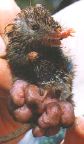
You don't have to count them. All antechinus have the same birthday, about the 12th of September. The males never live to see their first birthday, they all die around the 12th of August. They are a species of marsupial mouse and this is their strategy for survival. Now suppose that you wanted to know at what time of year insects are most numerous in the bush. The usual method would be to mark out some areas and count the number of insects in that patch, say each week of the year. Alternatively you could ask the antechinus, they live on insects. These marsupial mice have structured their reproductive cycle so that there is an abundance of food just when there is maximum demand, when they are lactating and before their young become independent. That is from mid-September till mid-December.
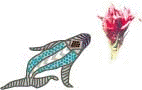
Gymea beacons. There is an international rule of the sea that states when a vessel is proceeding upstream it should keep all red channel markers on the left (port side). On the east coast of Australia there is a current which flows southward at a rate of up to 4 knots. Each year, humpback and southern right whales travel from Antarctica to the tropical waters off Queensland in June. As far as the east Australian current is concerned, they are travelling upstream. Whales prefer an easy life, so they try to avoid this current by keeping close to land, where there is an eddy, or counter-current flowing in the opposite direction. In the Port Stephens area there is a plant called the gymea lily which chooses to flower at this time of year (June). The red flower is huge, about 350mm across, which forms on top of a rigid upright stalk 5 metres in length. Additionally the gymea lily in this area only occurs on rocky slopes. There could be no better port marker in nature. Whales as they travel north come to the surface and roll their eyes landward, no doubt checking the 'channel markers'. Around October there is a second flowering of gymea lilies. This time the whales are heading south to Antarctica, further out to pick up the east Australian current. When two different things occur regularly in nature there might be a connection, perhaps an interdependence. It is also possible that the two flowering times of the gymea lily coinciding with the times that whales pass offshore, has no significance whatsoever.
INDEX ***Timelines Project*** Seasonal Calendars *** Observations *** Freebies *** Why? *** Links