INDEX ***Timelines Project*** Seasonal Calendars *** Observations *** Freebies *** Why? *** Links
A diary of natural events that occur each year in
the Port Stephens area, New South Wales, Australia.
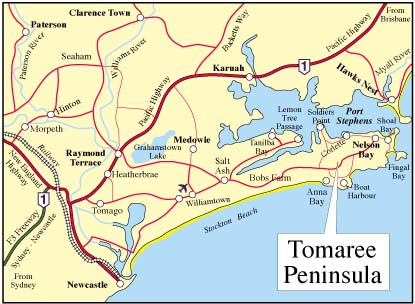
Below are my observations based on about 16 years of record keeping. Long ago I bought a copy of "Gum Leaves and Geckoes" a Gould League Nature Diary for keeping observations in. After getting right into the process I had enough info and enthusiasm to write my own book titled "Bush Mates, a guide to the wildlife of Nelson Bay".
Though listed only monthly, each observation is in strict chronological order, that is the early listings occur early in that month.
January ... February ... March
... April ... May
... June ... July
... August
... September ... October
... November ... December
...
Out there, beyond the back paling fences,
occur sudden explosions of activity, which will last for a day
or a few months. Each day fairy penguins come ashore on Broughton
Island to sleep underground. Just before Christmas our rarest
plant, the leafless tongue orchid, flowers and waits for a particular
wasp to help pollinate it. Suddenly, in mid August, all the males
of our local marsupial mouse population die within a week.
Most residents of the Tomaree Peninsula would be aware of some
of the major events of nature, the June appearence of the humpback
whales, the Easter blooming of the paperbarks, August wattles,
and the huge die off of muttonbirds in October on our beaches.
This is a month of moulting, the casting of fur, feathers, skin, leaves and bark.
Gymea Lily sends up flowering spikes, they will take months to form.
January is the peak time for snake births, 90% will die in the first year.
Scribbly Gums are finished moulting and have clean snowy/creamy bark.
Dragonflies mate.
Toad fish are washed up on the beaches.
Suggested New Year's resolutions; record daily rainfall with a rain gauge, keep a diary (this one) of insects, birds, flowers, wind strength and direction.
Mountain Devils in flower.
Young Ravens leave their parents' territory to establish a territory of their own.
Baby Koalas are born.
Sarsaparilla Vine Smilax glyciphylla is in fruit (blue berries).
Some Banksias are dripping with nectar.
Young sugar gliders leave their parents to fend for themselves.
Eastern Grey Kangaroos give birth.
Goannas lay eggs in termite nests in trees.
Bluebottles wash up on the beaches.
Tern and Dotterel chicks can be seen running across the sand.
Scorpion Flies appear around flowers, the male offers the female a fly.
Christmas bells flower in the wetlands.
Big Mud Wasps fly about building nests.
Mutton Bird chicks hatch on Broughton Island.
A good time to take cuttings from native plants (except Acacias or Eucalypts). Cut just under the node on new growth.
Green Tree Frog is breeding.
Snakes escape the heat by hiding in deep crevices.
Swifts feed on flying ants.
Grebes build floating grass nests in the wetlands.
Mongolian Dotterel arrives from its Siberian breeding grounds. Look for small birds moving rapidly on short legs over sand.
Young foxes leave their mother's den to find their own territory.
Breeding time for many species of lizard.
January and February are the months of highest temperature (27º average), and highest humidity (70%)
Wanderer butterflies and Ladybird beetles about.
Ring tail possums on Tomaree have babies in the pouch.
Planets visible on the eastern and western horizons at night.
Angophera costata (Smooth Barked Apple) "gumnuts" litter the ground.
Sunshine Wattle in bloom.
Snakes on Broughton Island prey upon the newly hatched mutton bird chicks.
Mullet start to run up the N.S.W. coast for the next three months.
Bluebottles found washed up on our beaches.
Geebungs are in flower.
Blackbutt in flower.
The first strong wind scatters the flowers of the Christmas Bush.
Blueberry Ash is fruiting.
Jelly Blubbers appear on beaches
Young Preying Mantids emerge.
Mangrove seeds wash up on the beach.
Leopard Slugs Mate.
Time to plant out natives (grown from the seeds you have collected) to harden for winter.
Painted Acacia Moth caterpillars appear on wattle trees.
Feral cats have their second litter for the year.
Wallaby births reach their peak.
Longicorn beetles emerge from wattles.
This is the time of seed production for many species, following the rush of spring.
"Spitfires" mass on branches.
Gamefish competition puts pressure on sharks and marlin.
Broad-leafed paperbark Melaleuca quinquenervia comes into flower.
Young birds fly around, in family groups, with their parents.
Fairy penguins come ashore on Broughton Island to moult for 2-3 weeks.
Mullet are in Nelson Bay harbour, and shooting the waves at Fingal Bay.
March Flies start biting.
Blackberries ripen.
Earthworms have their first breeding period for the year.
Kangaroo Apple in berry.
Goannas shed flakes of skin.
Bandicoot babies are out of the pouch.
Some parent birds take a four month holiday before parenting again.
Leaf-curling spiders are active.
Crickets call from the grass at night.
Tiger Moths fly about at night.
Some aquatic insect larva change into adult form.
In times past Aborigines cut notches in the bark of Acacias to allow the gum to exude.
European wasps gather at water.
Brushtail possums have the first of two litters of babies.
Very few wildflowers are in bloom at this time of year.
Broad-leafed paperbark Melaleuca quinquinervia in flower.
Conesticks in flower.
Gymea Lily flower heads start to form a flower.
Fruit bats mate.
Autumn Equinox 21st March, day = night.
Welcome Swallows depart.
Young Sugar Gliders are ejected from the family nest.
Octopus lay eggs.
Dotterels arrive from New Zealand.
Puffball fungi appear on the ground.
Orb Weaver Spiders are active.
Male flowering She Oak spikes attract swarms of bees.
Gould Petrel fledgelings leave Cabbage Tree Island.
Flame Robins come down from the hills.
Sea horses lay strings of eggs.
Spine Tailed Swifts depart.
Baby Noisy Miners and Rainbow Lorikeets are being fed.
Fairy penguin chicks leave their burrow for the open sea.
Muttonbird parents leave Broughton Island for a 30,000km flight.
From now until September Koalas are bellowing, fighting and scent marking.
Sugar glider young are ejected from the family nest.
Flying foxes mate.
New Holland and White-cheeked Honeyeaters raise their chicks.
April to July Bream and Luderick travelling north enter Port Stephens.
Swamp mahogany comes into flower.
Orion sets at night.
Geniah and Corvus appear in the night sky.
Noisy miners are active.
Quolls mate.
Gymea Lily flowers open.
Wild Parsnips in flower.
Muttonbird fledgelings leave Broughton Island.
Butcher birds are active.
Puff balls are dried out and spreading spores.
Channel Billed Cuckoo leaves for New Guinea.
Red Wattlebirds arrive.
Muttonbirds that left Broughton Island arrive at the Bering Sea.
The leaf of the Pixie Cap orchid appears on the ground.
The first greenhood orchids appear.
Granny Bonnet, Mountain Devil & Native Cherry in flower.
Cycad "cones" appear.
Squid are in Nelson Bay Harbour.
Blueberry Ash berries fall to the ground.
Clothes Moths in the cupboard.
Quolls are born.
Peak time for meteor showers.
Sour Current bush in flower.
Many species of bird migrate north to avoid winter.
Eels return to the sea to breed.
Silvereyes arrive from Tasmania.
Tuna arrive.
Mountain Devils in flower.
Southern Cross is high in the evening sky.
Orion sets at dark and Scorpio rises in the east.
The "6" net is set off Shoal Bay to capture migrating bream and blackfish.
Dingos mate.
Look for the smaller male spider at the edge of the web of the Golden Orb Spider.
Pittosporum revolutum in fruit.
Scaly Breasted Lorikeets squabble over Swamp Mahogany blooms, whilst Noisy Miners try to defend their territory.
Caterpillers feed on Melaleuca quinquenervia.
A few trigger plants are still in bloom.
Correa reflexa in flower.
Sunshine Wattle in bloom.
The flowers of Epacris pulchella start to dominate the bush.
White lerps form on bushes.
Wombats mate.
Fly Agaric toadstools grow.
Yellow Faced Honeyeaters pass through, moving north.
Tadpoles hatch in freshwater ponds.
Leaf Skeletoniser Caterpillars nibble on gum leaves.
Humpback Whales seen heading north from now until August.
Brown Antechinus babies disperse from their maternal home ranges.
Brushtail Possums are born.
May and June are the months of highest
rainfall.
Five-corners in flower.
Baby Quolls are born, the first six to attach to a nipple will survive.
Flocks of insect-eating birds fly about.
Pixie-cap orchid flowers appear.
After the summer bushfires Grass-Tree flowering spikes are covered in flowers.
World Environment Day.
Foxes mate.
Mosquitos die off, the few survivors forming the breeding stock for next summer's population
explosion.
Broad-Leaf Geebung in fruit.
Heavy dews keep the ground wet until mid day.
Plovers lay eggs in ground nests.
Striated Pardalote arrives from Tasmania.
Black Cormorants move about in large flocks.
Some Melaleuca quinquenervia are still in flower.
Acacia suaveolens is in flower.
Tailor are being caught locally as they travel north to Frazer Island.
The "wolf whistle" of the Currawong can be heard.
Quoll babies detach from their mothers teats and are left in the den while she forages.
Echidnas mate.
This is the time of year that fungi are most abundant.
Sour Current Bush is in fruit.
White Breasted Sea Eagles nest.
Earth Star fungus appears.
Red Ironbark in flower (Kurrara Hill).
Nights are getting cold, and snakes begin to hibernate down holes in the ground.
Bandicoots are at Middle Rock Caravan Park.
Wedge-Tail Eagle pairs perform pre-mating aerobatics.
Winter solstice, 22nd June, longest night, shortest day.
Puff Balls emerge through the bitumen on some roads (e.g. Gan Gan Hill).
After storms, look on the beaches for dogfish egg-cases and cuttlefish egg-masses.
The 6" net is set on Shoal Bay Beach to capture travelling blackfish and mullet.
King Prawn Season.
Bream head up the creeks.
Greenhood Orchids flower under the trees.
Some of the plants in flower include Lobelia gibbosa, White Finger Orchid, Woolsia pungens, Granny Bonnet and Black-Eyed Susan.
Blue-Faced Honeyeaters feed on flowering trees.
Wombats seen sometimes in the daytime as they warm up in the afternoon sun.
Wombat mothers have last years cub at heel and this years in the pouch.
June and July are the months of coldest water temperature, 13°C.
Inky Cap fungus appears.
Foggy mornings are more common.
Winter westerlies thrash boats on their moorings.
Helmet Orchids in flower.
Sand Flathead males wait at Tomaree for passing females heading for Providence Cove.
Dusky Flathead spawn in the estuary.
Fairy Penguins lay their eggs between July and November.
Fantail Cuckoo calls can be heard.
Blackthorn in flower.
On the 5-7-1993 a Southern Right Whale entered Port Stephens for a few hours.
Wattles show early signs of flowering.
Bushfires are lit for fuel reduction.
Magpies start collecting nest material.
Albatrosses can be seen out to sea.
Estuary Perch and Bass spawn in brackish water.
Young Galahs, born last year, fly up to 50 km from their birthplace in flocks of immature birds.
Male Echidnas look for females.
Female Echidnas develop a pouch and their milk glands get bigger.
Golden Wattle and Prickly Moses are in flower.
Swamp May has seed pods formed (bush tea).
Some of the plants in flower are Coast Tea Tree, Crimson Bottlebrush, Epacris obtusfolia and Drumsticks.
It is a real challenge to find a Christmas Bell still in flower (my record is August 14th).
Case moth caterpillars are active cutting sticks.
Earthworms wander about after rains.
Frogs call on still nights.
Maroonhood Orchids appear.
Gymea Lily in flower.
False Sarsparilla vines in flower.
Wax flowers bloom.
Dingo pups are born.
Lilly Pilly in fruit.
Cold weather causes some snakes, bats, lizards and small mammals to seek a secure shelter and lapse into a winter torpor.
Silver Gulls move to nesting islands with low vegetation.
July - the month of the least number of hours of sunshine, 6.
Mopoke calls at night.
Crickets call in the grass at night.
Female Echidna lays one soft egg.
Scrub Wrens build their nests.
Baby Ringtail Possums leave the pouch and start riding on their mother's back.
Both Green-Tailed and Yellow-Tailed Cockatoos can be seen in the area.
Swamp Wallabys come closer to settlement as their natural food supply dwindles.
Eastern Rosellas engage in courtship.
Echidna egg "hatches" and young attach to a teat.
Cup Fungi appears.
Bandicoots start breeding.
Occasional snow on Barrington Tops.
Wattle Day, some wattles are in bloom.
Cup Moth cocoons on gum leaves.
Young foxes start exploring and playing.
Pee Wees start building their mud nests.
Dagger Hakea in flower.
Antechinus mate.
This week all male Brown Antechinus die, leaving the females to raise the next generation.
Koels arrive from P.N.G. to lay eggs in other bird's nests.
Kookaburras lay 2 eggs.
This year's baby Quolls become independent.
King crickets lay eggs in Banksias.
Gnat orchids are in flower.
Painted Lady Butterflies emerge.
Pardolotes dig nest burrows.
Welcome Swallows arrive.
Euphrasia Collina is in flower.
Butchers Birds are active.
Koala cubs leave the pouch and climb onto their mother's back.
Donkey Orchids are in flower.
Mosquito wrigglers are abundant in pools of water.
Ducklings can be seen walking to water.
Reed Warblers return from the north.
Pallid and Bronze Cuckoos call.
Cormorants begin nesting.
Potato Orchid flowers open.
Greenhood Orchids everywhere.
Quoll babies are grown up.
Fairy Penguin eggs hatch on Broughton Island.
Wading birds arrive from Siberia (Stints, Curlews and Sandpipers).
Flies overwinter as lavae and pupa in crevices.
Rulingia hermannifolia in flower behind Kingsley Beach.
Gymea Lily in full flower.
Spring has started.
Sawfly grubs cluster on Eucalypt leaves.
Pixie Cap Orchid and Greenhood Orchid have reduced to just leaves on the ground.
Pink Finger Orchid in flower.
Yellow Robins nest.
Skipper Butterflies appear.
Milkmaids in flower.
Sugar Glider twins are born.
Cuttlefish come close to shore to breed in the shallows.
Oystercatchers start to breed.
Red Wattlebirds depart.
Reptiles can be seen basking in the sun.
September 1st is an alternative Wattle Day.
Magpies start dive-bombing.
Earthworms start their second main breeding period.
Whales are seen off the coast heading south.
Eastern Spinebills can be seen on wildflowers.
Admiral Butterflies about.
Sour Current bush carries lots of fruit.
Around September 7th, Antechinus babies are born.
Young Echidnas are weaned.
Swamp Rats start to breed.
Forest Clematis in flower.
Orioles can be heard calling.
Scented Sun Orchids open their flowers.
The seas are alive with tuna.
Australian Indigo in flower.
Willie Wagtails nest.
Bats can be heard at night.
Mackerel Tuna enter Port Stephens to eat schools of small fish.
Flying Fox babies are attached to their mother.
Christmas Beetles start banging against the windows at night.
Any Satin Bower birds that may have visited the area leave the coast to breed in the mountains.
Scallops spawn.
First Flying Duck orchids appear.
Red Beard Orchid in flower.
In 1992 at least 2 Dugong visited Port Stephens for a few months.
Millipedes wander into houses.
Cuckoo Shrikes feed on caterpillars.
Whiting school in Port Stephens.
Eastern Rosella chicks born a year ago have moulted and show their adult plumage for the first time.
Some Bandicoots start their second litter.
Emerald moths on house windows.
Channel-Billed Cuckoos arrive from New Guinea to breed.
For the next two months immature magpies demand food in the trees.
Every third year young Eels travel upstream.
Tiger moths seen flying about.
Bar-Tailed Godwits arrive from the Northern Hemisphere.
Christmas Bush puts on tiny buds in preparation for flowering.
Humpback whales still pass heading south to Antarctica.
Muttonbirds arrive from the North to breed on Broughton Island.
Feral cats have the first of two litters, 2-7 young.
Five Corners is fruiting.
Swamphens have their young.
Antechinus young become too large to carry in the pouch and are left in the nest.
Tailor that were here earlier in the year have arrived at Frazer Island to lay their eggs over sand.
Pythons lay their eggs.
Cranberry Heath in fruit.
Sallow Wattles have wasp galls.
Melaleuca groveana is in flower on Stephens Peak.
Sugar Gliders leave the pouch to spend a further month in the nest.
Fisheries inspectors decide when to open the prawn season, which will run from now until April.
Love Creeper and Black Wattle are in flower.
Fox cubs emerge from the den and begin hunting.
Mud Crabs and Blue Swimmer Crabs are mating.
Mistletoe berries are abundant.
October long week-end is the start of the trout fishing season.
Kookaburras tunnel into termite nests in trees for nesting hollows.
October to November is the peak mating time for koalas.
Kookaburras look for a mate.
Many birds move south to nest.
Bluebells are everywhere.
Sundews and Bladderworts are flowering.
The Southern Cross is low on the horizon in the evening.
Currawongs are nesting.
The first Trigger Plants begin to flower.
Red Beard Orchid is in flower.
Sawfly wasp larvae go to ground.
Flannel Flowers start to dominate the bush.
Exhausted Muttonbirds are washed up on our beaches.
Yellow Donkey Orchid and Coast Tea Tree come into flower.
Yellow and Black Hover Flies swarm in the shade on hot days.
Some of our local bats give birth, upside down.
Coast Myall comes into flower for a few weeks.
The best month of the year for bird-watching.
Flying foxes are looking for figs and Angopheras.
Snakes and skinks are active.
Cicadas emerge from underground and leave their pupa cases on tree trunks.
Angophera costata is in flower.
Female snakes leave a scent trail so that the males can find them.
Fairy Penguin fledgelings go to sea to hunt for themselves.
Skeletonizer moth larvae attack gum leaves.
Woody Pear in flower.
Peak time for viewing orchids.
Eastern Spinebill is active amongst the flowers.
The first flush of Spring is over.
Octopus and cuttlefish eggs wash up on the beaches.
Eastern Rosellas are hatching.
Scented Sun orchids start to flower.
Gulls leave their nesting islands.
Gymea Lily flowers fruit.
acarandas are in flower.
Rainbow Bee-eaters arrive from the north.
Christmas Bush puts on cream flowers.
Bees swarm.
Baby Quolls are independent of their mother.
Onion orchids in bloom.
Wasps look for nest sites.
Yellowtail Kingfish and Snapper spawn.
Many birds moult.
Black Faced Cuckoo Shrike are in abundance.
Crane flies emerge.
Baby Echidnas are 10 cm long and become too spiky for the pouch.
Dingo pups aged 4 months, make their first outings outside.
Whales are seen heading south.
Lacewings hatch.
Angophera costata sheds its bark.
Blueberry Ash starts flowering.
Prawns wait for rain to go to sea.
Trigger plants are now common.
Young magpies are being fed.
Wood-swallows nest after migrating south.
Blue Flax Lily has purple fruit.
Flying Duck Orchids abound.
Apple Berry and Lobelia gibbosa are in flower.
Sugar gliders leave the nest for the first time.
Antechinus babies stay in the nest or ride their mother's back while she goes hunting.
Crimson Bottlebrush is in flower.
Broad Leaf Geebung fruit drops to the ground.
Scribbly Gum sheds it bark.
Flying Ants swarm on a hot day.
Stink bugs appear on Lemon Trees.
Galahs have their annual moult and their young become independent.
Red Jellyfish appear in Port Stephens.
Baby foxes are born.
Noisy Miner chicks wishing to be fed, chirp from the trees.
Red Ichneumon Wasps are common.
Quaking Grass puts on its seed head.
Phascogale young are free to roam about.
Gulls moult their primary feathers
Eastern Rosella young are out of the nest and demanding to be fed.
Muttonbirds lay their eggs on Broughton Island.
This is a good time to collect seeds from the bush.
Grasshopper plagues begin.
Butcherbird young hatch.
Scribbly gums are in flower on Gan Gan Hill.
Antechinus babies are independent.
Wild Parsnip is in flower.
Beard Heath develops berries.
Oyster spat is collected.
Mud Dauber Wasp makes its nest.
Jacaranda blooms cover the ground.
Half of the Christmas Bush flowers have turned red.
Lobelia gibbosa, Mountain Devils and Apple Berry are in flower.
Broad Leaf Geebung is in flower.
December to January is peak birthing time for Koalas.
Handsome Flat Pea seed pods explode.
Jewel Beetles and Scorpion flies appear on blossoms.
Christmas Beetles fly against windows at night.
Shark egg cases and bluebottles wash up on beaches.
Pigmy Possums have their young.
Flies breed and multiply.
Christmas Bells are in flower.
Young Wombats are 6 months old, fully furred and leave the pouch.
Saw Banksia is in flower.
Nests are full of baby birds.
Gymea Lily flowering stalks begin to grow.
Kookaburra chicks are fully independent.
Look for baby Brushtail Possums peeking out of their mother's pouch.
Blue Wrens are seen more often.
Mosquito populations breed up.
Dagger Hakea is in flower.
Bark of Angophera costata litters the ground.
Prostanthra densa is in flower on the cliffs.
Wombat Berry is in fruit.
December 22nd, Summer Solstice, longest day of the year.
Man is everywhere.
Bushfire season.
White-fronted Terns visit from New Zealand.
Ant Lions transform into Lacewings.
Some Grass Trees are in flower.
INDEX ***Timelines Project*** Seasonal Calendars *** Observations *** Freebies *** Why? *** Links