|
 HERCULE
POIROT HERCULE
POIROT Childhood
Years
Police Years
Career as a Private Detective
Retirement
Post-War World
Death
The Age Controversy
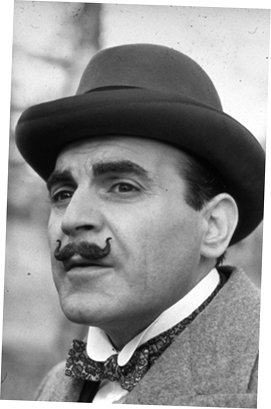
Poirot is remarkable for his small stature and egg-shaped head, his
cat-like green eyes, his meticulous moustache and his dandified
dressing habits. He appears in over thirty biographical novels and
over fifty short stories. Agatha Christie, his biographer, has noted
that he is her most famous client.
|
GENERAL
INFORMATION
Surname:
Poirot
First: Hercule
Marital Status: Single
Telephone: Trafalgar 8137
Lawyers:
McNeil and Hodgson, London
Secretary: Felicity Lemon
Valet: Georges
Automobile: Messaro Gratz
Height: 5' 4"
Weight: 200-250 lbs.
Eye Color: Green |
CHILDHOOD YEARS
Hercule Poirot was
born in Spa, Belgium. Not much is know of Poirot�s childhood other than he
once claimed in Three Act Tragedy to have been from a large
family with little wealth. In Taken at the Flood, he then
claimed to have been raised and educated by Nuns, suggesting he and
his siblings where orphaned.
Nothing is known of his siblings,
or relatives.
In The Murder of
Rodger Ackroyd, he creates a mentally disabled nephew as an excuse
to investigate the local mental homes. In Dumb Witness, he
regales us will stories of his elderly invalid mother as a pretence to
investigate the local nurses. His biggest creation, however, was his
twin brother Achille Poirot who was actually Poirot in disguise [first
mentioned in The Big Four]. He also mentioned a sister called
Yvonne in The Chocolate Box, who was never mentioned again.
^Index
POIROT'S POLICE YEARS
As an adult, Poirot
joined the Belgian police force and apparently had a distinguished
Career. Again there is no real information that can be considered
canon on this period of Poirot�s life. We do know that he had his only
real failure while in the police force as told in The Chocolate Box.
Poirot did say, in the same novel, that he has had other failures but
they were caused by events beyond his control such as ill health
forcing him to drop a case or another policeman solving the case
before him and he believes [rightly or wrongly] that these don�t
count.
It was also in this
period that Poirot killed his first man who was on a rooftop and
shooting the public below. Not much is know about this event or its
aftermath other than that Poirot killed the man right there and then
in order to save lives and was never sure afterwards whether or not
what he did was right.
It was also during his
police days that he first met Chief Inspector James Japp. In The
Mysterious Affair at Styles he mentions that they first met in
1904 during the Abercrombie Forgery and later that year joined forces
again to hunt down a criminal known as Baron Altara. Unfortunately we
hear nothing more about these events. Poirot finally retired in 1914
but events conspired against him and he was forced to face the wrath
of the invading German army.
^Index
Career
as a private detective
During the first
world war, Poirot was forced to flee Belgium for Britain. It hurt
Poirot badly to have been driven from his home and forced to live as a
refugee. However it was here that he met his lifelong friend, Captain
Arthur Hastings and began his new life after solving The Mysterious
Affair at Styles. After that case Poirot apparently came to the
attention of both MI6 and MI5 and did undertake cases for the British
government. Its presumably at this time of his life that he foils a
German attempt to abduct the Prime Minister in the short story The
Kidnapped Prime Minister.
After the war Poirot
became a free agent and began undertaking civilian cases. He moved
into what became both his home and work address, 56B Whitehaven
Mansions, Sandhurst Square, London W1.
The building used in the series can be found on Charterhouse Square -
City of London. Also known as, 28 Whitehaven Mansions
It was chosen by Poirot
for its symmetry. His first case was The Affair at the Victory Ball,
which saw Poirot enter the high society and begin his illustrious
career.
Between the first and
second world wars, Poirot traveled all over Europe and the Middle East
investigating crimes and murders. The main bulk of his cases happened
during this period. The Murder On the Links saw the Belgian pit
his grey cells against a French murderer. In the Middle East he solved
The Murder on the Orient Express, the Death on the Nile
and the Murder in Mesopotamia with ease and even survived An
Appointment with Death. However he did not travel to the
Americas or Australia, probably due to his mal de mer.
It was during this time
he met the Countess Vera Rossakoff, a glamorous jewel thief. Poirot
later became smitten with the woman and allowed her to escape justice.
He then returned to mainland Europe to solve the Mystery of the
Blue Train and faced Death in the Clouds.
Poirot was then to face
the biggest threat of his life, a gang called The Big Four who
were bent on world domination. It was during this ongoing battle that
he again encountered Vera Rossakoff. She had made a deal with Poirot�s
unholy enemy. However, Poirot was able to convince the countess to
betray her dark masters, in exchange for her long lost son who Poirot
had found. With her help, Poirot overcame the Big Four and achieved
international fame. After this he did contemplate marriage to the
Countess, but finally let Rossakoff go. Poirot was never to see her
again for twenty years and was sadly, never to marry.
^Index
Retirement
After the case of
The Big Four ended Poirot decides to retire. He retires at least five
times but is to much of a workaholic to give up his work. He retired
from the police force but is drawn into private investigation. He
retires and moves to the county to grow vegetable marrows but then
The Murder of Roger Ackroyd takes place right on his door step. He
then retires but is drawn back into the detective business when he
hears that Mrs. McGinty's Dead. He becomes a book reviewer but
became involved in another crime when he heard about The Clocks.
In the Labor of Hercules he agrees to take on twelve more cases
before retirement, but the retirement never happens.
^Index
Post-war world
After the war, as
he got older, he apparently became more of an armchair detective and
traveled less and less. His absolute obsession with order and
neatness, his disdain for detective methods that include crawling on
hands and knees and looking for clues and his egomania also grew to
outrageous levels. He once even bet his friend and Scotland Yard's
Chief Inspector Japp, that he could solve a case simply by sitting in
an easy chair and using his "little grey cells."
He also became increasing amused and
baffled by the vulgarism of the up and coming generations young
people. In Hickory Dickory Dock, Poirot investigates the
strange goings on in a student hostel. And when he met the Third
Girl, Poirot was forced to face facts and admit that he was
getting older and no longer understood the new modern youngsters and
the growing drug and pop culture.
^Index
Death
Towards the end
of his life Poirot began suffering from heart problems and
arthritis. He then came across a man called Norton who had
perfected a means of getting other people to kill for him, the
greatest murder method yet devised.
Poirot, his health
failing and knowing that the only way to stop Norton was to kill him
as he could never be brought to justice legally, pursued Norton to
Styles where he and his old friend Arthur Hastings hunted down this
one last murderer together before Poirot died peacefully in his sleep
on the 6th of August 1975.
^Index
THE AGE CONTROVERSY
Taken at face value
it appears that Poirot was over 125 years old when he died. This is
due mostly to confusion over what is canonical and what is not.
Although the majority of the Hercule Poirot novels are set between the
wars, the latter novels set them in the 1960s [Which is contemporary
with the time Agatha Christie was writing]. However, the many TV and
movie adaptations do not show this. Many people believe that Poirot
retired from Police work at around 50, but this is untrue, because as
shown in the short story The Chocolate Box, he retired at
around 30. This can explain why Poirot is around for so long. He was
in his nineties when he died.
^Index
|