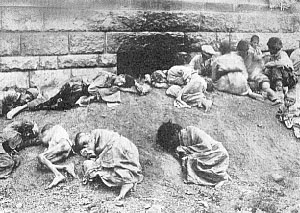
This group of human wreckage represents tens of thousands
when first approached with aid. (Barton 1930: 22a)
Being born at Mannheim (Baden), Germany, of Jewish origin, H.Morgenthau's humanitarian views were exceeding to narrow, nationalistic or local limitations. Opposing to Turkish racialist mentality, he admonished to the Turk leaders, that "� above all considerations of race and religion, there are such things as humanity and civilization � ." (Kloian 1985: 232, 266) Then he added about his origin and his political views: "... I am not here as a Jew but as American Ambassador. My country contains something more than 97.000.000 Christians and something less than 3.000.000 Jews. So, at least in my ambassadorial capacity, I am 97 per cent Christian. But after all that is not the point. I do not appeal to you in the name of any race or any religion, but merely as a human being. You have told me many times that you want to make Turkey a part of the modern progressive world. The way you are treating the Armenians will not help you to realize that ambition; it puts you in the class of backward, reactionary people." (Kloian 1985: 266) Backwardness, about which H.Morgenthau has expressed himself in his historical memoirs as follows: "I have no intention of describing the terrible vassalage and oppression that went on for a five centuries; my purpose is merely to emphasize this innate attitude of the Muslem Turk to people not of his own race and religion _ that they are not human beings with rights, but merely chattels, which may be permitted to live when they promote the interest of their masters, but which may be pitilessly destroyed when they have ceased to be useful. This attitude is intensified by a total disregard for human life and an intense delight in physical human suffering which are the not unusual qualities of primitive peoples." (Kloian 1985: 242)
During the years of war in Ottoman Turkey and under strengthened censorship conditions, H.Morgenthau received detailed information about the deportations, massacres and slaughters occurring in the eastern provinces through the American missionaries, who, overcoming road difficulties and risking their lives, came to the Embassy to witness to what they had seen and heard. H.Morgenthau has written in his memoirs: "For hours they (missionaries - K.A.) would sit in my office and, with tears streaming down their faces, they would tell me of the horrors through which they had passed. Many of these, both men and women, were almost broken in health from the scenes which they had witnessed. In many cases they brought me letters from American consuls, confirming the most dreadful of their narrations and adding many unprintable details. The general purport of all these first-hand reports was that the utter depravity and fiendishness of the Turkish nature, already sufficiently celebrated through the centuries, had now surpassed themselves. There was only one hope of saving nearly 2.000.000 people from massacre, starvation, and even worse, I was told _ that was the moral power of the United States. These spokesmen of a condemned nation declared that, unless the American Ambassador could persuade the Turk to stay his destroying arm, the whole Armenian nation would disappear." (Kloian 1985: 263) The European powers were also of this opinion.
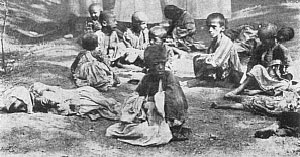
The American Embassy in the Ottoman Empire used all its diplomatic potential to stop the mad plans of the Young Turk leaders, "� for which civilization will hold the Turks responsible." (Kloian 1985: 260) H.Morgenthau demanded from the Young Turk leaders a guarantee of safety and security for the Americans, Englishmen, Frenchmen and for the Armenians. But Turkey did not give a guarantee for the security of Armenians and had no intention to give up its plans of extermination of a whole nation. On the contrary, the Young Turk leaders announced that the case of their attitude towards Armenians was of no concern to the USA and that the Armenians would mostly gain, if they were freed from the tutorial assistance of the USA, something which would urge them to rely only upon the good nature of the Turkish government. (Amerikyan 1990: 119, 275, 281, 291)
Nevertheless, H.Morgenthau did not miss the opportunity to use his authority in favor of the Armenians. Thus, on the occasion of the greatest religious holiday, Bayram, he interceded with Enver and obtained the liberation of seven Armenians condemned to death by the Ismir military tribunal. The Ambassador H.Morgenthau, realistically evaluating the situation created in the Ottoman Empire for the Armenians and persuaded that it was necessary to take measure "to rescue permanently the remnants of these fine, old, civilized, Christian people from the fangs of the Turks," he applied to the American Government for moving to the USA 550.000 Armenians miraculously saved from the Genocide and succeeded in charging the Young Turk leaders 1.000.000 dollars as part of the transportation expenses. With the help of its councils and missionaries, the American Embassy organized the distribution of foodstuff, clothing, medicines and other important aids supplied by the humanitarian institutions of USA to the rescued Armenians of Anatolia. (Morgenthau n.d.: 16. Kloian 1985: 50, 52)
| <<< | >>> |