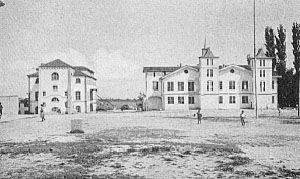
American College at Marsovan.
This building was among the many missionary institutions,
turned over to the use of the Committee. (Barton 1930: 34a)
It was the fate of Henry Morgenthau (1856-1946) to be the Ambassador of the United States of America in Turkey during the most tragic period of the Armenian history, in the years of World War I. As a diplomat and lawyer, he has devoted all his professional and human abilities to the establishment of justice in Turkey, in favor of the Christians' elementary rights for life, the defense of their interests and for the mitigation of their sufferings. H.Morgenthau was one of the exceptional politicians who never betrayed the humanistic principles of philanthropy and compassion; continuing the educational and enlightening task of the American Protestant Missionaries started a century before in Ottoman Turkey, he made his valuable contribution by converting it, under the new historico-political circumstances, into a tutorial pro-Armenian Mission.
As early as 1819, the American Board of Commissioners for Foreign Missions, which had the object of "spreading the Bible throughout the world," (Jizmejian 1955: 103) had found in the Armenians a reliable stronghold amid the centuries' old obscure backwardness of the Ottoman Empire for realizing their Christian-reformatory ideas and developing their enlightening activities. As far back as 1831, with the help of the Armenian Mission established in the quarter of Bebek in Constantinople, several Evangelical churches, schools and colleges had been founded, where teaching courses and sermons on European and American educational levels were organized. These institutions, which have been characterized by H.Morgenthau as "means of peaceful penetration" (Amerikyan 1990: 55) of American ideas, have greatly favored also the spiritual and mental awakening of the Armenians and the formation of the pro-western outlook, giving rise to the temporary emigration of the Armenians to the USA, in the beginning for educational purposes and afterwards for economic ones. Many of these Armenian emigrants, finding economic, political, cultural and religious freedom and prosperity in the USA, have settled in the New World, reducing the number of people returning to the Motherland and preparing conditions for the material and moral assistance to thousands of compatriots who emigrated in the following decades owing to pressing historico-political circumstances, as well as for assembling and organizing them as a community. (Avakian 1996A: 92, 94, 96-97)
By 1914, the following institutions were functioning thanks to the humanitarian efforts of the American Board and under the patronage of the USA Embassy almost in every Armenian-inhabited locality of the Ottoman Empire:
* 369 elementary schools with 22.700 pupils and 850 teachers,
* 137 churches with 50.900 adherents, 13.891 communicant members, and 179 native ministers,
* 46 boarding schools and secondary schools with 4.090 pupils,
* 19 hospitals with 39.503 patients,
* 15 missionary centers with 146 ministers,
* 10 colleges with 1.748 students,
* 8 industrial schools,
* 5 nurse-training schools,
* 5 orphanages,
* 4 theological seminaries with 24 students,
* 3 schools for defective (blind, deaf, and dumb) children,
* 2 old people's homes and others. (Chopourian 1962: 100, 101. Hay 1986: 39. Tootikian 1982: 27-28, 272-273. Papajian 1985: 89)
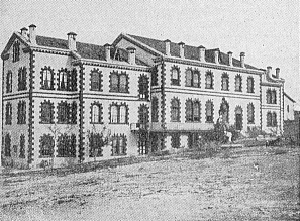
During its already 100 years of existence in Turkey, the American Board of Commissioners for Foreign Missions, which symbolized American humanism, had invested about 20 million dollars, had endured indescribable moral hardships and had suffered numerous human losses. In the years of First World War, the American missionaries (about 400 in number), faithful to their mission, stayed till the end at their institutions in Turkey, served Christianity and testified the whole world to the sufferings of the Armenians. (Kloian 1985: 40, 44)
"The Missionary Review of the World" (November, 1915) in its article "The American Missionary Interests" has substantiated the centennial interests of Americans towards Armenians as follows: "America has more interests in Turkey than any other country, or possibility than all Europe together. This interest is not political, but humanitarian. In 1819 the American Board of Commissioners for Foreign Missions began work in the Ottoman Empire, and has now for nearly a century prosecuted that work with vigor and statesman _ like foresight and breadth. The missionaries have introduced into the country the printing press and a periodical, literature, modern medicine and sanitation, the modern hospital, new industries and commercial enterprises, and western education, culminating in the well-organized colleges and graduate schools. � The Armenians as a people have been the most responsive to the appeals of modern education. The majority of the 25.000 students in the schools north of Syria have been from this historic and virile race. Thousands have taken graduate courses in the United States. It can be said that America discovered the Armenian race and introduced it to the Western World. It is therefore, eminently fitting that at this time of death-struggle America should be the first to lift its voice in protest, and the most ready to offer its help to save this nation from annihilation." (Kloian 1985: 102, 103)
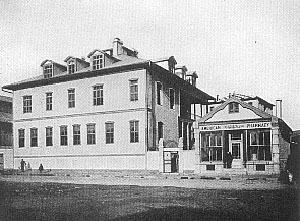
Although the American Ambassador in Turkey, Henry Morgenthau (November, 1913 - Spring, 1916) was called for "� merely to represent his government as worthily as possible, to protect American interests and particularly to watch over the American educational institutions which had accomplished such great things for the Christian populations," (Kloian 1985: 232) nevertheless he wholly devoted all his diplomatic skills for somehow extenuating the sufferings of Christian populations, especially of the Armenians, and for checking the extermination plans of Young-Turk leaders.
Here is what H.Morgenthau has told Talaat, the Minister of Internal Affairs of Turkey, to stop the persecutions against Armenians and in favor of the American missionaries' interests: "... Americans are outraged by your persecutions of the Armenians. You must base your principles on humanitarianism, not racial discrimination, or the United States will not regard you as a friend and an equal. And you should understand the great changes that are taking place among Christians all over the world. They are forgetting their differences and all sects are coming together as one. You look down on American missionaries but don't forget that it is the best element in America that supports their work, especially their educational institutions. Americans are not mere materialists, always chasing money _ they are broadly humanitarian, and interested in the spreading of the justice and civilization throughout the world. After this war is over you will face a new situation. You say that, if victorious, you can defy the world, but you are wrong. You will have to meet public opinion everywhere, especially in the United States. Our people will never forget these massacres. They will always resent the wholesale destruction of Christians in Turkey. They will look upon it as nothing but willful murder and will seriously condemn all the men who are responsible for it. You will not be able to protect yourself under your political status and say that you acted as Minister of Interior and not as Talaat. You are defying all ideas of justice as we understand the term in our country." (Kloian 1985: 266)
| <<< | >>> |