Bottom up fabrication is building structures with nanoscale materials. As opposed to top down, reducing large materials to the nano size,
DPN has many advantages, which will make this technology popular. These pros are:
-Decrease in the required amount of material
-Decrease in the power needed to run devices
-Increase in device speed
-Increase in the potential power and complexity
-Decrease in cost
Alkanethiol absorption on Gold
Using an alkanethiol to write on the gold substrate, surface, is due to the properties of atoms at the nanoscale. The properties of atoms are vastly different at the nanoscale.
Alkanethiols adsorb spontaneously from solution onto the surface of gold, silver, platinum and copper. The thiol groups chemisorb onto the gold surface via the formation of a thiol bond. Attractive van der Waals forces between the alkanethiols enhance the stability and order of the SAM. Therefore, long chain alkanethiols produce more ordered SAMs than those with shorter chains. The order of the SAM is also affected by the roughness of the gold surface.
Glossary:
Alkanethiol
(HS(CH2)xX)
The x variable represents the outer layer of the ink, so that when x is manipulated, desired chemical surfaces are obtained. This makes the surface easier to study wettability, absorption, adhesion and surface reactions.
Alkyl
An organometallic compound, such as tetraethyl lead, containing an alkyl group bound to a metal atom.
SAM
Self-Assembled Monolayers, nanoparticals that are programmed to form a predetermined structure.
Chemisorb
To take up and chemically bind (a substance) onto the surface of another substance.
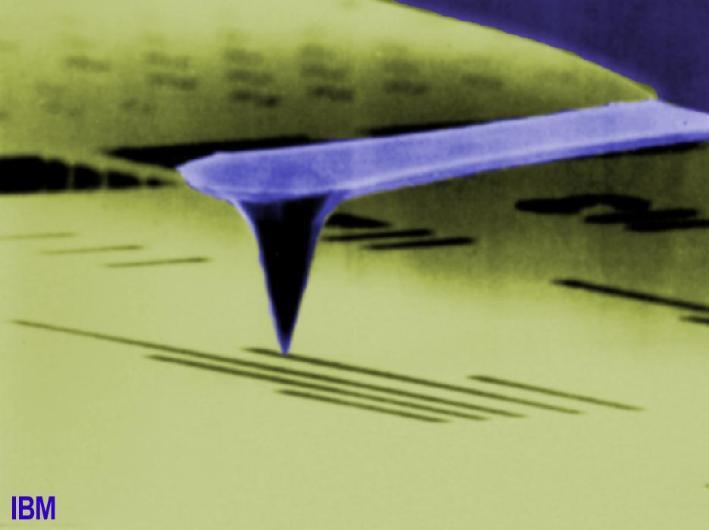
This is one type of microscope used to measure small surfaces, like atoms. The microscopes themselves are not used in DPI, just the tip. The microscope can only measure picometers of larger. DPI uses the AFM tip to write with, the tip of the pen so to speak. A new piece of equipment had to be built to move the tip by nano units. Another alteration of the tip is that it would be connected to an ink source. So, instead of reading off of a material, it would write on a material.