Original Copyright Countryside Books
Not to be used for commercial purposes.
Much of the text reproduced from Lost Railways of Sussex By Leslie Oppitz
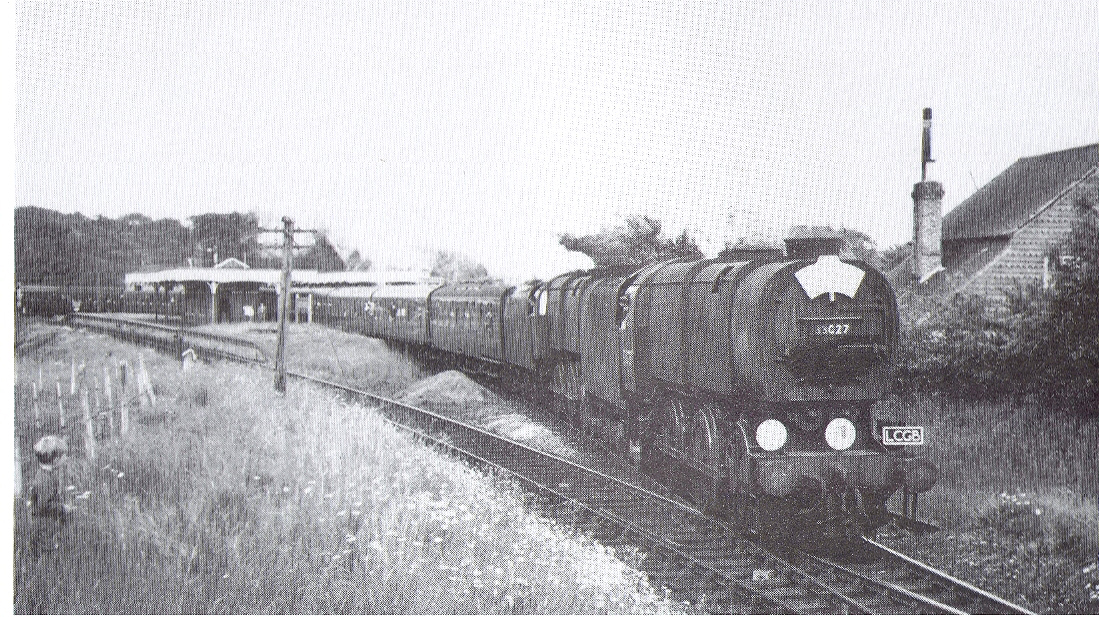
Rather poor reproduction photo below was the last train leaving Christ's Hospital Station on 13/06/65. The roof of Lower Barn Cottage can be seen to the right of the locomotives.
First ideas for a branch line from Christ's Hospital to Guildford in Surrey came in 1857 at a time when Jacomb Hood, engineer for the LBSCR, was very much involved in battles over a line from Christ's Hospital to Shoreham. Despite his preoccupation, Jacomb Hood saw that such a route would open up possibilities for connections between the South Coast resorts and the Midlands. A company called the Horsham and Guildford Direct Railway was formed and plans were authorised by Parliament on 6th August 1860. It was agreed the line should be built as single track leaving the Horsham to Pulborough line at Christ's Hospital. A triangular junction was to be built at this point to allow through running from Brighton to Guildford as well as Horsham to Guildford.
There were many construction problems and at one stage the contractor went bankrupt with a loss of over 30,000 pounds. The line was taken over in an incomplete state in 1864 by the LBSCR and work was not finished until the following year. Even at this stage the government inspector would not accept the siting of Rudgwick station on a 1 in 80 gradient and insisted this should be reduced to 1 in 130. Because of this the bridge over the River Arun, south of the station, had to be rebuilt. Services began on 2nd October 1865 even though Rudgwick station was not finished due to the resiting probem until almost two months later. Initially eight trains ran daily with certain trains terminating at Cranleigh. But the railway authorities had been over-optimistic and traffic was not good. Fares were increased within 18 months of the line's opening The triangular junction at Christ s Hospital also ran into difficulties. Intended for through trains to the Millands, it was not regularly used and the LBSCR closed it within two years.This was probably because they were concerned that their'old enemies', the LSWR, would have greater access to the South Coast with running powers on this section. No sign of this line remains today with the area ploughed over.
The Guildford line left the main Horsham to Pulborough line at Stammerham junction. Initially there was no station at Stammerham, only a small wooden platform used by a dairy to ferry milk up to London. But the dairy overspent and went bankrupt. The estate was quickly bought at a knock-down price by the Governors of Christ's Hospital School who were anxious to get away from the smoke and grime ef London.
When the school arrived in 1902. the LBSCR hoped to encourage residential development in the area. With this in mind, a magnificent brick-built station was erected at a cost of 30,000 pounds and the railway company waited for a 'boom town' to arrive. Seven facing platforms were constructed to deal with five through-tracks. Lines already existed to give trains from London via Horsham. the option of routes to Pulborough or Shoreham by Sea With Guildford within reach, Christ's Hospital station was set to become an important railway junction serving much of West Sussex. Three platforms covered the branch line to Guildford. On the main line two platforms dealt with Passengers and a loop swung off to two facing platforms covering the school passengers and baggage.
Return to Introduction page Click Here
Unhappily the railway authorities the housing development did occur It was possibly the arrival of the school that stopped any progress. After the school's efforts to get away from the gloom of London, it was considered hardly likely they would welcome suburban growth over the green fields around them.
Throughout its years the line never came up to expectations.Passenger traffic came mostly from Cranleigh in Surrey where a large amount of useful goods traffic used the through sidings. Before 1867 Cranleigh was spelt 'Cranley'. The change was made at the request of the Post Office to avoid confusion with Crawley in Sussex on badly written envelopes and parcels.
In 1896 there was a development which could have had an effect on the Guildford line. Plans were deposited for a light railway to run between Ockley (south of Holmwood on the Dorking-Horsham line) and Selham (west of Petworth on the line to Midhurst). Connections would have been made at Cranleigh thus creating a useful junction. Nothing materialised and later plans for a link from Holmwood direct to Cranleigh proposed in 1898 also failed.
During the Second World War there were several incidents on the Guildford line. In 1941 a bomb hit the track just north of the Worthing Road bridge outside Horsham. The line was badly damaged and a bus service was provided between Horsham and Christ's Hospital during repairs.
On 16th December 1942 a German plane strafed and bombed a train at Bramley. There were 42 passengers on the train and a number were killed and the remainder were admitted to hospital. Fortunately help was immediately forthcoming, including from a number of Canadian soldiers, otherwise things might have been far worse.
On a less serious occasion a locomotive from Pulborough steamed through Christ's Hospital towards Horsham without a driver. A cleaner managed to climb aboard just before Horsham. He had no doubt been surprised to see an engine approaching with several sets ef level crossing gates adorning the front buffers and no driver.
The 1955 railway strike sealed the fate of the line to Guildford. All services ceased during the strike and freight traffic never returned its previous level. The line was now losing money. At the same time the railways were not helping themselves. Trains were leaving Horsham a few minutes before possible connections yet there was 15 minute wait at Cranleigh. The line had outlived its usefullness and when closure proposals were announced in 1963 and they came as no surprise. An inquiry was held at Cranleigh Village Hall but protests against the closure were minimal. With such a poor service so little used there was no hope.
The last train left Guildford on 14th June 1965 (This date was given incorrecly as "July" in the Leslie Oppitz book) at 6.55 pm and returned at 8.34pm. Boys from Christ's Hospital school sang Abide with me to mark the special event as the train pulled out. The day after official closure train organised by the Locomotive Club of Great Britain covered the the entire route. Among the passengers was Bert Andrews the last Cranleigh signalman, who was the great-grandson of the guard on the first train.
The present Christ's Hospital station bears no resemblance to the grand building of the past. It looks more like a wayside halt and series one double track only, being the line between Horsham and PuIborough. Gone are the sidings and the school loop line. The platforms on the Guildford line have gone, the area lost in undergrowth. Christ's Hospital station itself was for a time under threat of closure but an outcry from the school plus a petition with 3,046 names sent to the Queen saved the day.
Two and a half miles to the north-west stood Slinfold station. Today the station has gone and a caravan site took its place. Nearby two LBSCR houses remain on the far side of a former level crossing. Rudgwick station on the Surrey-Sussex border stood south of the village. This has also been demolished and a health centre stands on the site of the station buildings. Between Rudgwick and Baynards was Baynards Tunnel where a summit was reached. Gone now are the days when many freight trains were brought to a halt by the very wet and slippery conditions in the tunnel. Once even a goods train hauled by a powerful Ql 0-6-0 was halted by the incline and conditions.
Baynards station in Surrey was named after the nearby Baynards Park. It had a goods yard and a private siding serving a Fuller's earth plant. The platforms have SUrvived the many years with the station building becoming a private residence. After Cranleigh came Bramley. The bridge over the River Wey has gone and beyond the line joined the Guildford to Portsmouth main line at Peasmarsh. Today most of the trackbed forms part of the Downs Link, a 30 mile long footpath and bridleway linking the North and South Downs. If one stands long enough on the GuildIord line remains of Christ's Hospital station at night, it is perhaps possible to imagine the whistle of a steam train in the distance or maybe it is an owl or a fox expressing its pleasure that the 'boom town' did not happen.
Return to Introduction page Click Here
