Come with me

You can click here !!!
KUALA
LUMPUR LIGHT RAIL DRIVERLESS METRO SYSTEM, MALAYSIA
|
|
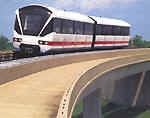
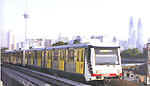
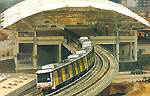
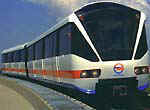
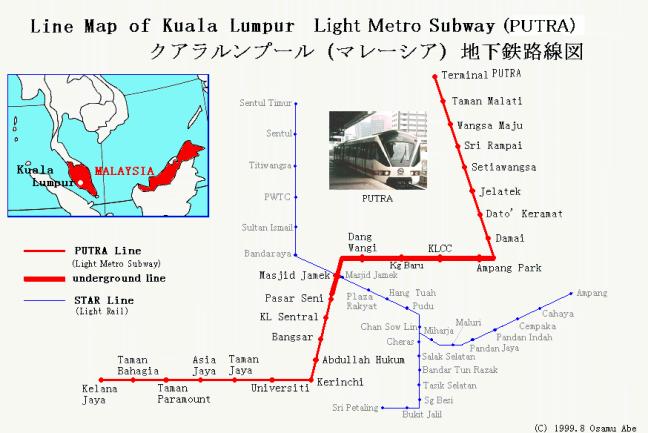
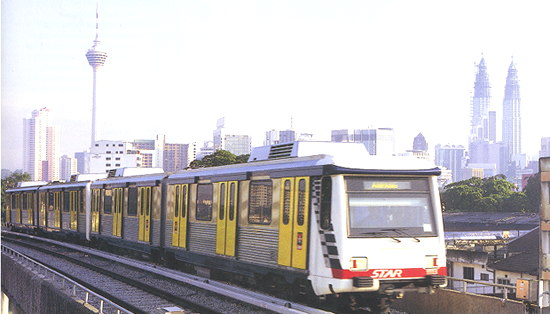
The Malaysian capital of Kuala Lumpur, one of the fastest-growing cities in the world, is being provided with a state-of-the-art metro system. Severe financial problems forced a Government takeover in June 2001. The system is popular and well-used, as the city's roads are hopelessly gridlocked. Linking the city's People's Park and Gombak, the fast, efficient east-west route was completed during 1999. The system, which is 29km long, is the longest fully-automated driverless metro system in the world. THE PROJECT The system was developed by Projek Usahasama Transit Ringan Automatik (PUTRA), a wholly-owned subsidiary of Renong, a 100% Malaysian-owned company with a track record in engineering, project management and construction of highways, power facilities and infrastructure works. The Malaysian Government has arranged a Malaysian $5.5 billion bonds issue to buy PUTRA’s assets, and also those of the associated two-line metro company Sistem Transit Aliran Ringan (STAR). The funds raised will settle the debts and convert Government loans into equity. The assets are then being leased back to the companies. Line one of the PUTRA light rail network runs 12km from Sultan Ismail, on the northern edge of the old city, to the eastern suburb of Ampang, and has 13 stations. ROLLING STOCK Each of the 70 air-conditioned vehicles is powered by two linear induction electric motors, which claim to keep noise levels at a minimum. The design and construction contract was let to Bombardier of North America. They operate in 35 two-car sets initially, but if demand warrants, can be expanded to three- or four-vehicle formations. Each two-car unit seats 64 passengers, with space for another 350 standing at peak times. Bombardier worked in conjunction with Vancouver SkyTrain transit system operator BC Transit to supply electrical and mechanical equipment. Power is provided through 14 substations to convert electricity to the 750v dc operating system. In addition to their driverless automatic train control, each train is also equipped with a steerable suspension for improved ride quality. INFRASTRUCTURE The PUTRA-LRT network has 24 stations along its 20-mile length, and was constructed in two sections: Lembah Subang to Pasar Seni, and Pasar Seni to Ampang Park and Gombak. The first phase is on elevated single-track bridge sections, which are also used for 8km of the 14.9km of the second phase, avoiding conflict with existing roads. The focal point of the system is People's Park, in the west of Kuala Lumpur and journey times to each end of the route are 45 minutes to Gombak and 21 minutes to Pasar Seni. The vast majority of the system is above ground, with 4.4km in tunnel. Five stations are underground, and four stations are designed for park-and-ride expansion. The average train is 40km/h (25mph), with an ultimate capacity of 30,000 passengers per hour in each direction. The system will operate for 18 hours a day, and service frequencies vary between five and ten minutes off-peak. Tighter headways in peak periods permit frequencies of one minute. Safety is also stressed in the design of the stations, with all platform edges being protected by a barrier, with an intrusion detection system incorporated to prevent passengers getting too close to the moving trains or tracks. Every platform has emergency buttons and two-way passenger assistance telephones linked to the central control room, which will also monitor fixed CCTV cameras located throughout the system. To ease monitoring, stations are constructed to a standard design, each with the same 68-metre platform length. Gradients along the network are slight, with a maximum of 5% (1-in-20). This enables an initial average speed of 38km/h (23.6mph). Links with other transport systems are an important part of the network. Each station has bus stops, and interchanges with existing rail lines at Brickfields (KTM line), Jalan Tun Perak (STAR line), and to the route from the city centre to Kuala Lumpur Airport. SIGNALLING/COMMUNICATIONS The network boasts fully automated signalling. Two-way communications on board trains allow passengers to speak to the central control room at any time. Fare-collection is fully automatic, while the busiest stations are designed to a standard formula to include ramps and elevators, specially textured floor surfaces, pre-recorded station announcements, and reserved seats for the elderly and wheelchair-bound. Information systems on board each vehicle allow each station on the system to be illuminated on a map display as the train approaches it. Despite the high level of automation, the metro still offer substantial employment opportunities in Kuala Lumpur and its environs, with up to 160 operations and 220 maintenance staff employed. THE FUTURE The Government takeover is allowing the city’s public transport to be restructured. A merger of six competing bus services is being considered, as well as an integrated ticketing system covering the city and surrounding areas. Both PUTRA and STAR have seen their existing concessions and franchises agreements cancelled, and fresh licences with new conditions issued. |
|
|
|
|
|
|
||||
|
|
||||
|
|
||||
|
|
||||
|
|
||||
|
|
||||
|
|
||||
|
|
||||
|
|
||||
|
|