 |
|
|
 |
|
|
|
Owner’s comments and tips
Trailer Information
Rig Information
Racing and Cruising
Split Hull
General info
Stepping the Mast
Nav Lights
Dagger Board
Port Replacement
Keeping the Rudder Down
|
|
|
|
|
|
|
Trailer information
The trailer is simple. It's a single axle 2000# capacity trailer with about a 16 foot long marine plywood (carpet covered) skid about 3 feet wide with a foil cut out about 2/3 's of the way forward for the dagger board to go down into and supported at the front and rear.
|
|
|
|
|
|
|
|
|
Rig Information
The original position for the spinnaker halyard is just below the forestay. Originally there was a stainless (Ronstan) double exit block inserted into a square cutout just an inch or so below the forestay. One halyard was for the jib and one was for the spinnaker. The problem with this was whenever you jibe the halyard attached to the spinnaker would chafe across the top of the forestay. I had a tuff luff and after a couple of years of this just burned that plastic down to the forestay. If you’re just going to day sail I would leave it like it is. If you're going to race use those 2 existing halyards that are running thru that exit block just below the forestay only for the jib and put in a separate halyard specifically for the spinnaker.
Approximately 18 inches above the forestay put in a Harken exit block. About 1 ½ inches above the forestay tap in a Harken bullseye with the stainless ring insert. About 6 feet above the deck on the starboard side of the mast dremmel out an opening, if there is not one already, about an inch high by ½ wide and cover it with a stainless Schaefer exit block plate. Three inches below the exit plate tap a Harken #150 cam cleat. Run the internal halyard up the mast and out the new exit plate above the forestay..down thru the bullseye and there you have a designated spinnaker halyard with 2 jib halyards in case you need a spare spinnaker halyard or need to peel down to a smaller jib. And when you get to be a real fanatic and become tired of going slow in the light stuff with that small stock spinnaker up, save up for an over sized spinnaker and a penalty pole. Put a bail on the very top of the mast with a swivel block and you'll really notice the speed increase. Make sure to get it down when the wind picks up!
Didn’t mean to get long winded here.....It's just my favorite boat. The only thing I didn’t like about the boat was really pounding into the chop, 45 footers, which is large for around here. The dagger board would "float" and bang around in the dagger board trunk. To minimize that you need to make a 4 foot or so "wedge" of delrin or starboard. About an inch thick by the width of the dagger board trunk. Cut a "long" wedge into the end and jam it in between the front edge of the dagger board top and the trunk. That will quiet things down and stop the banging. Until the next question
John
|
|
|
|
|
|
|
|
|
Racing and Cruising
I've owned two of them and raced them extensively. Here's what I like.
Good performance with most of the "gofast" stuff and strings to pull, so it's fun. The retractable ballasted dagger board retracts flush with the bottom so it loads on the trailer like a power boat. I used to dry sail mine and I could be loaded on the trailer, parked in the club parking area, and in the yacht club bar hoisting a cool one quicker than the average guy could tie up in a slip.
Two people can raise and lower the mast and be road ready in about 45 minutes, so for out of town races, we usually towed the boat. A 2 or 4 hp outboard is plenty big. We used the 2 hp for racing and the 4 hp for cruising. Locally, we were, until recently, allowed to demount and store the outboard below or sail without any outboard at all. Check your local PHRF rules.
Since it's a fractional rig, the chute is small and easy for a husband and wife team to handle. It races best with 3 large or 4 medium folks onboard, but only the skipper and foredeck need be experienced. Stupid rail meat will do for the rest of the crew. This fact alone makes racing much easier (and cheaper) than the average club PHRF boat.
We also did some "cruising", which was limited to one or two overnights. The ability to get into really shallow water was great because of the lifting daggerboard and rudder. The bunks are very large for a small boat. However, I'd consider it a two person (adult) boat, even though it sleeps 4.
On the other hand, it would work fine for 2 adults and 2 kids if you happen to have that sort of family.
The boat surfs earlier than most, so we have had several fleet overall wins in typical PHRF fleets under downwind conditions with short steep waves like you find in a shallow bay. I remember one Dauphin Island return race to Fairhope Alabama when my wife and I double handed our boat on a long downwind dash in moderate conditions and waxed something like 115 boats, all larger than we were. Our fleet overall win really made the high dollar guys choke, many of which had more invested in their Nav gear than I had in my whole boat.
OTOH, the boat is usually the smallest in the fleet, so beating into the same waves will kill you. In other words, sometimes the boat sails better than her rating and sometimes not. Flat water and very light conditions will find you up with the 40 footers if you have very good sails, especially beating. You can sail higher and faster than most if it's very light. But 18 knots of wind and a nasty chop will put you way at the back. In 25 knots you may be able to keep up by flying your small chute when the typical club racer chickens out and goes main and jib, especially if there isn't too much beating. Those are the facts of life with a boat that is simply physically smaller than the rest of the fleet.
We've also done some near coastal racing in pretty wild and wooly conditions where half the fleet drops out and some boats are demasted, but this was with my first boat when I was quite a bit younger. It is not really a great off shore boat when the weather is really nasty. She's simply not very big.
All in all, I'd much rather have a Lindenberg 22 than something like a Catalina 22, especially for racing. It's really a fun boat. I sold mine 2 years ago and I miss her.
Bob
|
|
|
|
|
|
|
|
|
Split Hull
Several of the earlier ones had slight desalination problems. One split at the hull in it's first race from Port Canaveral to Ft. Pierce. They did win the class, but had to beach it afterwards to keep it from sinking. After the forth or fifth one, Paul got the act together and can't remember any problems after that.
Bob
|
|
|
|
|
|
|
|
|
General info.
Set up the trailer to carry the boat as low as possible. I liked my first trailer best. It had those small diameter wheels with big fat tires and it was lower than my second trailer, which was fitted with car sized tires.
Both of them simply had a carpet covered 3/4 " plywood single "bunk" running from a couple of feet aft of the bow to the aft end of the trailer. This was carefully fitted to match the rocker in the bottom of the hull, which is considerable. Remember the hull is flat on the bottom and rides nicely on this single board which is about 2 feet wide or so. It is fastened down to a cross member roughly in the middle and the two ends are blocked up with a 2x4 (approximately) cross wise block at each end. It seems like there was an additional intermediate block or two, but I don't remember for sure.
No need for a roller under the bow. Just a normal plastic "V" chock for the cutwater mounted just under the winch. If I was going long distances, I used a tie down strap at the bow, and another at the stern. I also had long "guide on" pipes at the very aft end of the trailer to keep the stern aligned during launch. These were simply schedule 40 aluminum bent to 90 degrees and clamped to the aft cross bar of the trailer using ordinary "U" bolts. They could be slid inboard and outboard to match the max beam of the hull. The upper arms were covered with glued on carpet or you can slid a piece of PVC pipe over the aluminum so as not to scratch the topsides.
Oh yeah. Once the boat is onboard, mark and cut a slot in the bottom bunk plywood to match the dagger board so you can lower the board down through the slot enough to "lock" the boat in place. It gives piece of mind when trailering the boat and comes in handy if you have to work on the board.
When going long distances I always used a safety strap around the whole boat and trailer under the board so that if the winch cable broke, the board wouldn't hit the highway and grind away as I was tooling along at 70 mph.
If your speedo paddle is in the normal place, you must remove it before loading or it will be crushed. Carry a spare paddle wheel or two. Ask me how I know.
Anyway, your plan sounds much more complex and difficult to fit up than a simple flat plywood board blocked up at the ends. I'd say make the board first, fasten it amidships and block each end up about 4 inches or so, and then load the boat. Once it's on the trailer, you should be able to add temporary wedges to steady the boat till you get it home, and then adjust the end blocking and intermediate blocking so that the curve of the plywood matches the hull perfectly. Does that make sense?
The stock winch set up is a worm drive winch drum mounted on the aft starboard corner of the house with a cable leading forward to a turning block on the top of the house mounded abeam of the middle of the lifting dagger board. From there it turns 90 degrees and goes inboard to a fitting spanning the dagger board trunk containing another turning block. The cable runs down the dagger board trunk in the slot cut in the dagger board, around a block fastened to the dagger board, and then turns 180 degrees and goes up to dead end on that fitting which spans the dagger board trunk. That rigging gives a 2 to 1 purchase plus what ever you get from the worm drive winch.
The hatch slides forward so that when it's wide open it covers the aft end of the dagger board trunk, so that it can only go full open when the dagger board is lowered enough so that the top of the board is lower than the house. When the board is lifted above that, it slightly restricts the opening of the hatch, but the winch itself has nothing to do with this on the stock boat.
I saw one L22 with a stern pulpit designed to meet a local racing safety rule, but I would only fit one if absolutely required by a rule. As a practical matter, the back stay is all you need as a grab rail to safely negotiate the stern area. No one ever fell off by boat via the open stern. For sure, sail the boat without it first and then evaluate any need for a pulpit. I have no idea where to get one.
I hope this helps. Good luck.
Bob
|
|
|
|
|
|
|
|
|
Stepping the Mast
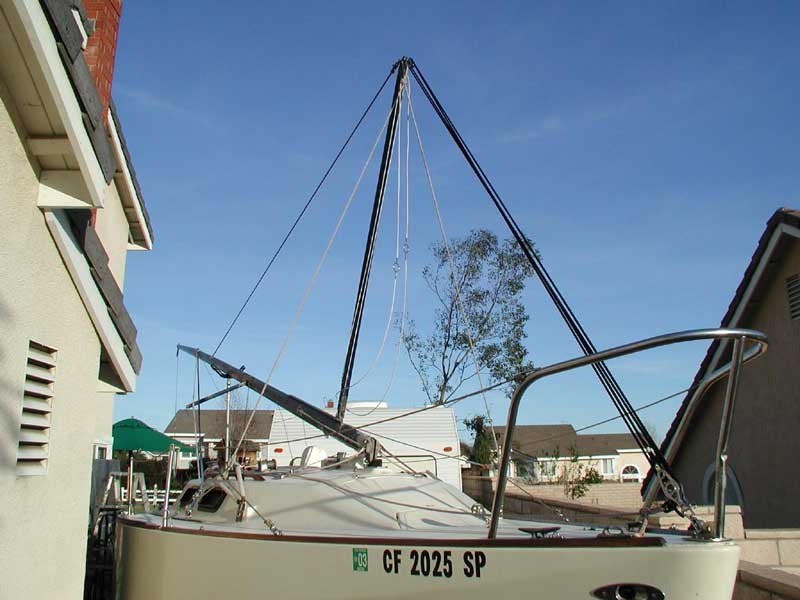
Below is a photo of how I step my mast. The important first step is to make a harness that will allow the halyards, spinnaker pole guys to be even with the bolt on the mast step. This keeps the mast and spinnaker pole from swaying from side to side. This harness has clips to connect it to the toe rail and a loop to connect it to the spinnaker pole. I picked up two stainless steel rings to connect the halyards to. The topping lift is connected to the spinnaker pole which is then connected to the bow of the boat using my boom vang. The vang is run back to my winch so I can easily crank up the mast. At the rear of the boat you can see my mast crutch. It is made from a piece of tubing from Home Depot used as the top pole on a chain link fence. One end is tapered so the pole can be stored as two separate pieces. The pole sits on the ground and is held in place by the rudder bracket. I have a section of water pipe insulation around the pipe so protect the rudder bracket. A nylon strap around the pipe and rudder bracket holds it firmly in place. The “Y” to support the mast is made from 45 degree and Tee pipe fittings. They are also covered with the insulation material to protect the mast.
Tom #44
(Click on the image for a larger view)
|
|
|
 |
|
|
|
|
|
|
|
|
Stepping the Mast
Rig a snatch block to one of the jib tack points. Raise one jib halyard a little bit so that the shackle end is a couple of feet above the deck. Cleat the other end and then tie it to some place on the mast for safety. Tie a bowline in a line and fasten it to the jib halyard, go through the snatch block, and aft to the cabin top winch. East the back stay all the way. Take tension on the winch to put slack in the forestay. Pull the forestay pin. Close the hatch, put a cushion on the aft edge of the hatch.
Put the big guy on the cabin top and have the little guy (wife) ease the winch. Oh yeah, make sure the bow is tied down to the trailer and the dagger board is lowered so that it's flush with the cabin top. I remember now why it's important to have a hole in the trailer bed under the dagger board.
As the mast comes aft, walk aft and coordinate with the winch person. Have them stop easing as you step from the cabin top to the cockpit seats. This can be tricky, but it's easier if the winch person takes the load. Beyond this point, the angle is too steep for the winch to stop the mast from continuing so get a good position in the cockpit standing on the seats before they ease further.
Lower the mast and rest it on the cushion. Ease the winch all the way and have your helper assist while you pull the mast step bolt. It helps if they raise the upper part of the mast a bit so that the bolt will come out easier. The mast will just about balance on the aft edge of the hatch.
Walk the mast forward, being careful not to kink the rigging. Rest the mast on a special block you've made to fit the bow pulpit and on the cabin top with a cushion or better, a special fixture you've made that fits in the cockpit and supports the mast clear of the cabin. Use 2x4 lumber and rig these fixtures so you can lash them securely in position. Make sure the aft fixture is just as wide as the cockpit so it can't shift and provide it with fore and aft "feet" long enough so that it can't tilt forward when you slam on the brakes. The mast should be off center left or right just enough so that you can raise the dagger board without hitting the mast. Don't forget to raise it!!!
Clean up the rigging and bungee everything in place. Toss the rudder in the cabin along with the outboard. You're good to go.
Raising the mast is the reverse. Be careful to insure that the backstay doesn't foul on the motor mount just as you muscle the mast to 45 degrees. It really hurts your back to start over 2 or 3 times.<g> Past 45 degrees the winch person can take over, but I generally push the mast rapidly up and use the winch person just for a safety. If you have a 3rd person, have them tend the backstay so that it doesn't foul.
Take tension on the winch to hold the mast forward while you rig the forestay and insert the pin. That's it. Good luck.
Bob
|
|
|
|
|
|
|
|
|
Nav Lights
Ad far as I know, the lights on your boat are stock. I don't have either of my old boats at hand, so I can't check brands, but they look the same.
Unfortunately, they don't meet the Offshore regulations anymore, which say that lights must be above the deck level. These lights were crap when they were brand new, and worse when they get old.
I'd get a combination bow light from Hella (1 st choice) or Aquasignal (2nd choice) and mount it on the bow pulpit.
On the other hand, if you don't sail under the Offshore regulations and you've found replacements, perhaps that's a better and cheaper solution. At least they don't foul any lines.
Bob
|
|
|
|
|
|
|
|
|
Dagger Board
I know of two Lindenberg 22s that have flipped and lost their board. So if you want to keep yours, take your sails down during threatening weather. However, if you are racing the boat and this is not an option you need to somehow pin the board down or use something like a big screwdriver and wedge it along side the board. And keep your hatch boards in!
I did have the boat go over once before during racing. The main sheet was jammed and the boat laid on its side. I swam over to the board and stood on it and the boat came up and the mainsheet freed itself.
I still want to fix up my boat again even after my two experiences.
Kurt
|
|
|
|
|
|
|
|
|
Port Replacement
Replacement ports and screens can still be purchased from Beckson.com
Port (lens) LNZ-414SD $32.50/ea.
screen SCR-414 $11.00/ea.
Gasket only GK-414 $6.00/ea.
|
|
|
|
|
|
|
|
|
Keeping the Rudder Down
Here is how I resolved that problem.
1. I mounted a four screw pad eye on the top of the
rudder.
2. I then mounted a two screw pad eye on the starboard
side of the aluminum housing near the top of the
housing.
3. I then mounted a small harken cleat (with fairlead)
on the port side of the aluminum housing near the
top of the housing.
4. I tied a short piece of rope (1/4 inch) about 5
feet long to the starboard pad eye.
5. I led the rope through the pad eye on the top of
the rudder and then down through the harken cleat.
6. I then tied several knots in the end of the rope
after it has been passed through the cleat.
7. When I am sailing and I want the rudder in the down
position, I simply pull the rope through the cleat
and presto, it is down and snugged in place by the
rope.
8. When I want to raise the rudder, I simply release
the rope in the cleat, and Presto, the rudder will
surface on its' own.
10. This gives you the option of setting the height of
the rudder to your choice.
11. Make sure that you line up the pad eyes with the
cleat so that you are fair lead.
12. Make sure that the rope is long enough so that you
still have some slack when the rudder is raised.
About the only bother with this system is that when I remove the rudder, I need to untie
the knots that are in the end of the rope that has been passed through the cleat. That
is a small inconvenience for solving the major problem of how to get the rudder up and
down while sailing.
Jim Keeley
Blow Up Doll
Hull #1
|
|
|
|


