| HOLGUIN Rafael Freyre There is only one real reason for the steam enthusiast to consider heading for Holguin - the wonderful narrow gauge system at Rafael Freyre. Situated some 200 miles to the east of the main steam activity around Ciego De Avila this line is without parallel in Cuba, offering spectacular scenery, an extensive system including a number of branch lines and a wonderful collection of 2'6" Baldwins. However, to the surprise and dismay of many, the whole system was closed during the 2001 season and although it was open again in 2002 it was certainly not functioning at previous levels. The future is uncertain - many branches may not see steam again and the introduction of a 'tourist train' may signal the beginnings of the end for this fantastic railway. Even if the railway remains open, the increasing use of diesels may serve to blight future visits. Four diesels are in regular service, although supplies of fuel oil are reported to be erratic. However when it does all come together it is undoubtedly worth the time and effort to reach Rafael Freyre. There can be few shots in Cuba to compare with the 'Five Hills' shot at Barjay or the sight and sound of the locomotives as they attempt to lift heavy trains up the steep gradients which are a feature of the line. |
 |
 |
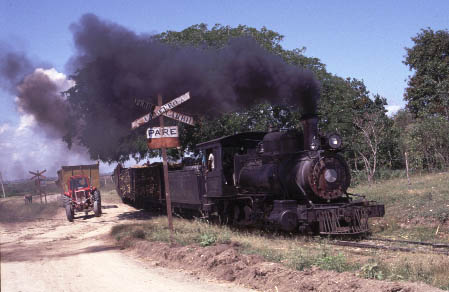 |
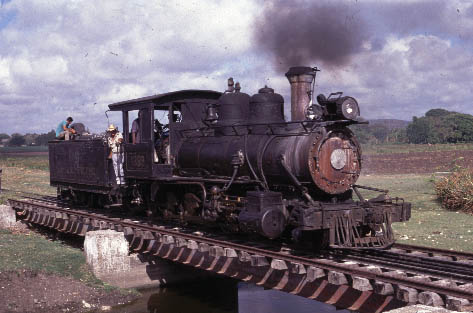
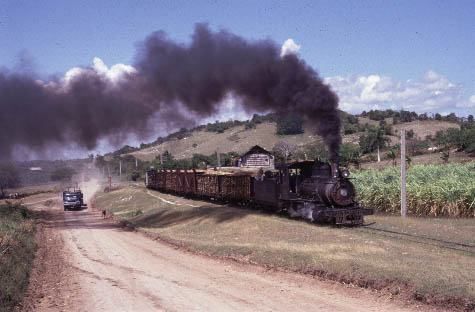
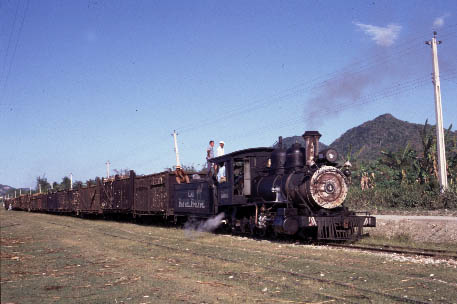
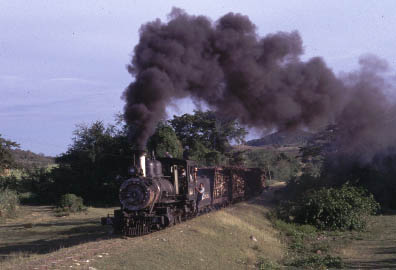
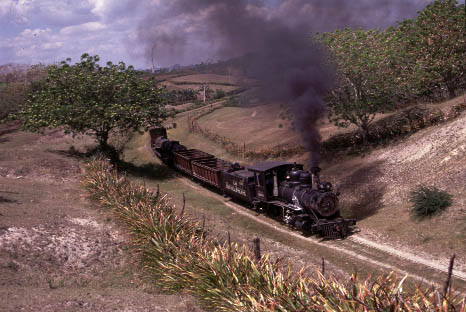
| 'Find a train and stick with it' has always been the advice given by our guides in Cuba and it is certainly a wise policy. As with any industrial system the trains do not operate to a strict timetable (although distinct patterns of working are discernable) and fruitless hours can be spent chasing distant smoke which never seems to get any closer! Most trains actually travel quite slowly, with stops at loading points en route, making car-based chasing a real possibility. However upsetting the locals by racing through villages is not advised and is very dangerous. Those who are foolish enough to do so have returned to their car to find all the tyres let down! Baldwin 2-8-0 No.1389 at work on the western branch from Purial (top, upper and lower left) |
 |
 |
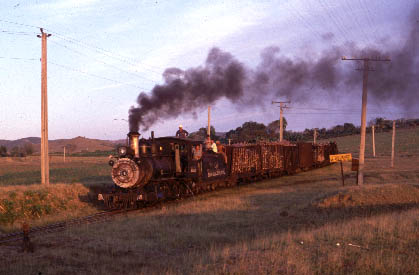 |
| The line to the east is far longer than the line to the west and has a number of branches. This makes finding trains even more difficult as a train which appears to be on its way to the mill may then head off up a branch to collect more loaded wagons. This was the case with this train, hauled by Baldwin No.1386 which set off from Princesa loading point and then stopped in La Vega (above). Here the locomotive was detached and it then went down the Hondura branch, returning some time later with four more wagons (upper right) The train was then remarshalled and eventually arrived at the Luciano loading point just before sunset (lower right). Final arrival back at the mill would have occured long after dark depriving us of the opportunity to take the 'Five Hills' shot at Barjay |
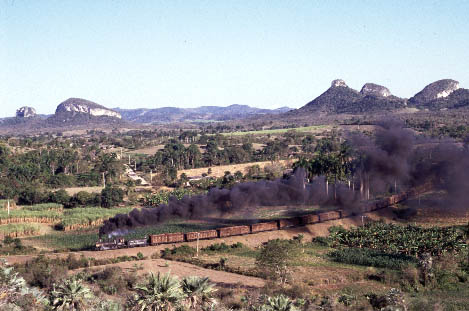 |
| This is the shot that most visitors to Rafael Freyre aim to take. Near to the village of Barjay the line sweeps round a long uphill curve. During the late afternoon the sun shines across the valley illuminating the line and lighting up the five limestone outcrops on the skyline, providing a wonderful backdrop to the main action. On 29th March 1987, Baldwin 2-8-0 No.1390 makes its way back townards the mill with a long train of loaded cane wagons. |
 |
 |
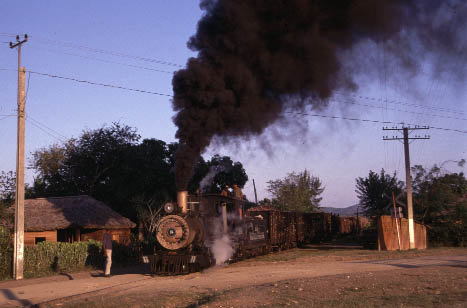 |
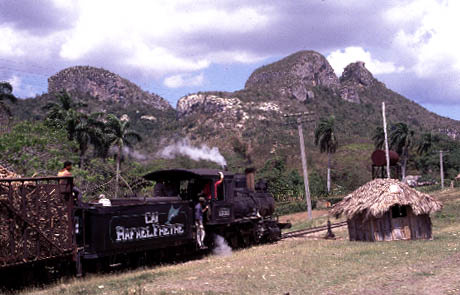
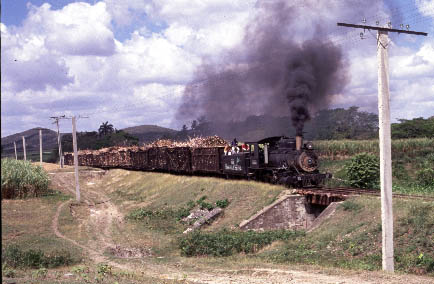
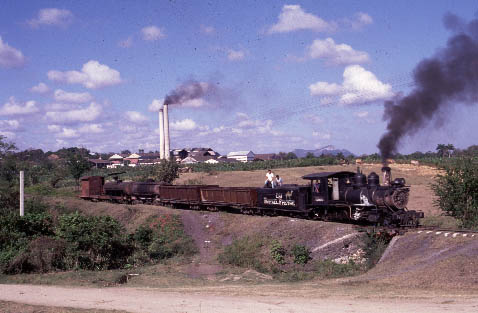
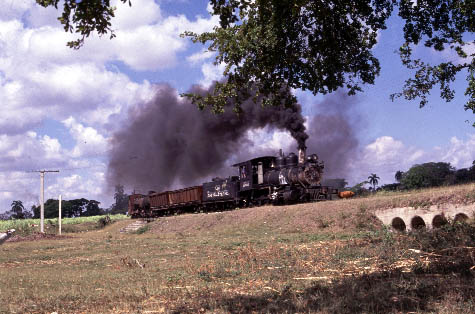
| The limestone outcrops visible in the 'Five Hills' shot are again a feature of this photograph of No.1390 as it works a train along the Luciano branch (upper left) No.1390 is slowly putting together an ever increasing load as it is seen here on the Teche branch (above) The last rays of the evening sun light up No.1390 as it makes its way across the road in the village of Barjay. The tin shed on the right hand side of the picture bears a freshly painted slogan 'Viva Fidel' suggesting that the popularity of the revolutionary leader and a continuing belief in the Socialist ideal is still strong in this largely rural area of Cuba. (lower left) |
 |
 |
 |
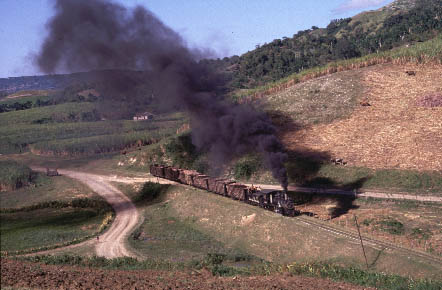
| Little or no traffic uses the branch line to Peurto Vita and so to get any photographs on this section it has always been necessary to arrange for a special train. However plans are nowunderway to make this a passenger carying tourist line and so regular traffic may soon return to this delightful byway. The mill chimneys at Rafael Freyre can be clearly seen as No.1386 sets off along the port branch (above) Runpasts are possible with the special train and smoke is available by request (upper right) Journeys end is normally before reaching Puerto Vita and the train is then propelled back to the mill (lower right) |
 |
 |
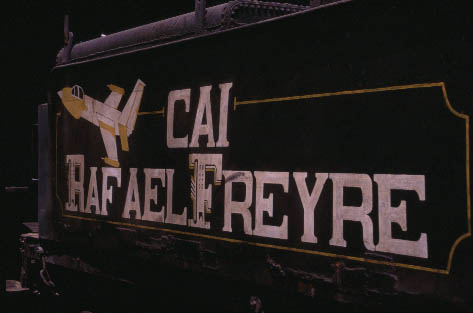 |
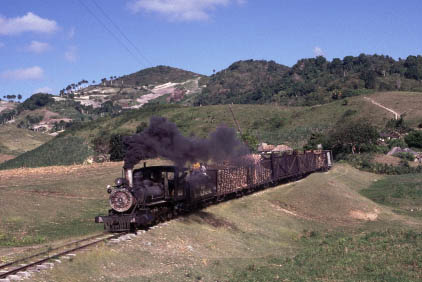
| The furthest point on the eastern line is the remote loading point at Latour. Here most of the cane is hand cut due to the terrain and only a few wagon loads a day are moved. No.1386 is again the train engine as it departs through the spectacular landscape at Latour (upper left) No.1386 continues to make its way through the delightful countryside as it passes through Uvilla (above) Identification of individual locomotives, often seen from a distance, is aided by the painting of 'logos' on the sides of the tenders. No.1390 sports a marlin, No.1386 has a camel, No. 1388 has a rabbit and No. 1391 has this artists impression of MIG fighter! (lower left) |