| HAVANA REGION Amistad con los Pueblos, Gregorio Arlee Manalich, Ruben Martinez Villena and Boris Santa Luis Coloma Most enthusiasts arrived in Havana, and the region to the south-east of the capital provided an excellent introduction to the island's steam treasures. As with many Cuban sugar mills the amount of activity varied from season to season and in some years mills were closed and cane was worked to other mills via the FCC or even by road. Amistad con los Pueblos was one mill which rarely, if ever, seemed to be open. However cane is grown in the fields surrounding the mill and then taken to Hector Molina for processing. This meant that steam was still to be found in the shed area of the mill and inter-mill workings could provide considerable interest. Gregorio Arlee Manalich was of particular interest since this mill is served by lines of different gauges. The mill had a fleet of standard gauge locomotives and also a number of 2'6" gauge locomotives. Over the years the ubiquitous supplies of black paint, the traditional livery of MINAZ locomotives, was supplimented by a range of more interesting colours and mills were encouraged to take a greater pride in their locomotives. Thus in 1998 the locomotives there were in a fetching shade of brown and more recently they have appeared in a light blue livery. Gregorio Arlee Manalich was one of the last mills to retain working steam and it is not beyond the realms of possibility that it may continue to use them occasionally but this should certainly not be depended upon. |
 |
 |
 |
 |
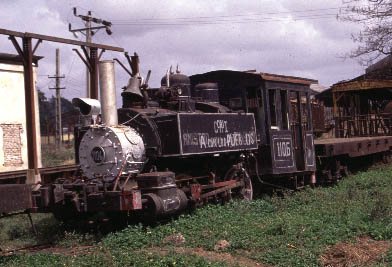
| In complete contrast, Baldwin 0-6-0ST No.1106 stands out of use in the shed yard at Amistad Con Los Pueblos. |
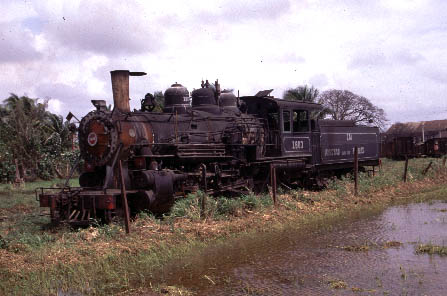
| Our arrival in Cuba in 1997 was proceeded by a period of heavy rainfall and much of the cane cutting had come to a standstill. Baldwin 2-8-0 No.1803 was found standing in light steam besides a flooded field at Amistad |
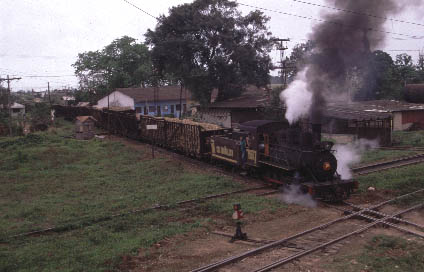
| Baldwin No.1306 brings a loaded cane train over the flat crossing at Gregorio Arlee Manalich. Both of my visits to this mill were blighted by unusually poor weather and photographs are less than pleasing. |
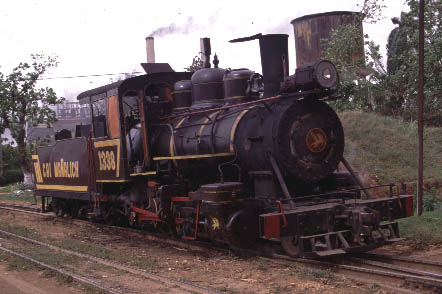
| Baldwin No.1338 looked particularly attractive in its brown livery with 'flying horse' motif on the smokebox and only a lack of sunshine was able to spoil the shot. |
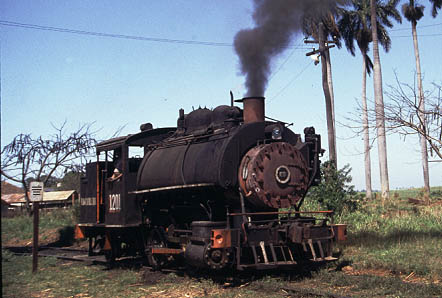
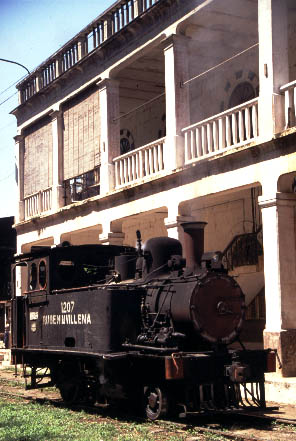
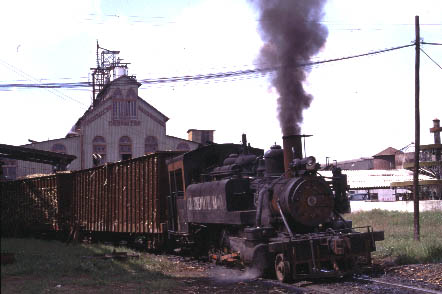
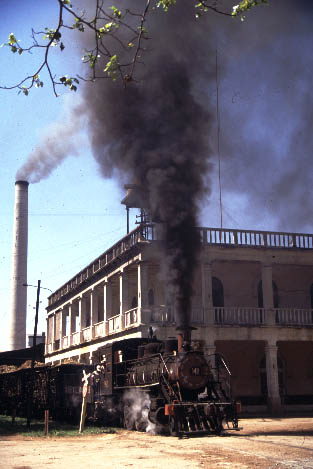
| In architectural terms at least, Ruben Martinez Villena was one of the most attractive mills in Cuba. Its main building betrayed a heavy colonial influence and provided a wonderful backdrop for the amazing fleet of engines to be found there. These included Cuba's oldest working locomotive, a Baldwin 0-4-2 built in 1878 which is steamed on high days and holidays (usually in return for a fistful of dollars!) together with several other small tank locomotives such as Vulcan 0-4-ST No.1201, Henschel 2-4-0T No.1207 and Baldwin 2-6-2T No.1311. A number of larger 2-8-0 engines were also employed to undertake the more arduous field workings. |
 |
 |
 |
 |
| RUBEN MARTINEZ VILLENA |
| Vulcan 0-4-2ST No.1201 makes a rare appearance in steam during a visit in March 1996 (upper left) Henschel 2-4-0T No.1207 stands alongside the beautiful colonial administration building (lower left) Baldwin 2-6-0 No.1411 storms past the administrative building with a loaded train (upper right) Baldwin 2-6-2T No.1311 struggles as it tries to shunt a raft of loaded wagons into the mill (lower right) |
| Boris Luis Santa Coloma or 'The Mill On The Hill' was one of Cubas most active mills with spectacular climbs up to the mill from both the north and the south. However the amount of steam activity there dramatically declined with the introduction of diesels and the general decline in the overall Cuban sugar harvest. A 1998 visit to Boris found yet another variation in the Minaz livery story with all locomotives running in grey undercoat, with attractive red lettering, following a failure in supplies of black paint! It was during this visit that we visited a rum stall by the side of the road and saw a picture of two QJ's storming out of Tunnel No.3 on the recently discovered Jingpeng line in China. As the afternoon wore on plans were formulated for a trip which would provide a total contrast to the warmth of Cuba! |
 |
 |
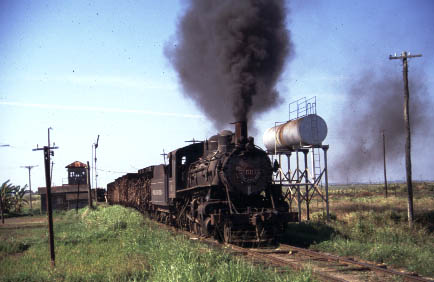
| ALCO 2-8-0 No.1711 passing the level crossing prior to the climb up to Boris from the north. This was one of the very few sugar lines in Cuba that had semaphore signals |
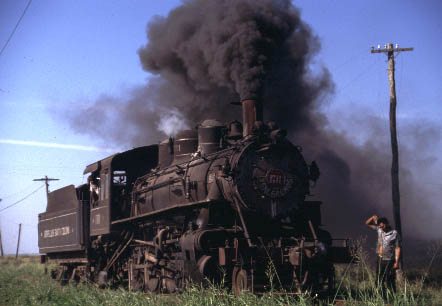
| The same locomotive 'brews up' after a water top - most Cuban locomotives are oil burners and could be relied upon to produce volcanic exhaust even on the hottest of days |
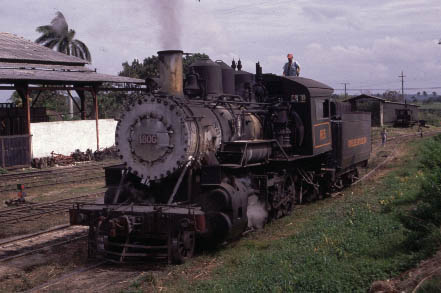 |
| Vulcan 2-8-0 No.1806 in the main yard with the engine shed in the background |
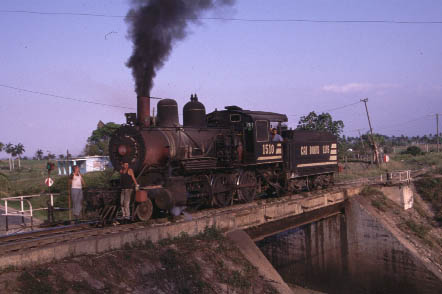 |
| ALCO 2-6-0 No.1510 stands on the road bridge about to enter the main shunting yard |
 |
 |
 |
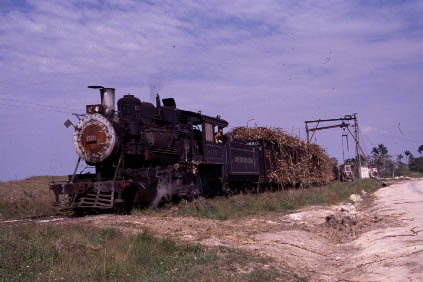
| Baldwin 2-8-0 No.1710 on a train at the one of the loading points to the south of the mill |
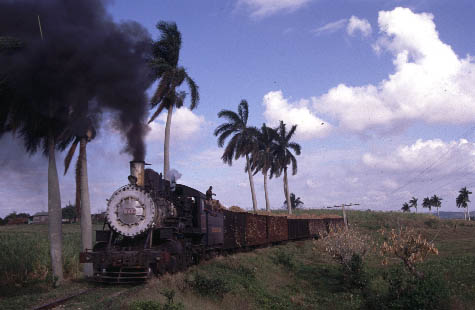
| Vulcan No.1806 storms up the final gradient to the mill as it approaches from the south |
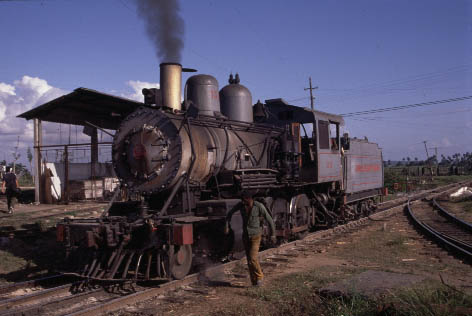
| The Great Cuban Paint Shortage - No.1510 wears grey undercoat with red lettering in March 1998 |
| MORE CUBAN STEAM PHOTOGRAPHS West of Havana Matanzas Villa Clara Cienfuegos Ciega de Avila Sancti Spiritus Holguin |