|
|
 Life in the West Bank
Olive pickin' and a grinnin'
by Jonathan Smith
October 24, 2002
|
Click on any picture to see an enlarged view. It may take
a minute for the pictures to load depending on the speed of your connection. |
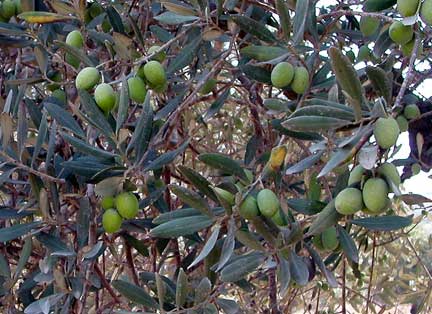 October and November make up the olive picking season in northern Palestine.
Olives are the trademark of Palestine, and the oil they produce is a great
source of income for the land’s inhabitants. Since you can’t look anywhere
around here without seeing an olive tree, there’s plenty of work for everyone
to collect all those olives. Many families own a small grove of their
own, and spend the weekends in this time collecting olives to make their
own fresh oil. Larger groves are usually farmed by laborers who pay
the owners a commission to collect olives on their land. In the past
few weeks I have been invited to pick olives on at least five separate occasions.
A couple of those invitations were just the tourist type of visit in order
to have the experience for a few minutes. On this sunny October day
I did the real thing – joining a group of students at the
university
to help out some of the local residents in their olive picking.
The location
October and November make up the olive picking season in northern Palestine.
Olives are the trademark of Palestine, and the oil they produce is a great
source of income for the land’s inhabitants. Since you can’t look anywhere
around here without seeing an olive tree, there’s plenty of work for everyone
to collect all those olives. Many families own a small grove of their
own, and spend the weekends in this time collecting olives to make their
own fresh oil. Larger groves are usually farmed by laborers who pay
the owners a commission to collect olives on their land. In the past
few weeks I have been invited to pick olives on at least five separate occasions.
A couple of those invitations were just the tourist type of visit in order
to have the experience for a few minutes. On this sunny October day
I did the real thing – joining a group of students at the
university
to help out some of the local residents in their olive picking.
The location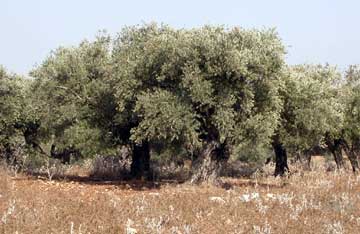 was an ancient olive grove (some claimed that the trees were planted
during Roman times, but I’m a bit skeptical – anyway, they were old) outside
Mesilyah, a small village only 4 miles to the southeast from the university
(for a map of the northern West Bank, click here
). I have seen a lot of olive trees, but rarely so huge. My
first thought was, “I hope we’re not expected to finish off all of these
trees.” We didn’t even come close to accomplishing that task, but we
did manage to pick some olives and have a good time in the process.
was an ancient olive grove (some claimed that the trees were planted
during Roman times, but I’m a bit skeptical – anyway, they were old) outside
Mesilyah, a small village only 4 miles to the southeast from the university
(for a map of the northern West Bank, click here
). I have seen a lot of olive trees, but rarely so huge. My
first thought was, “I hope we’re not expected to finish off all of these
trees.” We didn’t even come close to accomplishing that task, but we
did manage to pick some olives and have a good time in the process. 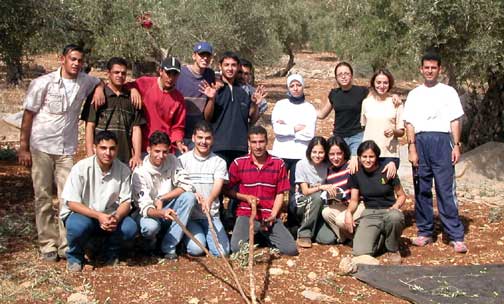 Our group of about 20 students initially attacked
the trees with gusto. We put out large tarps around the trees, picked
up long sticks, and started banging away. Every hit was rewarded with
a shower of olives raining down from above. But the most fun was being
in the treetop crew, who got to climb up the tree (which isn’t too difficult
because the branches on olive trees begin close to the gro
Our group of about 20 students initially attacked
the trees with gusto. We put out large tarps around the trees, picked
up long sticks, and started banging away. Every hit was rewarded with
a shower of olives raining down from above. But the most fun was being
in the treetop crew, who got to climb up the tree (which isn’t too difficult
because the branches on olive trees begin close to the gro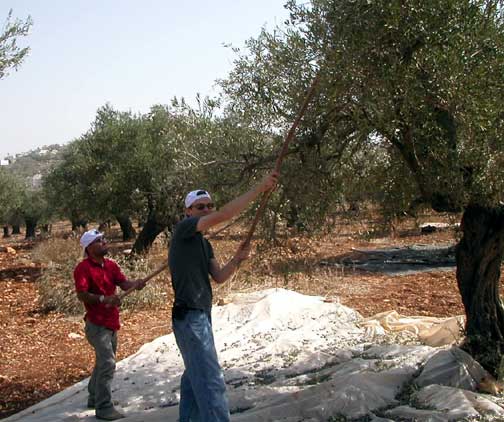 und), find an isolated extremity, and attack it with
a shorter stick. Actually I was quite surprised to
see everyone using sticks because I had been brought
into an earlier controversy about the best method
for picking olives. Many students had informed me that it was preferable
to pick the olives by hand, because it was less damaging to the tree.
But hands were definitely not the tool of choice in this operation.
The size of the trees made sticks a more practical way for reaching all
und), find an isolated extremity, and attack it with
a shorter stick. Actually I was quite surprised to
see everyone using sticks because I had been brought
into an earlier controversy about the best method
for picking olives. Many students had informed me that it was preferable
to pick the olives by hand, because it was less damaging to the tree.
But hands were definitely not the tool of choice in this operation.
The size of the trees made sticks a more practical way for reaching all
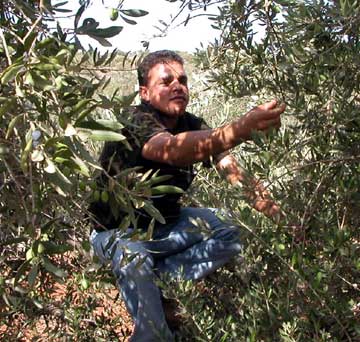 of the olives, and besides, it was more fun that way. After a couple
of hours of this work in the hot sun, some started to lose the will to continue.
Let’s face it, after the initial newness wears off, olive picking becomes
just like any other type of manual labor.
of the olives, and besides, it was more fun that way. After a couple
of hours of this work in the hot sun, some started to lose the will to continue.
Let’s face it, after the initial newness wears off, olive picking becomes
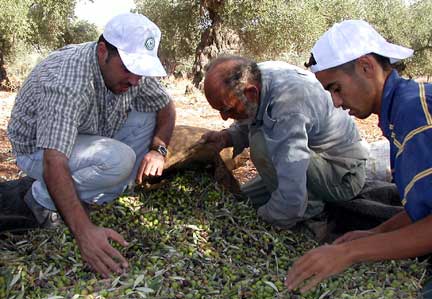
just like any other type of manual labor. I was soon looking forward to a break myself. Here you see me on one of my breaks with two guys who 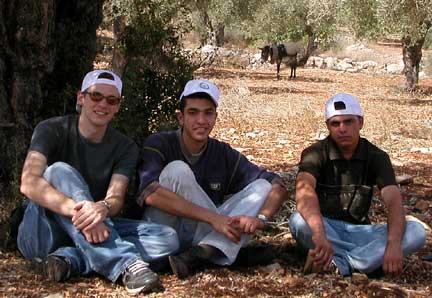 are both students in my English class this semester. Their names
are Ma’azoz and Rashed, and they are from a nearby village named Tubas.
Both had been olive picking before, so they knew what they were doing.
They represent a new generation in Palestine, one that is equally knowledgeable
about olive picking and computer programming. It will be interesting
to see what affect they will have on their traditionally rural society.
are both students in my English class this semester. Their names
are Ma’azoz and Rashed, and they are from a nearby village named Tubas.
Both had been olive picking before, so they knew what they were doing.
They represent a new generation in Palestine, one that is equally knowledgeable
about olive picking and computer programming. It will be interesting
to see what affect they will have on their traditionally rural society.
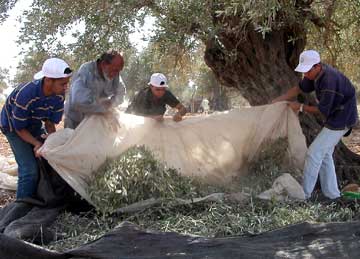 Our hosts for this activity were an elderly couple
who were in charge of picking the olives in that grove. They put all
of us young people to shame, let me tell you. As the day wore on and
the students began taking more frequent breaks, or started using the sticks
for other purposes like play fighting, the owners just kept working at the
same steady pace, not stopping or even appearing to get tired. After
each tree had given up all the olives that could be knocked off, the tarps
were gathered up and the olives were dragged and dumped onto another tarp.
At this stage the stray leaves and branches were sorted out from the olives.
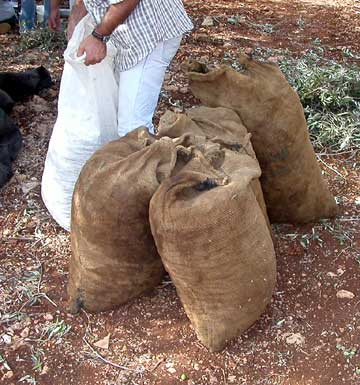
Then the olives were packed into burlap sacks for transport to an olive
press to make them into oil.
Our hosts for this activity were an elderly couple
who were in charge of picking the olives in that grove. They put all
of us young people to shame, let me tell you. As the day wore on and
the students began taking more frequent breaks, or started using the sticks
for other purposes like play fighting, the owners just kept working at the
same steady pace, not stopping or even appearing to get tired. After
each tree had given up all the olives that could be knocked off, the tarps
were gathered up and the olives were dragged and dumped onto another tarp.
At this stage the stray leaves and branches were sorted out from the olives.
Then the olives were packed into burlap sacks for transport to an olive
press to make them into oil. 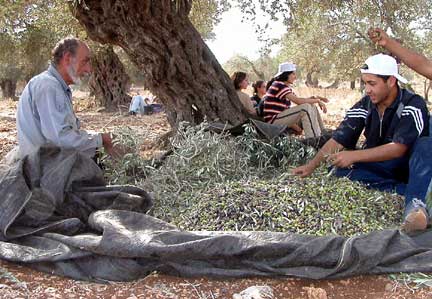
After four hours of steady labor, I started to wonder what had convinced a group of students to volunteer 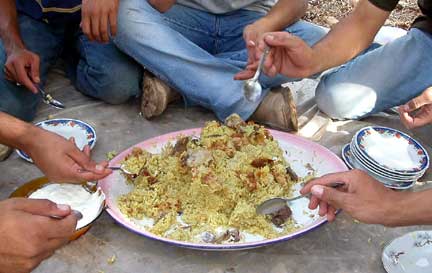 for this kind of assignment. The answer soon drove up in an old
Peugot station wagon loaded down with food. I began to understand
the appeal. Showing traditional Arab hospitality, our hosts were not
going to let us visit without eating something.
We gathered in large masses around the huge platters loaded down with maklube,
(Arabic for upside down), a traditional Palestinian dish of rice and meat
(beef on that day), eaten with fresh yogurt and, of course, Coca Cola to
drink – it’s inescapable anywhere in the world.
for this kind of assignment. The answer soon drove up in an old
Peugot station wagon loaded down with food. I began to understand
the appeal. Showing traditional Arab hospitality, our hosts were not
going to let us visit without eating something.
We gathered in large masses around the huge platters loaded down with maklube,
(Arabic for upside down), a traditional Palestinian dish of rice and meat
(beef on that day), eaten with fresh yogurt and, of course, Coca Cola to
drink – it’s inescapable anywhere in the world. After restoring our energy, we hit the trees again for a few minutes, but soon began to tire out again. Fortunately, the university bus came soon after to rescue us. We gratefully took our leave of the elderly couple who were still working away. I’ve been told that it is common for people to work six days a week 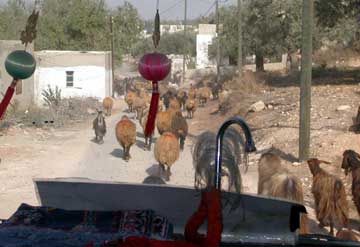 from sunrise to sunset collecting the olives, and I believe it. As
we wound our way back through the crowded streets with the students’ singing
along with a famous Iraqi pop singer on the radio, we were accosted by a
herd of sheep. They filled the road, slowly wandering along in front
of us. There was no way around them, so we rolled slowly along behind
them. The driver at times tried beeping the horn to make them speed
up, but that seemed to have little affect. It was then that I realized
for sure that I was in Palestine, a land of ancient history where olive picking
and sheep herds have been a part of life here for centuries. Our modern
bus was the newcomer in that scene. The sheep understood the truth
– they really did own the road.
from sunrise to sunset collecting the olives, and I believe it. As
we wound our way back through the crowded streets with the students’ singing
along with a famous Iraqi pop singer on the radio, we were accosted by a
herd of sheep. They filled the road, slowly wandering along in front
of us. There was no way around them, so we rolled slowly along behind
them. The driver at times tried beeping the horn to make them speed
up, but that seemed to have little affect. It was then that I realized
for sure that I was in Palestine, a land of ancient history where olive picking
and sheep herds have been a part of life here for centuries. Our modern
bus was the newcomer in that scene. The sheep understood the truth
– they really did own the road. back to Photos & Stories |